Kepler-33b
|
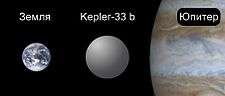
The size of Kepler-33b as compared to Earth and Jupiter | |
| Discovery[1] | |
|---|---|
| Discovered by | Jack Lissauer |
| Discovery site | Moffett Field, California |
| Discovery date | January 26, 2012 |
| detected by transit | |
| Designations | |
| KOI-707[2] | |
| Orbital characteristics | |
| 0.0677 ± 0.0014 AU[3] | |
| Eccentricity | 0 |
| 5.66793 ± 0.00012 days[3] | |
| Inclination | 86.39 ± 1.17°[3] |
| 90°[2] | |
| 2454964.8981 ± 0.0075 jd[2] | |
| Physical characteristics | |
Mean radius | 0.16 ± 0.02 RJ[3] |
| 3.6g[2] | |
|
| |
Kepler-33b is an extrasolar planet orbiting Kepler-33 in the constellation Cygnus. It is one of five planets orbiting Kepler-33.
Discovery
Kepler-33b was, along with twenty-six other planets in eleven different planetary systems, confirmed to be a planet on January 26, 2012.[1][4]
The Kepler-33 system
Kepler-33b orbits its host star with 4 other planets. All five planets orbit its star closer than Mercury does to the Sun.[5] Of those five, Kepler-33b is closest.[4] All Kepler-33 planets are too close to be in the habitable zone.[6]
See also
List of planets discovered by the Kepler spacecraft
References
- 1 2 Lissauer, Jack J.; Marcy, Geoffrey W.; Rowe, Jason F.; Bryson, Stephen T.; Adams, Elisabeth; Buchhave, Lars A.; Ciardi, David R.; Cochran, William D.; Fabrycky, Daniel C.; Ford, Eric B.; Fressin, Francois; Geary, John; Gilliland, Ronald L.; Holman, Matthew J.; Howell, Steve B.; Jenkins, Jon M.; Kinemuchi, Karen; Koch, David G.; Morehead, Robert C.; Ragozzine, Darin; Seader, Shawn E.; Tanenbaum, Peter G.; Torres, Guillermo; Twicken, Joseph D. (January 26, 2012). "Almost All of Kepler's Multiple Planet Candidates are Planets". The Astrophysical Journal. 750 (2): 112. arXiv:1201.5424
 . doi:10.1088/0004-637X/750/2/112.
 - 1 2 3 4 "Kepler-33b". exoplanets.org. Retrieved December 31, 2012.
- 1 2 3 4 "Kepler-33b". kepler.nasa.gov. Retrieved December 31, 2012.
- 1 2 "NASA's Kepler announces 11 planetary systems hosting 26 planets". kepler.nasa.gov. January 26, 2012. Retrieved December 31, 2012.
- ↑ "NASA's Kepler mission announces 11 planetary systems hosting 26 planets". ucsc.edu. January 26, 2012. Retrieved December 31, 2012.
- ↑ "Planet Kepler-33 b". hanno.rein.de. Retrieved December 31, 2012.
This article is issued from Wikipedia - version of the 10/27/2016. The text is available under the Creative Commons Attribution/Share Alike but additional terms may apply for the media files.