Land of Tema
.jpg)
The Land of Tema, te'-ma or tema', ( תֵּמָא, Θαιμάν, تيماء (مدينة) and Thaiman) is a place mentioned in the bible.[1][2] as the place where the descendents of Ishmaels son Tema dwelt.[3]
Description
Name
In Hebrew the name means "south country" and was named for Tema, a son of Ishmael [4][5] and the tribe descended from him [6]
Biblical references
The Bible mentions it 5 times. It was in Edom[7][8][9] It is described as a remote[10] oasis on a main trade route through Arabia [11] It is often associated with The land of Dumah. It was admonished by Amos and Jeremiah.
Extra Biblical references
It was mentioned by Ptolemy,[12] Pliny[13] by Agatharchides[14][15] and by Josephus.[16]
It was noted as halfway between Damascus and Mecca, and between Babylonia and Egypt.[17][18]
Yaqut mentions that in the middle Ages it was inhabited by a Jewish Community.[19]
Identification
| Tayma | |
|---|---|
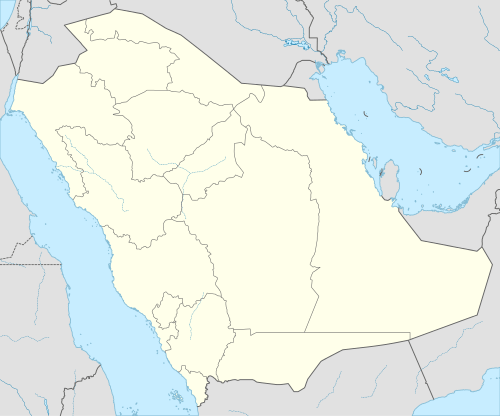  Tayma Location in Saudi Arabia | |
| Coordinates: 27°37′47″N 38°32′38″E / 27.62972°N 38.54389°E |
The Land of Tema was most likely in northern Saudi Arabia and has been identified with the modern Teima',[20][21][22][23] an oasis (fitting with the description in Jeremiah) which lies about 200 miles North of Medina, and some 40 miles South of Dumat (Dumah), now known as el-Jauf. Teima' is on the ancient caravan road connecting the Persian Gulf with the Gulf of Aqaba; which in antiquity bought wealth to the town[24][25] Doughty has described at Teima the ruins of an old city wall 3 miles in circuit.[26] An Aramaic stele recently discovered, belonging to the 6th century B.C., shows the influence of Assyrian in the town. The place is mentioned in the cuneiform inscriptions.[27][28]
Noted people associated
- Husham of the land of the Temanites [29]
- Eliphaz the Temanite [30]
- Nabunaid of Babylon took the city [31][32] and settled there till Cyrus the Great took the city and moved him to Carmainia.
References
- ↑ S. Smith, Babylonian Historical Texts (1924), 98-123
- ↑ Arnulf Hausleitner, "Tayma - eine frühe Oasensiedlung", in: Archäologie in Deutschland, 3/213, pp. 14–19
- ↑ Job 6:19 and Isaiah 21:14)
- ↑ Genesis 25:15 1
- ↑ Chronicles 1:30
- ↑ Jeremiah 25:23
- ↑ Jeremiah 49:7 and 20
- ↑ Obadiah 1:9
- ↑ Amos 1:12
- ↑ Jeremiah 25:23
- ↑ Isaiah 21:14
- ↑ Ptolemy 5:19, section 6
- ↑ Pliny, Geogr. 5, 19 and Hist. Nat. 6:32
- ↑ Rev Charles Foster, The historical geography of Arabia; or, The patriarchal evidences of revealed religion. With an appendix containing translations of the Hamyaritic inscriptions recently discovered in Hadramaut, Volume 1 (Duncan and Malcom, 1844) p294.
- ↑ Agatharchides LXX
- ↑ Josephus Antiquities X.xi.2
- ↑ https://www.biblicaltraining.org/library/tema#sthash.F7rKtOfr.dpuf
- ↑ Rodolfo C. Estimo Jr. (7 November 2010). "Pharaonic inscription found in Saudi Arabia". ArabNews.
- ↑ Yaqut, Šihāb al-Dīn ibn ‘Abd Allah al-Ḥamawī. "Mu’jam al-Buldān". Dār Ṣādir, Beirut 1995, p. 67
- ↑ R. P. Dougherty, Nabonidus and Belshazzar. (1929) p 1-5-200
- ↑ S. Smith, Babylonian Historical Texts (1924), 98-123
- ↑ Arnulf Hausleitner, "Tayma - eine frühe Oasensiedlung", in: Archäologie in Deutschland, 3/213, pp. 14–19
- ↑ Rev Charles Foster, The historical geography of Arabia; or, The patriarchal evidences of revealed religion. With an appendix containing translations of the Hamyaritic inscriptions recently discovered in Hadramaut, Volume 1 (1844) p 294.
- ↑ See Job 6:19
- ↑ See:Isaiah 21:14
- ↑ R. P. Dougherty,, Arabia Deserta, I, p285
- ↑ Schrader, KAT2, 149
- ↑ Tema at BibleAtlas.com.
- ↑ 1 Chronicles 1:45
- ↑ Job 4:1
- ↑ Jack Finegan, Light from the Ancient Past, Vol. 1: The Archaeological Background of the Hebrew-Christian Religion (Princeton University Press, 8 Dec. 2015) p190.
- ↑ R. P. Dougherty, Nabonidus and Belshazzar. (1929) p 1-5-200