Laurence Alma-Tadema
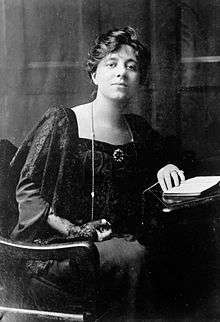
Laurence Alma-Tadema (born Laurense Tadema, 1865–1940), was an English novelist and poet of the late 19th and early 20th centuries who worked in many genres.[1] Eldest daughter of the Dutch painter Lawrence Alma-Tadema (1836–1912) and his first wife Marie-Pauline Gressin Dumoulin, she was born in Brussels. [2] Her stepmother, Lady Laura Theresa Alma-Tadema (1852–1909) and sister Anna Alma-Tadema (1867–1943) were also noted artists.[3] Laurence Alma-Tadema lived in "The Fair Haven", Wittersham, Kent, and she involved herself with music and plays with the villagers and their children, going on to construct a building to seat a hundred people, used for musical concerts and plays, which she named "Hall of Happy Hours".[4] She never married and died in a nursing home in London in 1940.[1][5]
Literary work
Her first novel, Love's Martyr, was published in 1886. In addition to her own collections of stories and poems, which she often published herself, Alma-Tadema wrote two novels, songs and works on drama; she also made translations. The Orlando Project says about Alma-Tadema's writing that the "characteristic tone is one of intense emotion, but in prose and verse she has the gift of compression".[1] She contributed widely to periodicals, notably The Yellow Book, and also edited one herself.[1] Some of Alma-Tadema's plays were successfully produced in Germany.[4]
Political activities
Alma Tadema had a close association with Poland. She was secretary of the "Poland and the Polish Victims Relief Fund" from 1915 to 1939. She was an admirer and long-term associate of Ignacy Jan Paderewski both as far as his music and political activities were concerned, notably on Polish independence.[5] Alma-Tadema maintained a long-correspondence with him from 1915 to the end of her life. Some of her papers are deposited with the Bodleian Library, University of Oxford.[6]
American Tour
Alma-Tadema, who had socialist leanings, travelled to America in 1907–08 to tour the country widely.[4] She gave a series of readings on the "Meaning of Happiness," which proved exceedingly popular.[4] She also spoke on the plight of the divided Poland and asked her audience to express their feelings for this cause.[7][8]
If No One Ever Marries Me
Alma-Tadema's poem "If No One Ever Marries Me", written in 1897 and published in Realms of Unknown Kings,[9] saw performances as a song in the 21st century by Natalie Merchant on her double album Leave Your Sleep.[10][11] In 1900 it had been included in the musical score, The daisy chain, cycle of twelve songs of childhood by Liza Lehmann,[12] and in 1922 in the musical score Little girls composed by Louise Sington.
Works
- Love's Martyr, Longmans, London, Green, and Co., {1886}, hardcover, 208 pages; New York, D. Appleton (1886)
- One Way of Love: A Play (1893), Edinburgh : R. & R. Clark, 54 pages
- The wings of Icarus: being the life of one Emilia Fletcher, revealed by herself in I. Thirty-five letters, written to Constance Norris between July 18th, 188–, and March 26th of the following year; II. A fragmentary journal; III. A postscript, MacMillan New York and London, 1894
- The Crucifix, A Venetian Phantasy, and Other Tales, London, Osgood, McIlvaine & Co. (1895), 172 pages
- Realms of unknown kings, London, G. Richards, 1897
- The fate-spinner, London, E.B. Mortlock, 1900
- The Daisy-Chain (Liza Lehmann, L. Alma-Tadema, R.L. Stevenson and others) (1900)
- Songs of childhood, Wrotham, Kent, Herb O'Grace, 1902.
- Songs of womanhood, London: Grant Richards, 1903, hardcover, 117 pages
- Four plays, London, Green Sheaf, 1905
- Tales from my garden: three fairy tales, coauthored with Pamela Colman Smith, London, The Green Sheaf, 1906
- The meaning of happiness : a discourse, London, Elkin Mathews, 1909
- A few lyrics, London, E. Mathews, 1909
- Mother Goose Nursery Rhymes : Proverbs and Rhyme Games, illustrated by Charles Robinson, forward by Laurence Alma-Tadema, Collins Clear-Type Press, London, c. 1910, hardcover, 208 pages
- Chopin. A discourse ... Translated from the Polish by Laurence Alma Tadema, Ignace Jan Paderewski, London, W. Adlington, 1911
- Pelleas and Melisanda and the Sightless Two Plays By Maurice Maeterlinck, translation by Laurence Alma-Tadema, Walter Scott Ltd., London, hardcover and G. Allen and Unwin, London {1914}
- Poland, Russia and the war, St. Catherine press (1915)
- A Child's Garden of Verses ... With an introduction by Laurence Alma Tadema. Illustrated by Kate Elizabeth Olver. by Robert Louis Stevenson; Kate Elizabeth OLVER; Laura Theresa Alma-Tadema, London & Glasgow, : Collins' Clear-Type Press, [1927]
- Little bo Peep's Story Book, Laurence Alma-Tadema, John Lea, and others, Children's Press, London, hardcover
- A Gleaner's Sheaf. Verses., London: St. Martin's Press (1927)
- The divine orbit : seventeen sonnets, Wittersham [Kent], s.n., London, Printed by Finden Brown & Co., 1933
- Playgrounds (single poem)
Notes
- 1 2 3 4 Brown, Susan; Clements, Patricia; Grundy, Isobel (n.d.). "Laurence Alma-Tadema entry: Overview screen.". Orlando Project – Women's Writing in the British Isles from the Beginning to the Present. The Orlando Project. Retrieved 16 August 2011.
- ↑ She appears in the painting by her father This is our corner (http://www.artrenewal.org/pages/artwork.php?artworkid=13422), 1873, also known as Laurense and Anna Alma-Tadema, Van Gogh Museum, Amsterdam) as the young girl in the foreground holding papers. Her younger sister Anna is shown lying on the bed in the background.
- ↑ Source: www.antiquesandfineart.com/roughton (n.d.). "Lady Laura Alma-Tadema". Fine Art Database. Antiques and Fine Art Magazine. Retrieved 16 August 2011.
- 1 2 3 4 Unattributed (1910–1912). "Miss Laurence Alma-Tadema". Every Woman's Encyclopaedia. London S.N. Retrieved 16 August 2011. External link in
|work=(help) - 1 2 Ignacy Jan Paderewski. Translated by Laurence Alma Tadema. Originally published 1911. (Winter 2001). "Chopin: A Discourse". Polish Music Journal. 4 (2). ISSN 1521-6039. Retrieved 16 August 2011.
- ↑ "Collection Level Description: Papers of Miss Laurence Alma-Tadema". Retrieved 16 August 2011.
- ↑ Unattributed (19 November 1907). "ASKS WOMEN TO AID POLAND.; Laurence Alma Tadema Wants Them to Help Sienklewicz's Plan.". New York Times. Retrieved 16 August 2011.
- ↑ Unatributed (10 February 1908). "A RECIPE FOR HAPPINESS.; Miss Alma Tadema Here to Tell Americans How to Attain It.". The New York Times. Retrieved 13 August 2011.
- ↑ Unattributed. "Laurence Alma-Tadema - "If No One Ever Marries Me"". ArtMagick Illustrated Poetry Collection. ArtMagick. Retrieved 17 August 2011.
- ↑ Merchant, Natalie (February 2010). "Natalie Merchant sings old poems to life". TED2010. TED Conference LLC. Retrieved 13 August 2011.. See Interactive transcript for referred fact.
- ↑ "If No One Ever Marries Me – Laurence Alma-Tadema (1865–1940) (The Official Natalie Merchant Website | Leave Your Sleep | Read | If No One Ever Marries Me)". The Official Natalie Merchant Website. Retrieved 17 August 2011. External link in
|work=(help) - ↑ "Album Information – LEHMANN: Daisy Chain (The) / Bird Songs / Four Cautionary Tales (English Song, Vol. 8)". ClassicsOnline. Naxos Digital Services Ltd. 2011. Retrieved 17 August 2011. External link in
|work=(help)
External links
- Works by Laurence Alma-Tadema at Project Gutenberg
- Works by or about Laurence Alma-Tadema at Internet Archive
- If No One Ever Marries Me ArtMagick Illustrated Poetry Collection
This article is based on material originally published on Wikinfo at http://www.wikinfo.org/index.php/Laurence_Alma-Tadema under the CC-BY-SA 3.0 License and the GFDL.