Levuglandin
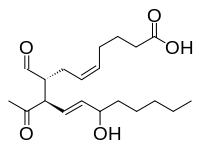 | |
| Names | |
|---|---|
| IUPAC name
(5Z,8R,9R,10E,12S)-9-acetyl-8-formyl-12- hydroxyheptadeca-5,10-dienoic acid | |
| Identifiers | |
91712-44-6  | |
| 3D model (Jmol) | Interactive image |
| KEGG | C13808 |
| PubChem | 9548876 |
| |
| Properties | |
| C20H32O5 | |
| Molar mass | 352.465 g/mol |
| Except where otherwise noted, data are given for materials in their standard state (at 25 °C [77 °F], 100 kPa). | |
verify (what is  ?) ?) | |
| Infobox references | |
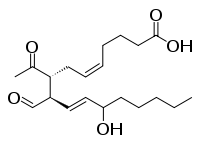 | |
| Names | |
|---|---|
| IUPAC name
(5Z,8R,9R,10E,12S)-8-acetyl-9-formyl-12- hydroxyheptadeca-5,10-dienoic acid | |
| Other names
LGE2 | |
| Identifiers | |
| 91712-41-3 | |
| 3D model (Jmol) | Interactive image |
| KEGG | C13807 |
| PubChem | 5771742 |
| |
| Properties | |
| C20H32O5 | |
| Molar mass | 352.465 g/mol |
| Except where otherwise noted, data are given for materials in their standard state (at 25 °C [77 °F], 100 kPa). | |
| Infobox references | |
Levuglandins are reactive aldehydes formed by the spontaneous rearrangement of prostaglandin H (PGH). Enantiomerically pure levuglandin (LG) E2 can also be formed through the cyclooxygenase (COX) pathway by a rearrangement of the prostaglandin (PG) endoperoxide PGH 2.[1] They are nonclassic eicosanoids. One species, levuglandin E2, (LGE2), forms neurotoxic adducts with amyloid beta.[2] Levuglandins and isolevuglandins can damage proteins by covalent adduction, thereby interfering with their normal functions. These lipid-derived protein modifications may serve as dosimeters of oxidative injury. Elevated plasma levels of isoLG-protein epitopes are associated with atherosclerosis but are independent of total cholesterol, a classical risk factor.
History
Though spontaneous rearrangements of PGH2 are known to generate prostaglandins (PG) PGD2 and PGE2.[3][4] Prof. Robert Salomon at Case Western Reserve University discovered that a novel alternative rearrangement also occurs that producing two γ-ketoaldehydes[5] and named them levuglandins LGD2 and LGE2 as they are derivatives of levulinaldehyde with prostanoid side chains.
References
- ↑ Salomon RG (2005). "Isolevuglandins, oxidatively truncated phospholipids, and atherosclerosis". Ann. N. Y. Acad. Sci. 1043: 327–42. doi:10.1196/annals.1333.040. PMID 16037255. Retrieved 2008-01-16.
- ↑ Bautaud; Brame, CJ; Salomon, RG; Roberts Lj, 2nd; Oates, JA; et al. (1999). "PGH -derived levuglandin adducts increase the neurotoxicity of Amyloid Β1–42" (pdf). Biochemistry. 38 (29): 9389–9396. doi:10.1021/bi990470+. PMID 10413514. Retrieved 2007-10-02.
- ↑ Hamberg M., Samuelsson B. (1973). "Detection and isolation of an endoperoxide intermediate in prostaglandin biosynthesis". Proc. Natl. Acad. Sci. U.S.A. 70: 899–903. doi:10.1073/pnas.70.3.899.
- ↑ Nugteren D.H., Hazelhof E. (1973). "Isolation and properties of intermediates in prostaglandin biosynthesis". Biochim. Biophys. Acta. 326 (3): 448–461. doi:10.1016/0005-2760(73)90145-8.
- ↑ Salomon R.G., Miller D.B., Zagorski M.G., Coughlin D.J. (1984). "Prostaglandin endoperoxides. 14. Solvent-induced fragmentation of prostaglandin endoperoxides. New aldehyde products from PGH2 and a novel intramolecular 1*2-hydride shift during endoperoxide fragmentation in aqueous solution". J. Am. Chem. Soc. 106 (20): 6049–6060. doi:10.1021/ja00332a049.