Yellow-tufted honeyeater
| Yellow-tufted honeyeater | |
|---|---|
 | |
| Scientific classification | |
| Kingdom: | Animalia |
| Phylum: | Chordata |
| Class: | Aves |
| Order: | Passeriformes |
| Family: | Meliphagidae |
| Genus: | Lichenostomus |
| Species: | L. melanops |
| Binomial name | |
| Lichenostomus melanops Latham, 1801 | |
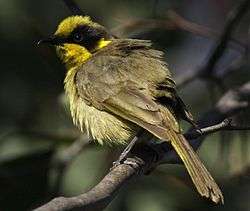
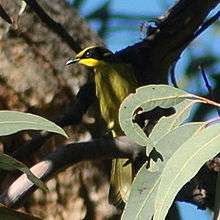
The yellow-tufted honeyeater (Lichenostomus melanops) is a passerine bird found in the south-east ranges of Australia from south-east Queensland through eastern New South Wales and across Victoria into the tip of Southeastern South Australia. A predominantly black and yellow honeyeater, it is split into three subspecies.
Taxonomy
The yellow-tufted honeyeater was first described by the English ornithologist John Latham in 1801 and given two different binomial names: Muscicapa auricomis and Turdus melanops.[2][3] The latter name was retained as a nomen protectum and the former a nomen oblitum as the epithet melanops has been used consistently for over a century. It belongs to the honeyeater family Meliphagidae. More recently, DNA analysis has shown honeyeaters to be related to the Pardalotidae, and the Petroicidae (Australian robins) in a large corvid superfamily; some researchers considering all these families in a broadly defined Corvidae.
Subspecies
Four races are recognised:
- L. m. cassidix, helmeted honeyeater, restricted to a five km length of remnant bushland along two streams in the Yellingbo Nature Conservation Reserve, 50 km east of Melbourne in Victoria. It is the brightest and largest (weight 28 - 32 g) subspecies. In 2003 there were 103 individuals in the wild with 20 breeding pairs known as well as a further 34 birds in captivity at the Healesville Sanctuary.[4]
- L. m. gippslandicus, Gippsland yellow-tufted honeyeater
- L. m. melanops, Sydney yellow-tufted honeyeater
- L. m. meltoni, inland yellow-tufted honeyeater, smaller and duller in plumage with a smaller tuft, described by G. M. Mathews in 1912.[5]
Description
It is 17–23 cm long, with females usually smaller, and has a bright yellow forehead, crown and throat, a black mask and a yellow ear and forehead tuft. The back is olive-green and underparts more olive-yellow.[6]
Distribution and habitat
The helmeted honeyeater subspecies is largely restricted to dense vegetation along riverbanks, dominated by the mountain swamp gum (Eucalyptus camphora) with a dense understorey of sedges and tussock grasses.[7]
Diet
Food includes lerps and other invertebrates, as well as nectar from eucalypts and other flowers.[4]
Breeding
Breeding takes place between July and January, with one or two broods each season. The nest is a cup-shaped structure of dried grasses, bits of bark and other plant material usually in a fork of a tree 3–4 m (9.8–13.1 ft) above the ground. Two or three eggs are laid, pinkish in colour blotched with pale reddish- or buff-brown.[8]
Status
Yellow-tufted honeyeaters, as a species, are not listed as threatened on the Australian Environment Protection and Biodiversity Conservation Act 1999 or on any state-based legislation. However, at the subspecies level, the helmeted honeyeater (L. m. cassidix) is considered to be a threatened species:
- This subspecies is listed as endangered on the Australian Environment Protection and Biodiversity Conservation Act 1999.
- This subspecies is listed as threatened on the Victorian Flora and Fauna Guarantee Act (1988).[9] Under this Act, an Action Statement for the recovery and future management of this species has been prepared.[10]
- On the 2007 advisory list of threatened vertebrate fauna in Victoria, the helmeted honeyeater is listed as critically endangered.[11]
References
- ↑ BirdLife International (2012). "Lichenostomus melanops". IUCN Red List of Threatened Species. Version 2013.2. International Union for Conservation of Nature. Retrieved 26 November 2013.
- ↑ Latham, John (1801). Supplementum indicis ornithologici sive systematis ornithologiae (in Latin). London: Leigh & Sotheby. pp. xl, xlix.
- ↑ Salomonsen, F. (1967). "Family Maliphagidae, Honeyeaters". In Paynter, R.A. Jnr. Check-list of Birds of the World (Volume 12). Cambridge, Mass.: Museum of Comparative Zoology. p. 385.
- 1 2 Menkhorst P, Smales I, Quin B (2003). "Helmeted Honeyeater Recovery Plan 1999-2003". Australian Government, Department of the Environment and Water Resources. Retrieved 2007-06-21.
- ↑ Mathews, G.M. (1912). A Reference-List to the Birds of Australia. Novit. Zool. 18: 171-455 [408]
- ↑ Simpson K, Day N, Trusler P (1993). Field Guide to the Birds of Australia. Ringwood, Victoria: Viking O'Neil. p. 392. ISBN 0-670-90478-3.
- ↑ McMahon, A.R.G. and Franklin, D.C. 1993. The significance of Mountain Swamp Gum for Helmeted Honeyeater populations in the Yarra Valley. Victorian Naturalist 110: 230-237.
- ↑ Beruldsen, G (2003). Australian Birds: Their Nests and Eggs. Kenmore Hills, Qld: self. pp. 308–309. ISBN 0-646-42798-9.
- ↑ Department of Sustainability and Environment, Victoria
- ↑ Department of Sustainability and Environment, Victoria
- ↑ Victorian Department of Sustainability and Environment (2007). Advisory List of Threatened Vertebrate Fauna in Victoria - 2007. East Melbourne, Victoria: Department of Sustainability and Environment. p. 15. ISBN 978-1-74208-039-0.
External links
 |
Wikimedia Commons has media related to Lichenostomus melanops. |
 |
Wikispecies has information related to: Lichenostomus melanops |