Liparia (plant)
This article is about the legume genus. For the fish, see Alosa macedonica.
| Liparia | |
|---|---|
| Scientific classification | |
| Kingdom: | Plantae |
| (unranked): | Angiosperms |
| (unranked): | Eudicots |
| (unranked): | Rosids |
| Order: | Fabales |
| Family: | Fabaceae |
| Subfamily: | Faboideae |
| Tribe: | Podalyrieae[1][2] |
| Genus: | Liparia L. |
| Sections and Species | |
|
See text. | |
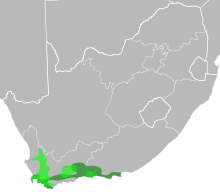 | |
Liparia is endemic to South Africa.[3]
| |
| Synonyms[4][3] | |
| |
Liparia is a genus of flowering plants in the legume family, Fabaceae. It belongs to the sub family Faboideae.
Species
Liparia comprises the following species:[4][3][5][6][7][8]
Section Decussatae
- Liparia bonaespei A. L. Schutte
- Liparia boucheri E. G. H. Oliv. & Fellingham) A. L. Schutte
- Liparia calycina (L. Bolus) A. L. Schutte
- Liparia capitata Thunb.
- Liparia congesta A. L. Schutte
- Liparia laevigata (L.) Thunb.
- Liparia latifolia (Benth.) A. L. Schutte
- Liparia myrtifolia Thunb.
- Liparia rafnioides A. L. Schutte
- Liparia umbellifera Thunb.
- Liparia vestita Thunb.
Section Liparia
- Liparia angustifolia (Eckl. & Zeyh.) A. L. Schutte
- Liparia confusa A. L. Schutte
- Liparia genistoides (Lam.) A. L. Schutte
- †Liparia graminifolia L.[1]
- Liparia hirsuta Thunb.
- Liparia parva Vogel ex Walp.
- Liparia racemosa A. L. Schutte
- Liparia splendens (Burm. f.) Bos & de Wit
- subsp. comantha (Eckl. & Zeyh.) Bos & de Wit
- subsp. splendens (Burm. f.) Bos & de Wit
- Liparia striata A. L. Schutte
Nomina Dubia
- Liparia hybrida Steud.
- Liparia opposita L.
- Liparia sericea (L.) E. Mey.
References
- 1 2 Boatwright JS, Savolainen V, Van Wyk B-E, Schutte-Vlok AL, Forest F., Van der Bank M. (2008). "Systematic position of the anomalous genus Cadia and the phylogeny of the tribe Podalyrieae (Fabaceae)". Syst Bot. 33 (1): 133–147. doi:10.1600/036364408783887500.
- ↑ Cardoso D, Pennington RT, de Queiroz LP, Boatwright JS, Van Wyk B-E, Wojciechowski MF, Lavin M. (2013). "Reconstructing the deep-branching relationships of the papilionoid legumes". S Afr J Bot. 89: 58–75. doi:10.1016/j.sajb.2013.05.001.
- 1 2 3 Schutte AL. (1997). "Systematics of the genus Liparia (Fabaceae)". Nord J Bot. 17 (1): 11–37. doi:10.1111/j.1756-1051.1997.tb00287.x.
- 1 2 Schutte AL, Van Wyk B-E. (1994). "A reappraisal of the generic status of Liparia and Priestleya (Fabaceae)". Taxon. 43 (4): 573–582. JSTOR 1223543.
- ↑ Schutte AL. (1995). "Five new species of the genus Liparia (Fabaceae) from South Africa". Nord J Bot. 15 (2): 149–156. doi:10.1111/j.1756-1051.1995.tb00132.x.
- ↑ "The Plant List entry for Liparia". The Plant List. Royal Botanic Gardens, Kew and the Missouri Botanical Garden. 2013. Retrieved 27 February 2014.
- ↑ "ILDIS LegumeWeb entry for Liparia". International Legume Database & Information Service. Cardiff School of Computer Science & Informatics. Retrieved 27 February 2014. See also "ILDIS LegumeWeb entry for Priestleya (synonym of Liparia)". International Legume Database & Information Service. Cardiff School of Computer Science & Informatics. Retrieved 27 February 2014.
- ↑ USDA, ARS, National Genetic Resources Program. "GRIN species records of Liparia". Germplasm Resources Information Network—(GRIN) [Online Database]. National Germplasm Resources Laboratory, Beltsville, Maryland. Retrieved 27 February 2014.
This article is issued from Wikipedia - version of the 11/10/2016. The text is available under the Creative Commons Attribution/Share Alike but additional terms may apply for the media files.