List of Galician words of Celtic origin
This is a list of Galician words of Celtic origin, many of them being also shared with Portuguese since both languages share a common origin in the medieval language of Galician-Portuguese. A few of these words existed in Latin as loanwords from a Celtic source, usually Gaulish, while other have been later received from other languages, mainly French, Occitan, and Spanish. Finally, some were directly acquired from Gallaecian, the local pre-Latin Celtic language. Any form with an asterisk (*) is unattested and therefore hypothetical.
A systematic investigation of the Celtic words in Galician is still lacking.[1]
A - C
- abanqueiro[2][3] [m] 'waterfall' < *'(beaver) dam', formally a derivative in -arium of *abanco, from Proto-Celtic *abankos 'beaver, water demon'[4][5] cognate of Old Irish abacc 'dwarf', Welsh afanc 'beaver, dwarf', Breton avank 'dwarf, sea monster'. Akin also to Arpitan avans 'wicker'.[6]
- abeneiro [7] [m] 'common alder', a derivative in -arium of *abona 'river', related to Breton aven, Welsh afon, Irish abha/abhainn 'river'.
- abrancar[8] 'to embrace', from Latin branca 'paw', of probable Celtic origin.[9]
- abrollar[10] 'to sprout', from Celtic *brogilos 'copse'.[11]
- abruño/abruñeiro 'prunus spinosa'[m] 'sloe', dialectal agruño,[12] from Vulgar Latin *aprūneu, from Latin prūnum, maybe under the influence of Celtic *agrīnio;[4][5][13] akin to Irish áirne, Welsh eirin 'plum'; cognate of Occitan agranhon, Provençal agreno, Catalan aranyó,[14] Aragonese arañon, Spanish arándano (< *agran-dano).
- álamo [m] 'poplar tree', from a probably Celtic etymon *alamos 'idem'.[15]
- albó, alboio [m] 'shed, barn, enclosure', from proto-Celtic *ɸare-bow-yo-,[16] cognate of Old Irish airbe 'hedge, fence, pen'.
- Old Galician ambas [f p] 'waters, river', ambas mestas [f] 'confluence',[17][18] from Celtic ambe[19] 'water, river', akin to Gaulish ambe 'river', Old Irish abu.
- banastra [f] 'basket', from Old French banaste, from Celtic *benna 'cart'.[20]
- banzo[2] [m] (alternative spelling banço) 'crossbar, beam', from proto-Celtic *wank-yo-,[4] cognate of Spanish banzo; akin to Irish féige 'ridgepole'.
- Derivatives: banza 'backrest', banzado, banzao 'palisade, dam'.
- barga [f] 'hut; wall made of hurdles; hurdle, fence', from Celtic *wraga,[21][22] cognate of Spanish varga 'hut', French barge, akin to Old Irish fraig, Irish fraigh 'braided wall, roof, pen', Br gwrac'hell 'haybale, rick of hay'.
- Derivatives: bargo 'stake or flagstone used for making fences or walls'; barganzo, bargado 'hurdle, fence'.
- barra [f] 'garret, loft, upper platform', from proto-Celtic *barro-,[4][5] cognate of Irish, Breton barr 'summit, peak, top', Welsh bar
- bascullo [m] 'bundle of straw; broom', from proto-Celtic *baski- 'bundle',[5] cognate of Gascon bascojo 'basket', Asturian bascayu 'broom', Breton bec'h 'bundle, load'.
.JPG)
Berros.
- berro [m] 'watercress', from proto-Celtic *beru-ro-,[4][5][23][24] cognate of Spanish berro; akin to Old Irish biror, Welsh berwr, Old Breton beror; similarly French berle 'water parsnip' (< berula ; Ir biolar, Breton beler).
- bico [m] 'beak, kiss', from proto-Celtic *bekko-,[5][25][26] cognate of Italian becco, French bec.
- Derivatives: bicar 'to kiss', bicaño 'hill', bicallo (a fish, Gadus luscus).
- bidueiro[2] [m] < *betūlariu, biduo [m] < *betūlu, bidulo [m] < *betūllu 'birch',[27] from Celtic *betu- or *betū-,[4][5] cognate of Spanish biezo, Catalan beç, Occitan bèç (< bettiu); Spanish abedul, French bouleau, Italian betulla (< betula); akin to Irish beith, Welsh bedw, Breton bezv.
- Derivatives: Bidueiral, Bidual 'place with birch-trees'.
- billa,[2] alternative spelling bilha, [f] 'spigot; stick' to Proto-Celtic *beljo- 'tree, trunk',[28] akin to Old Irish bille 'large tree, tree trunk', Manx billey 'tree', Welsh pill 'stump', Breton pil; cognate of French bille 'log, chunk of wood'.
- borba[2] [f] 'mud, slime, mucus', from proto-Celtic *borwâ-,[29] cognate of French bourbe 'mud'; akin to Irish borb 'mud, slime', bearbh 'boiling', Welsh berw 'boiling', Breton berv 'broth, bubbling'.
- Derivatives: borbento 'mucilaginous'.
- borne [m] 'edge', from French borne 'milestone, landmark', from Old French bosne, bodne, from Vulgar Latin *bodĭna / *budĭna 'border tree', from proto-Celtic *botina 'troop'.,[30] akin to Old Irish buiden, Welsh byddin 'army' (from *budīnā)
- braga[2] [f] 'trousers', from proto-Celtic *braco-,[31] cognate of Spanish, Occitan braga, French braie, Italian brache.
- Derivatives: bragal, bragada 'spawn', bragueiro 'trus'.
- braña [f] (alternative spelling branha) 'meadow, bog, quagmire', from proto-Celtic *bragno-,[5][32] cognate of Asturian and Cantabrian braña, Catalan braina, akin to Irish brén Welsh braen Breton brein 'putrid', Ir bréanar W braenar Br breinar 'fallow field'.
- Derivatives: brañal, brañeira, brañento 'idem'.
- breixo[33] [m] 'heather', from *broccius,[34] from Proto-Celtic *vroiki-,[28] akin to Old Irish froich, Welsh grug, gwrug, Cornish grug, Breton brug; cognate of Spanish brezo, Occitan bruga, French bruyère.
- Old Galician bren [m] 'bran', maybe from Provençal brem, from proto-Celtic *brenno-,[35] cognate of French bran, Lombard bren.
- bringa[36] [f]'stalk, rod', from *brīnikā, from Celtic *brīnos 'rod'; akin to Welsh brwyn 'rush', Cornish broenn, Breton broen; cognate of French brin 'blade (of grass), stalk'.
- brío[2] [m] 'might, power', from Italian brio, from Catalan/Old Occitan briu 'wild', from Celtic *brigos,[5] cognate of Occitan briu, Old French brif 'finesse, style'; akin to Old Irish bríg 'power', Welsh bri 'prestige, authority', Breton bri 'respect'.
- Old Galician busto [m] 'cattle farm, dairy', from a Celtic compound *bow-sto-[37] meaning 'cow-place', akin to Celtiberian boustom 'cow shed, byre', Old Irish bua-thech 'cow house/byre'; cognate of Portuguese bostar, Spanish bustar
- Derivatives: bustar 'pastures'.
- cai [m] 'quay, jetty', maybe from French (itself from Norman) quai, from proto-Celtic *kag-yo-,[5][38][39] akin to Welsh cae, Cornish ke, Breton kae 'hedge'; French chai 'cellar'.
- callao [m] 'boulder; pebble', from Celtic *kalyāwo- 'stone'.[40]
- cambiar 'to change', from Vulgar Latin cambiare, from proto-Celtic *kambo-,[4][5][41] cognate of French changer, Occitan/Spanish cambiar, Catalan canviar, Italian cambiare; akin to Breton kemm 'exchange', Old Irish cimb 'ransom'.
- Derivatives: cambio 'exchange', cambiador 'exchanger'.
- camba[2] [f] 'wheel rim' from proto-Celtic *kambo-,[4][5][42] cognate of Old Irish camm 'crooked, bent, curved'. Cognate of Occitan cambeta 'part of plough', Limousin Occitan chambija (< *cambica) 'part of plough'
- Derivatives: cambito, cambada, camballa, cambeira 'coil; crooked log for hanging fish', cambela 'type of plough', cambota 'beam'.
- camiño[2][43] [m] 'pathway', alternative spelling caminho, from Vulgar Latin *cammīnus, from proto-Celtic *kanxsman-,[5][44] cognate of Italian cammino, French chemin, Spanish camino, Catalan camí, Occitan camin ; akin to Old Irish céimm, Cornish and Breton kamm 'step'.
- Derivatives: camiñar 'to walk'.
- camisa[2] [f] 'shirt' from Latin, from Gaulish camisia.[45] cognate of Spanish/Occitan camisa, Italian camicia, French chainse
- cando [m] 'dry stick', from medieval candano, from Celtic *kando- 'bright, white', cognate of Welsh cann 'bright, light'.[46]
- canga[2][47] [f] 'collar, yoke', from Celtic *kambika.[48]
- canto [m] 'rim, corner', from proto-Celtic *kanto-,[4] akin to Old Irish cét 'round stone pillar, Welsh cant 'tire rim', Breton kant 'disk'; cognate of Old French chant, Occitan cant, Spanish canto.
- Derivatives: recanto 'corner', cantón 'edge of a field', acantoar 'to hide, to isolate', cantil 'cliff'

A Galician traditional carro. The wheels are built with cambas or curved pieces; the laterals of the cart are called chedas.
- carro [m] 'cart, wagon', from Vulgar Latin carrum, from proto-Celtic *karro-,[4][5][49] cognate of Rumanian car, Italian carro, French char, Provençal car, Spanish carro; akin to Irish carr, Welsh car, Breton karr.
- Derivatives: carreira 'road', carregar 'to load'.
- caxigo [m] 'oak; Portuguese oak', from *cassīcos, from Celtic *cassos 'curly, twisted',[50] akin to Irish cas 'twist, turn, spin', Old Welsh cascord 'to twist'; cognate of Asturian caxigu, Aragonese caixico, Gascon casse, French chêne 'oak' (< *cassanos).
- centolo [m] 'European spider crab', akin to Gaulish personal name CINTULLOS 'the first one',[51] from PCl *kintu- 'first'.
- cervexa[2] [f] 'beer', alternative spelling cerveja, from Vulgar Latin *cerevisia, from Gaulish[52] Cognates: Old French cervoise, Provençal, Spanish cerveza; akin to Old Irish coirm, Welsh cwrw, Cornish and Breton korev.
- cheda[2] [f] 'lateral external board of a cart, where the crossbars are affixed', from Medieval Latin cleta, from proto-Celtic *klētā,[4][5][53] cognate of Irish cloí (cloidhe) 'fence', clíath 'palisade, hurdle', Welsh clwyd 'barrier, wattle, scaffolding, gate', Cornish kloos 'fence', Breton kloued 'barrier, fence'; cognate of French claie 'rack, wattle fencing', Occitan cleda, Catalan cleda 'livestock pen', Basque gereta.
- choco [m] 'cowbell; squid', from proto-Celtic *klokko-,[4][5][54] akin to Old Irish clocc, Welsh cloch, Breton kloc'h; cognate of Asturian llueca and llócara 'cowbell', French cloche 'bell', German Glock.
- Derivatives: chocar 'to bang, to shock', chocallo 'cowbell'.
- colmea[2] [m] 'beehive', from a Celtic form *kolmēnā 'made of straw'[55] (cf. Spanish colmena 'beehive'), from *kolmos 'straw', which gave Leonese cuelmo; cf. Welsh calaf "reed, stalk", Cornish kala and kalaven "straw", Breton kolo "stalk").
- cómaro, comareiro [m] 'limits of a patch or field, usually left intentionally unploughed', from proto-Celtic *kom-ɸare-(yo)-,[5] cognate of Old Irish comair 'in front of', Welsh cyfair 'direction, place, spot, acre'. Or either to *kom-boros 'brought together'.[56]
- Derivatives: acomarar 'to mark out a field (literally to dote with cómaros)'.
- comba [f] 'valley, inflexion', from proto-Celtic *kumbā,[4][5][57] cognate of North Italian comba, French combe, Occitan comba; akin to Irish com, Welsh cwm 'hollow (land form)', Cornish komm 'small valley, dingle', Breton komm 'small valley, deep water'.
- combarro [m], combarrizo [m] 'shed, shelter',[58] from proto-Celtic *kom-ber-o- 'bring together'.[5] Cognate of Middle French combres 'palisade in a river, for fishing'.
- combo [m] (adj.) 'curved, bent', from Celtic *kumbo-,[4][5][59] cognate of Provençal comb, Spanish combo.
- Derivatives: combar 'to bend'.
- comboa [f] 'corral used for capturing fish trapped in low tide', from Old Galician combona, from Celtic *combā 'valley' or *cambos 'bent'.[59]
- croio[2] [m] 'rolling stone', croia [f] 'pip', from proto-Celtic *krowdi-,[4][5][60] akin to Old Irish crúaid 'hard, harsh', Welsh cru, Breton kriz; cognate of Occitan croi 'cruel', North Italian crojo.
- Derivatives: croio (adj.) 'ugly, rude'; croído, croieira 'stony place/beach'.
- crouca [f] 'head; withers (ox)', from Celtic croucā,[4][5][61] cognate of Provençal crauc 'heap', Occitan cruca 'cape (land form)'; akin to Irish cruach 'pile, haystack', Welsh crug 'hillock, barrow, heap', Cornish and Breton krug 'mound, barrow'.
- Derivatives: crocar 'swell, bulge, bruise', croque 'bump'.
- curro [m] 'corral, pen; corner', from Celtic *korro-,[5] akin to Middle Irish cor 'circle, turn', corrán 'sickle', Welsh cor 'enclosure', Cornish kor 'turn, veering'; cognate of Spanish corro, corral.
- Derivatives: curruncho, currucho, currullo 'corner, end', currusco 'protruding part (in bread)', curral 'corral, pen'.
D - Z
- dorna [f] 'a type of boat; trough, measurement (volume)',[62] from proto-Celtic *durno- 'fist'.,[63] Irish dorn fish, Welsh dwrn, Cornish and Breton dorn 'hand'; Akin to Old French, Occitan dorn, 'a handful'.[64] Nevertheless the Asturian duerna 'bowl' demand a form **dorno-.
- embaixada [f] 'embassy', from Provençal ambaissada, from ambaissa 'service, duty', from proto-Celtic *ambactos 'servant',[65] akin to Welsh amaeth 'farm', Cornish ammeth 'farming', Old Breton ambaith, modern Breton amaezh.
- engo, irgo [m] 'danewort', from *édgo, from a Low Latin EDUCUS, from Gaulish odocos,[66] idem.[67] Cognate of Spanish yezgo, Asturian yeldu, Provençal olègue, idem.
- gabela [f] 'handful, faggot', alternative spelling gavela, from proto-Celtic *gabaglā-,[68][69][70] cognate of French javelle, Provençal gavela, Spanish gavilla; akin to Old Cornish gavael 'catch, capture', Irish gabháil 'get, take, grab, capture', gabhal 'fork'.
- galga [f] 'plain stone', from *gallikā, to Proto-Celtic *gallos 'stone',[4] akin to Irish gall, French galet 'gravel' gallete 'plain cake', Spanish galga.
- Derivatives: galgar 'carving a stone to make it plain and regular'.
- gorar[2] 'to hatch, to brood (an egg, or a sickness)', from proto-Celtic *gʷhor-,[71][72] akin to Irish gor 'sit on eggs, brood (eggs)' Welsh/Cornish gori 'to brood, sit (on eggs)', Breton goriñ.
- Derivatives: goro 'warmed infertile egg'.
- gubia [f] 'gouge', from Celtic *gulbia, from *gulb- 'beak',[73][74] cognate of Portuguese goiva, Spanish gubia, French gouge, Italian gubba; akin to Old Irish gulba 'sting', Irish gealbhán 'sparrow', Welsh gylyf 'sickle', gylf 'beak'.
- lándoa [f] 'uncultivated plot', from *landula, Romance derivative of proto-Celtic *landā,[4][5][75] cognate of Old Irish lann 'land, plot', Welsh lann 'church-yard', Breton lann 'heath', French lande 'sandy moor, heath', Provençal, Catalan landa.
- laxe[2][76] [f] 'stone slab', alternative spelling lage, from the medieval form lagena, from proto-Celtic *ɸlāgenā,[77] cognate of Old Irish lágan, láigean, Welsh llain 'broad spearhead, blade'; akin to Irish láighe 'mattock, spade'.
- legua or légua[78] [f] 'league', to Proto-Celtic *leukā, cognate of French lieue, Spanish legua; akin to Old Irish líe (genitive líag) 'stone', Irish lia
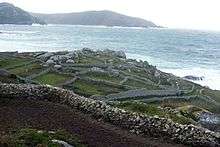
- leira [f] 'plot, delimited and levelled field', from the medieval form laria, from proto-Celtic *ɸlār-yo-,[5][79] akin to Old Irish làr 'ground, floor', Cornish and Breton leur 'ground', Welsh llawr 'floor'.
- Derivatives: leiro 'small, ou unleveled, plot', leirar 'land working', leiroto, leiruca 'small plot'.
- Old Galician ler [m] 'sea, seashore', from proto-Celtic *liros,[4][5] cognate of Old Irish ler, Irish lear, Welsh llyr 'sea'.
- lercha[80] [f] 'rod, stick (used for hanging fish)', from proto-Celtic *wliskā[81] 'stick', cognate of Old Irish flesc.
- lousa[2] [f] 'flagstone', from Proto-Celtic *laws-,[82] cognate of Provençal lausa, Spanish losa, French losenge 'diamond'.
- Derivatives: enlousar 'to cover with flagstones', lousado 'roof'.
- marulo [m] 'big, fat kid', from *mārullu,[83] diminutive of Proto-Celtic *māros 'large, great, big', akin to Irish mór, Welsh mawr, Cornish and Breton meur.
- meniño [m] 'kid, child, baby', alternative spelling meninho, from medieval mennino, from proto-Celtic *menno-,[5] akin to Old Irish menn 'kid (goat)', Irish meannán, Welsh myn, Cornish mynn, Breton menn.
- Derivatives: meniñez 'childhood'.
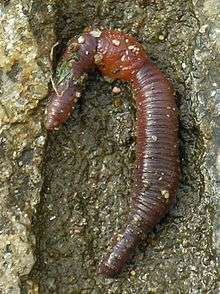
A miñoca.
- miñoca [f] 'earthworm', alternative spelling minhoca, dialectal mioca, miroca, from medieval *milocca, from proto-Celtic *mîlo-,[4][5] akin to Asturian milu, merucu 'earthworm', Irish míol 'worm, maggot', Welsh, Cornish and Breton mil 'animal'.
- mostea [f] 'bundle of straw', from proto-Celtic *bostā- 'hand, palm, fist'.,[84] Irish bos, bas 'palm of hand'.
- olga [f] 'patch, plot', from proto-Celtic *ɸolkā,[85][86][87] cognate of French ouche, Provençal olca. Nevertheless *ɸolkā should become **ouca.
- osca [f] 'notch', from Celtic *oska 'idem', cognate of Asturian güezca, French osche, Welsh osg 'idem'.[88]
- peza [f] 'piece', alternative spelling peça, from Vulgar Latin *pettia, from Gaulish petsi, from proto-Celtic *kʷezdi,[5][89][90] cognate of Italian pezza, French pièce, Spanish pieza; akin to Old Irish cuit (Irish cuid) 'piece, share, part', Welsh peth 'thing', Breton pezh.
- Derivatives: empezar 'to begin'.
- rego [m], rega [f] 'furrow, ditch', from proto-Celtic *ɸrikā,[91][92][93] akin to Welsh rhych, Breton reg, Scottish/Irish riach 'trace left from something'; cognate of French raie, Occitan, Catalan rega, Basque erreka, Italian riga 'wrinkle'.
- Derivatives: derregar 'to mark out a field', regato 'stream, gully, glen'.
- reo [m] 'Salmo trutta trutta', from a Celtic form rhedo (Ausonius).[94]
- rodaballo[2] [m] 'turbot', alternative spelling rodavalho, from a Celtic composite form *roto-ball-jo-,[95] meaning 'round-extremity', akin to Irish roth 'wheel', Welsh rhod, Breton rod, and Irish ball 'limb, organ'.
- saboga, samborca [f] 'allis shad', akin to Gaulish samauca, idem, from Celtic *samākā 'summery'.[96]
- saio [97] [m] 'coat' and saia [f] 'skirt', from the medieval form sagia, from an ancient Celtic form from which also Latin sagum 'robe'.[98]
- seara, senra [f] 'sown field recently broken up, but which is left fallow', from a medieval form senara, a Celtic compound of *seni- 'apart, separated' (cf. Old Irish sain 'alone', Welsh han 'other') and *aro- 'ploughed field'.[99] (cf. Welsh âr, Irish ár 'ploughed field').
- tasca [f] and tascón [m], 'swingle', related to Galatian taskós 'peg, stake'.[100]
- tol and tola[101] [m / f] 'irrigation channel', to Proto-Celtic *tullo- 'pierced, perforated',[28] akin to Irish toll 'hollow, cave, hole', Welsh twll 'hole', Cornish toll 'hole', Breton toull 'hole'; cognate of Spanish tollo 'hole', Catalan toll 'pool in a river', Old French tolon 'hill, upland'.
- tona [f] 'skin, bark, scum of milk', from proto-Celtic *tondā,[5][102][103] cognate of Old Irish tonn, Welsh tonn.
- Derivatives: toneira 'pot for obtaining butter from the milk'.
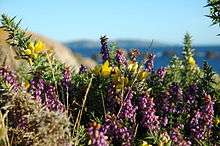
Toxos and breixos, near O Grove
- toxo [m], alternative spelling tojo, 'gorse, furze (Ulex europaeus)', from Celtic *togi-,[104] akin to Spanish/Gascon toja, French dialectal tuie.
- Derivatives: fura-toxos 'marten'; toxa 'ulex gallii'; toxedo, toxa, toxeira 'place with toxos'.
- trosma[105] [m] 'awkward, dimwitted', from proto-Celtic *trudsmo- or *truksmo- 'heavy',[106] akin to Old Irish tromm, Welsh trwm.
- trado, trade [m] 'auger', from proto-Celtic *taratro-,[4][5][107] cognate of Irish tarathar, Welsh taradr, Breton tarar, Occitan taraire, Catalan taradre, Spanish taladro, French tarière, Romansch tarader.
- Derivatives: tradar 'to drill'.
- tranca [f], tranco [m] 'beam, pole', from proto-Celtic *tarankā,[108][109] cognate of Spanish tranca 'club, cudgel', French taranche 'screw bar, ratchet (wine press)', Provençal tarenco; akin to OIr tairinge 'iron nail, tine', Ir tairne 'metal nail, Sc tairnge 'nail'.
- Derivatives: taranzón 'pillar inside the potter's oven' < *tarankyon-, tarangallo 'Wood nail, pin', trancar 'to bar a door'.
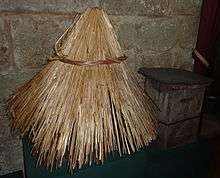
Galician traditional trobos or colmeas (beehives). The closer one is similar to reconstructed Iron Age huts.
- trebo, trobo [m] 'beehive', from the medieval form trebano, proto-Celtic *trebno-,[5] akin to Old Irish treb 'farm', Cornish tre 'home; town', Welsh tref 'town'; akin to Asturian truébanu 'beehive', Provençal trevar 'to dwell, live (at)'.
- trogo [m] 'sadness, anxiety, pity', from proto-Celtic *trougos,[4][5] akin to Old Irish tróg, Irish trogha, Welsh tru 'wretched', Breton tru 'miserable'; cognate of Portuguese truhão, Spanish truhan 'baffoon, jester', French truand 'beggar'.
- trollo [m] 'semicircular rake to move the oven's hot coals'. bret. troellen, cornish trolh, welsh troel, 'idem'.[110]
- turro [m] 'boulder, heap', from a probably Celtic etymon *tūrra 'heap of earth', cognate of Welsh twrr 'heap'.[111]
- vasalo [m] 'vassal', alternative spelling vassalo, from Vulgar Latin vassalus, from proto-Celtic *wasto-,[5][112] cognate of French vassal, Spanish vasallo, Middle Irish foss 'servant', Welsh gwas 'servant; lad', Breton gwaz.
- verea [f] 'main road', from the medieval form vereda, from Celtic *uɸo-rēdo-,[113][114] cognate of Spanish vereda 'pathway'; akin to Welsh gorwydd 'steed', Vulgar Latin veredus 'horse', French palefroi 'steed' (< *para-veredus).
Notes
- ↑ cf. Koch, John T. (ed.) (2006). Celtic culture: a historical encyclopedia. ABC-CLIO. p. 790. ISBN 1-85109-440-7.
- 1 2 3 4 5 6 7 8 9 10 11 12 13 14 15 16 17 18 19 Mariño Paz, Ramón (1998). Historia da lingua galega (2. ed.). Santiago de Compostela: Sotelo Blanco. p. 30. ISBN 84-7824-333-X.
- ↑ Prósper (2002) p. 90.
- 1 2 3 4 5 6 7 8 9 10 11 12 13 14 15 16 17 18 19 20 21 22 Ward A. (1996), s.v.
- 1 2 3 4 5 6 7 8 9 10 11 12 13 14 15 16 17 18 19 20 21 22 23 24 25 26 27 28 29 30 31 32 33 34 Matasovic R. (2009), s.v.
- ↑ Grzega 2001: 50.
- ↑ Bascuas, Edelmiro (2002). Estudios de hidronimia paleoeuropea gallega. Santiago de Compostela: Universidade, Servicio de Publicacións e Intercambio Científico. pp. 257–262. ISBN 84-9750-026-1.
- ↑ Rivas Quintas 2015: 16
- ↑ "TLFi". CNRTL. Retrieved 20 August 2015.
- ↑ Rivas Quintas 2015: 17
- ↑ DCECH s.v. BROLLAR
- ↑ Cf. Dicionario de Dicionarios da lingua galega, s.v. agruño, and Tesouro do léxico patrimonial galego-portugués s.v. abruño.
- ↑ cf. Meyer-Lübke 294.
- ↑ Grzega 2001: 53.
- ↑ Grzega 2001: 54; Rivas Quintas 2015: 25.
- ↑ Ward A. (1996), s.v. AREBOWION.
- ↑ Bascuas, Edelmiro (2002). Estudios de hidronimia paleoeuropea gallega. Santiago de Compostela: Universidade, Servicio de Publicacións e Intercambio Científico. p. 212. ISBN 84-9750-026-1.
- ↑ Moralejo (2007) p. 50.
- ↑ Matasovic R. (2009), s.v. *abon-
- ↑ Remacle, Louis (1997). Etymologie et phonétique wallonnes : Questions diverses. Liège: Faculté de Philosophie et Lettres de l'Université de Liège. pp. 15–21. ISBN 978-2-87019-267-2.
- ↑ Coromines (1997) s.v. varga
- ↑ TLFi s.v. barge3
- ↑ Meyer-Lübke 1054
- ↑ Donkin (1864), s.v. berro
- ↑ Ward A. (1996), s.v. BECLOS
- ↑ Meyer-Lübke 1013
- ↑ Meyer-Lübke s. v. *betulus, *betullus
- 1 2 3 Matasovic (2009) s.v.
- ↑ Ward A. (1996), s.v. BORWOS
- ↑ Meyer-Lübke 1235
- ↑ Meyer-Lübke 1252
- ↑ Ward A. (1996), s.v. MRAKNOS
- ↑ Báscuas (2006) p. 134.
- ↑ Cf. Coromines (1973) s.v. brezo.
- ↑ Meyer-Lübke 1284
- ↑ Coromines (1973) s.v. brizna.
- ↑ Matasovic R. (2009), s.v. *bow-
- ↑ Ward A. (1996), s.v. KAGOS
- ↑ Meyer-Lübke 1480
- ↑ Rivas Quintas 2015: 103; Buschmann 1965: 127.
- ↑ Meyer-Lübke 1540
- ↑ Meyer-Lübke 1542
- ↑ Rivas Quintas 2015: 106; Buschmann 1965: 133.
- ↑ Meyer-Lübke 1552
- ↑ Meyer-Lübke 1550.
- ↑ Rivas Quintas 2015: 109; Buschmann 1965: 135.
- ↑ Rivas Quintas 2015: 110; Buschmann 1965: 130.
- ↑ Meyer-Lübke 1541.
- ↑ Meyer-Lübke 1721
- ↑ Coromines (1997) s.v. quejigo; Matasovic (2009) s.v. *casso-
- ↑ DCECH s.v. centollo
- ↑ Meyer-Lübke 1830.
- ↑ Meyer-Lübke 1988
- ↑ Donkin (1864), s.v.
- ↑ cf. Varela Sieiro, Xaime. Léxico Cotián na Alta Idade Media de Galicia: A arquitectura civil. Santiago, 2008. ISBN 978-84-9750-781-3. pp. 205-206.
- ↑ Prósper (2002) p. 242.
- ↑ Meyer-Lübke 2386
- ↑ Varela Sieiro, Xaime (2008). Léxico cotián na alta Idade Media de Galicia : a arquitectura civil. Santiago de Compostela: Universidade de Santiago de Compostela. p. 207. ISBN 9788497507813.
- 1 2 Meyer-Lübke 2387
- ↑ Meyer-Lübke 2338
- ↑ Meyer-Lübke 2340
- ↑ Varela Sieiro, Xaime (2003). Léxico cotián na Alta Idade Media de Galicia : o enxoval. A Coruña: Do Castro. pp. 293–294. ISBN 84-8485-120-6.
- ↑ Matasovic R. (2009), s.v. *durno-
- ↑ Meyer-Lübke 2754
- ↑ Meyer-Lübke 448.
- ↑ Marcellinus De Medicamentis, 7.13
- ↑ Cf. Coromines (1997) s.v. yezgo
- ↑ Ward A. (1996), s.v. GABIT
- ↑ Matasovic R. (2009), s.v. *gab-yo-
- ↑ Meyer-Lübke 3627
- ↑ Ward A. (1996), s.v. GORIT
- ↑ Matasovic R. (2009), s.v. *gwer-o-
- ↑ Matasovic R. (2009), s.v. *gulb-
- ↑ Meyer-Lübke 3911
- ↑ Meyer-Lübke 4884
- ↑ Búa, Carlos (2007). Dieter Kremer, ed. Onomástica galega: con especial consideración da situación prerromana : actas do primeiro Coloquio de Trier 19 e 20 de maio de 2006. Santiago de Compostela: Universidade de Santiago de Compostela. p. 34. ISBN 978-84-9750-794-3.
- ↑ Ward A. (1996), s.v. LĀGENĀ
- ↑ Coromines (1973) s.v. legua.
- ↑ cf. Meyer-Lübke 4911.
- ↑ DCECH s.v. lercha
- ↑ Matasovic R. (2009), s.v. *wliskā
- ↑ Cf. Matasovic (2009), s.v. Lîwank-.
- ↑ Moralejo Laso, Abelardo (1981). Anuario Brigantino (PDF): 36 http://anuariobrigantino.betanzos.net/Ab1981PDF/1981%20032_037.pdf. Missing or empty
|title=(help) - ↑ Caraballeira Anllo, Xosé Ma.; et al. (2005). Diccionario Xerais da lingua (3 ed.). Vigo: Edicións Xerais de Galicia. ISBN 978-84-9782-265-7.
- ↑ Ward A. (1996), s.v. OLCĀ
- ↑ Matasovic R. (2009), s.v. *folkā
- ↑ Meyer-Lübke 6050
- ↑ Grzega 2001: 217
- ↑ Ward A. (1996), s.v. QEZDI
- ↑ Meyer-Lübke 6450
- ↑ Matasovic R. (2009), s.v. frikā-.
- ↑ Ward A. (1996), s.v. RIKS.
- ↑ Meyer-Lübke 7299.
- ↑ Piel, Joseph M. (1976). "AUSÓNIO, FR. MARTÍN SARMIENTO E O PEIXE "REO"". Grial: 514–518. JSTOR 29749484. – via JSTOR (subscription required)
- ↑ Ward A. (1996), s.v. ROTIS
- ↑ DCECH s.v. sábalo
- ↑ Varela Sieiro, Xaime (2003). Léxico cotián na Alta Idade Media de Galicia : o enxoval. A Coruña: Do Castro. pp. 103–105. ISBN 84-8485-120-6.
- ↑ de Vaan, Michiel (2008). Etymological dictionary of Latin and the other Italic languages. Leiden: Brill. p. 534. ISBN 9789004167971.
- ↑ Coromines (1997) s.v. serna; Matasovic s.v. *aro-
- ↑ Coromines (1997) s.v. tascar
- ↑ Bascuas (2006) p. 151
- ↑ Ward A. (1996), s.v. TONDOS
- ↑ Meyer-Lübke 8987
- ↑ Ward A. (1996), s.v. TOGIT.
- ↑ Martins Estêvez, Higinio (2008). As tribos calaicas: proto-história da Galiza à luz dos dados linguísticos. San Cugat del Vallès, Barcelona: Edições da Galiza. pp. 535–537. ISBN 978-84-936218-0-3.
- ↑ Cf. Matasovich R. (2009) s.v. *trummo-.
- ↑ Meyer-Lübke 8570
- ↑ Matasovic R. (2009), s.v. *tarankyo-
- ↑ Meyer-Lübke 8585
- ↑ Francesco Benozzo "Un reperto lessicale di epoca preistorica: emiliano occidentale tròl, galego trollo ‘rastrello per le braci’". In Quaderni di filologia romanza nº 19, pxs 217-221. 2006.
- ↑ Grzega 2001: 248-249.
- ↑ Meyer-Lübke 9166
- ↑ Ward A. (1996), s.v. WORÊDOS
- ↑ Matasovic R. (2009), s.v. *ufo-rēdos
Literature
- Bascuas López, Edelmiro (2006). La Diosa Reve y los trasancos. Estudios Mindonienses (22): 801-842.
- Bascuas López, Edelmiro (2008). La hidronimia de Galicia. Tres estratos: paleoeuropeo, celta y latino. Estudios Mindonienses (24): 521-550.
- Buschmann, Sigrid (1965). Beiträge zum etymologischen Wörterbuch des Galizischen. Bonn: Romanisches Seminar der Univ. Bonn.
- Carvalho Calero, Ricardo (1976). Gramática elemental del gallego común. Galaxia. ISBN 84-7154-037-1. Google Books (Spanish)
- Coromines, J. (1997). Breve diccionario etimológico de la lengua castellana. Gredos. ISBN 978-84-249-3555-9.
- DCECH = Coromines, Joan; Pascual, José Antonio (2012). Diccionario crítico etimológico castellano e hispánico (Ed. en CD-ROM. ed.). Madrid: Gredos. ISBN 9788424936549.
- Donkin, T. C. (1864). An etymological dictionary of the Romance languages; chiefly from the Germ. of F. Diez. Williams and Norgate. Online at the Internet Archive.
- Grzega, Joachim (2001). Romania Gallica Cisalpina etymologisch-geolinguistische Studien zu den oberitalienisch-rätoromanischen Keltizismen. Tübingen: M. Niemeyer. ISBN 978-3-11-094440-2. Retrieved 26 August 2015 – via De Gruyter. (subscription required (help)).
- Mariño Paz, Ramon (1998). Historia da lingua galega. Sotelo Blanco. ISBN 84-7824-333-X.
- Matasovic, R. (2009). Etymological Dictionary of Proto-Celtic. Brill. ISBN 90-04-17336-6.
- Meyer-Lübke, W. (1911). Romanisches etymologisches Wörterbuch. Carl Winter's U. Online at the Internet Archive.
- Moralejo, Juán J. (2007) Callaica Nomina. A Coruña: Fundación Barrié. 2007. ISBN 978-84-95892-68-3.
- Prósper, Blanca María (2002). Lenguas y religiones prerromanas del occidente de la península ibérica. Ediciones Universidad de Salamanca. ISBN 978-84-7800-818-6.
- Rivas Quintas, C.M., Eligio (2015). Dicioniario etimolóxico da lingua galega (1a ed.). Santiago de Compostela: Tórculo. ISBN 978-84-8408-374-0.
- Ward, A. (1996). A Checklist of Proto-Celtic lexical Items. Online at Scribd.
Dictionaries
- Dicionario de Dicionarios da lingua Galega. (Galician)
- Dicionario de dicionarios do galego medieval. (Galician)
This article is issued from Wikipedia - version of the 11/10/2016. The text is available under the Creative Commons Attribution/Share Alike but additional terms may apply for the media files.