Littoral cell angioma
| Littoral cell angioma | |
|---|---|
 | |
| Low magnification micrograph of a littoral cell angioma. H&E stain. | |
| Classification and external resources |
Littoral cell angioma, abbreviated LCA, and formally known as littoral cell angioma of the spleen, is a benign tumour of the spleen that arises from the cells that line the red pulp.[1]
Symptoms
LCAs can manifest with splenomegaly, persistent fever and weight loss.[2]
Some patients show no symptoms and the tumours are found incidentally.
Diagnosis
Littoral cell angiomas show in CT scans. They are diagnosed by pathologists by taking a sample of the tumour via Fine Needle Aspiration or Core Needle Aspiration. Histologically, they have anastoming small vascular channels and cystic spaces with papillary projections.[2]
Treatment
The treatment for a littoral cell angioma is a splenectomy.
If they do not cause the patient any problems, the spleen can remain and the tumours can be monitored for changes with regular CT scans.
See also
Additional images
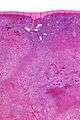 Very low mag.
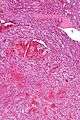 Intermed. mag.
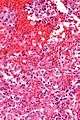 Very high mag.
References
- ↑ Tan, YM.; Chuah, KL.; Wong, WK. (Jul 2004). "Littoral cell angioma of the spleen." (PDF). Ann Acad Med Singap. 33 (4): 524–6. PMID 15329769.
- 1 2 Dascalescu, CM.; Wendum, D.; Gorin, NC. (Sep 2001). "Littoral-cell angioma as a cause of splenomegaly.". N Engl J Med. 345 (10): 772–3. doi:10.1056/NEJM200109063451016. PMID 11547761.