Lucas sequence
In mathematics, the Lucas sequences and are certain constant-recursive integer sequences that satisfy the recurrence relation



where and are fixed integers. Any sequence satisfying this recurrence relation can be represented as a linear combination of the Lucas sequences and .


More generally, Lucas sequences and represent sequences of polynomials in and with integer coefficients.
Famous examples of Lucas sequences include the Fibonacci numbers, Mersenne numbers, Pell numbers, Lucas numbers, Jacobsthal numbers, and a superset of Fermat numbers. Lucas sequences are named after the French mathematician Édouard Lucas.
Recurrence relations
Given two integer parameters P and Q, the Lucas sequences of the first kind Un(P,Q) and of the second kind Vn(P,Q) are defined by the recurrence relations:

and

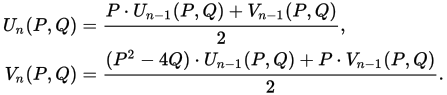
It is not hard to show that for ,

Examples
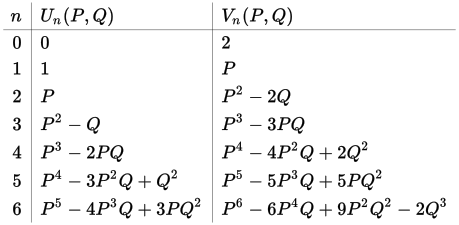
Initial terms of Lucas sequences Un(P,Q) and Vn(P,Q) are given in the table:
Explicit expressions
The characteristic equation of the recurrence relation for Lucas sequences and is:

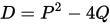
It has the discriminant and the roots:

Thus:

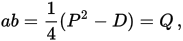
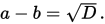
Note that the sequence and the sequence also satisfy the recurrence relation. However these might not be integer sequences.


Distinct roots
When , a and b are distinct and one quickly verifies that

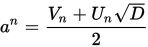
- .
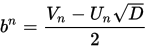
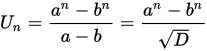
It follows that the terms of Lucas sequences can be expressed in terms of a and b as follows

Repeated root
The case occurs exactly when for some integer S so that . In this case one easily finds that




- .

Properties
Generating functions
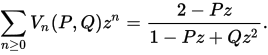
The ordinary generating functions are

Sequences with the same discriminant
If the Lucas sequences and have discriminant , then the sequences based on and where



have the same discriminant: .

Pell equations
When , the Lucas sequences and satisfy certain Pell equations:




Other relations
The terms of Lucas sequences satisfy relations that are generalizations of those between Fibonacci numbers and Lucas numbers . For example:


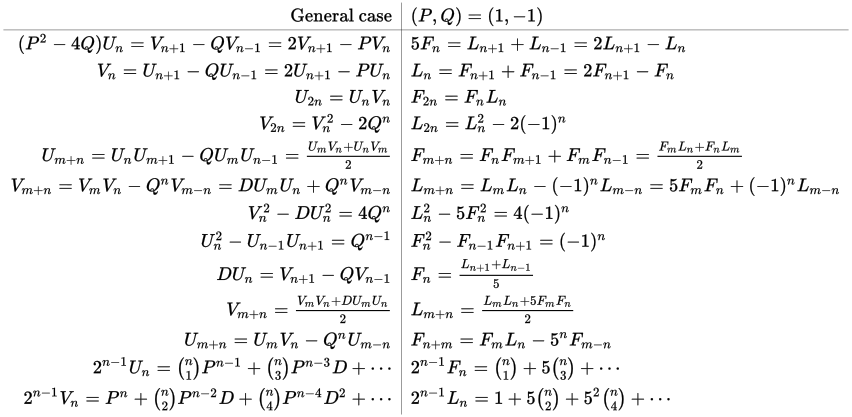
Among the consequences is that is a multiple of , i.e., the sequence is a divisibility sequence. This implies, in particular, that can be prime only when n is prime. Another consequence is an analog of exponentiation by squaring that allows fast computation of for large values of n. Further divisibility properties are follows:[1]



- If n / m is odd, then divides .
- Let N be an integer relatively prime to 2Q. If the smallest positive integer r for which N divides exists, then the set of n for which N divides is exactly the set of multiples of r.
- If P and Q are even, then are always even except .
- If P is even and Q is odd, then the parity of is the same as n and is always even.
- If P is odd and Q is even, then are always odd for .
- If P and Q are odd, then are even if and only if n is a multiple of 3.
- If p is an odd prime, then .
- If p is an odd prime and divides P and Q, then p divides for every .
- If p is an odd prime and divides P but not Q, then p divides if and only if n is even.
- If p is an odd prime and divides not P but Q, then p never divides for .
- If p is an odd prime and divides not PQ but D, then p divides if and only if p divides n.
- If p is an odd prime and does not divide PQD, then p divides , where .





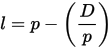
The last fact generalizes Fermat's little theorem. These facts are used in the Lucas–Lehmer primality test. The converse of the last fact does not hold, as the converse of Fermat's little theorem does not hold. There exists a composite n relatively prime to D and dividing , where . Such a composite is called Lucas pseudoprime.
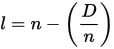
A prime factor of a term in a Lucas sequence that does not divide any earlier term in the sequence is called primitive. Carmichael's theorem states that all but finitely many of the terms in a Lucas sequence have a primitive prime factor(Yubuta 2001). Indeed, Carmichael (1913) showed that if D is positive and n is not 1, 2 or 6, then has a primitive prime factor. In the case D is negative, a deep result of Bilu, Hanrot, Voutier and Mignotte[2] shows that if n > 30, then has a primitive prime factor and determines all cases has no primitive prime factor.
Specific names
The Lucas sequences for some values of P and Q have specific names:
- Un(1,−1) : Fibonacci numbers
- Vn(1,−1) : Lucas numbers
- Un(2,−1) : Pell numbers
- Vn(2,−1) : Companion Pell numbers or Pell-Lucas numbers
- Un(1,−2) : Jacobsthal numbers
- Vn(1,−2) : Jacobsthal-Lucas numbers
- Un(3, 2) : Mersenne numbers 2n − 1
- Vn(3, 2) : Numbers of the form 2n + 1, which include the Fermat numbers (Yubuta 2001).
- Un(x,−1) : Fibonacci polynomials
- Vn(x,−1) : Lucas polynomials
- Un(2x, 1) : Chebyshev polynomials of second kind
- Vn(2x, 1) : Chebyshev polynomials of first kind multiplied by 2
- Un(x+1, x) : Repunits base x
- Vn(x+1, x) : xn + 1
Some Lucas sequences have entries in the On-Line Encyclopedia of Integer Sequences:
-1 3  A214733
1 -1 A000045 A0000321 1 A128834 A0872041 2 A1079202 -1 A000129 A0022032 1 A0014772 2 A009545 A0073952 3 A0881372 4 A0881382 5 A0458733 -5 A015523 A0722633 -4 A015521 A2014553 -3 A030195 A1720123 -2 A007482 A2067763 -1 A006190 A0064973 1 A001906 A0052483 2 A000225 A0000513 5 A1909594 -3 A015530 A0800424 -2 A0900174 -1 A001076 A0144484 1 A001353 A0035004 2 A007070 A0562364 3 A003462 A0344724 4 A0017875 -3 A0155365 -2 A0155355 -1 A052918 A0871305 1 A004254 A0035015 4 A002450 A052539


Applications
- Lucas sequences are used in probabilistic Lucas pseudoprime tests, which are part of the commonly used Baillie-PSW primality test.
- Lucas sequences are used in some primality proof methods, including the Lucas-Lehmer-Riesel test, and the N+1 and hybrid N-1/N+1 methods such as those in Brillhart-Lehmer-Selfridge 1975[3]
- LUC is a public-key cryptosystem based on Lucas sequences[4] that implements the analogs of ElGamal (LUCELG), Diffie-Hellman (LUCDIF), and RSA (LUCRSA). The encryption of the message in LUC is computed as a term of certain Lucas sequence, instead of using modular exponentiation as in RSA or Diffie-Hellman. However, a paper by Bleichenbacher et al.[5] shows that many of the supposed security advantages of LUC over cryptosystems based on modular exponentiation are either not present, or not as substantial as claimed.
See also
Notes
- ↑ For such relations and divisibility properties, see Carmichael (1913), Lehmer (1930) or 2. IV of Ribenboim (1996).
- ↑ Bilu, Yuri; Hanrot, Guillaume; Voutier, Paul M.; Mignotte, Maurice (2001). "Existence of primitive divisors of Lucas and Lehmer numbers". J. Reine Angew. Math. 539: 75–122. doi:10.1515/crll.2001.080. MR 1863855.
- ↑ John Brillhart; Derrick Henry Lehmer; John Selfridge (April 1975). "New Primality Criteria and Factorizations of 2^m ± 1". Mathematics of Computation. 29 (130): 620–647. doi:10.1090/S0025-5718-1975-0384673-1.
- ↑ P. J. Smith; M. J. J. Lennon (1993). "LUC: A new public key system". Proceedings of the Ninth IFIP Int. Symp. on Computer Security: 103–117.
- ↑ D. Bleichenbacher; W. Bosma; A. K. Lenstra (1995). "Some Remarks on Lucas-Based Cryptosystems" (PDF). Lecture Notes in Computer Science. 963: 386–396. doi:10.1007/3-540-44750-4_31.
References
- Carmichael, R. D. (1913), "On the numerical factors of the arithmetic forms αn±βn", Annals of Mathematics, 15 (1/4): 30–70, doi:10.2307/1967797, JSTOR 1967797.
- Lehmer, D. H. (1930). "An extended theory of Lucas' functions". Annals of Mathematics. 31 (3): 419–448. Bibcode:1930AnMat..31..419L. doi:10.2307/1968235. JSTOR 1968235.
- Ward, Morgan (1954). "Prime divisors of second order recurring sequences". Duke Math. J. 21 (4): 607–614. doi:10.1215/S0012-7094-54-02163-8. MR 0064073.
- Somer, Lawrence (1980). "The divisibility properties of primary Lucas Recurrences with respect to primes" (PDF). Fibonacci Quarterly. 18: 316.
- Lagarias, J. C. (1985). "The set of primes dividing Lucas Numbers has density 2/3". Pac. J. Math. 118 (2): 449–461. doi:10.2140/pjm.1985.118.449. MR 789184.
- Hans Riesel (1994). Prime Numbers and Computer Methods for Factorization. Progress in Mathematics. 126 (2nd ed.). Birkhäuser. pp. 107–121. ISBN 0-8176-3743-5.
- Ribenboim, Paulo; McDaniel, Wayne L. (1996). "The square terms in Lucas Sequences". J. Numb. Theory. 58 (1): 104–123. doi:10.1006/jnth.1996.0068.
- Joye, M.; Quisquater, J.-J. (1996). "Efficient computation of full Lucas sequences" (PDF). El. Lett. 32 (6): 537–538. doi:10.1049/el:19960359.
- Ribenboim, Paulo (1996). The New Book of Prime Number Records (eBook ed.). Springer-Verlag, New York. doi:10.1007/978-1-4612-0759-7. ISBN 978-1-4612-0759-7.
- Ribenboim, Paulo (2000). My Numbers, My Friends: Popular Lectures on Number Theory. New York: Springer-Verlag. pp. 1–50. ISBN 0-387-98911-0.
- Luca, Florian (2000). "Perfect Fibonacci and Lucas numbers". Rend. Circ Matem. Palermo. 49 (2): 313–318. doi:10.1007/BF02904236.
- Yabuta, M. (2001). "A simple proof of Carmichael's theorem on primitive divisors" (PDF). Fibonacci Quarterly. 39: 439–443..
- Arthur T. Benjamin; Jennifer J. Quinn (2003). Proofs that Really Count. Mathematical Association of America. p. 35. ISBN 0-88385-333-7.
- Lucas sequence at Encyclopedia of Mathematics.
- Weisstein, Eric W. "Lucas Sequence". MathWorld.