Luminoso
 | |
| Privately-held company | |
| Industry | Text analytics |
| Founded | 2010 |
| Headquarters | Cambridge, Massachusetts, United States |
Key people | Co-founders: Catherine Havasi (CEO), Dennis Clark, Jason Alonso, Rob Speer |
| Products | Text analytics using artificial intelligence. |
| Website | www.luminoso.com |
Luminoso, a Cambridge, MA-based text analysis and artificial intelligence company, spun out of the MIT Media Lab and its crowd-sourced Open Mind Common Sense (OMCS) project.[1][2][3][4]
The company has raised $8 million in financing[5] and its clients include Sony, Autodesk, Intel, NASA, REI and Scotts.[1][2][4][6]
History
Luminoso was co-founded in 2010 by Dennis Clark, Jason Alonso, Rob Speer, and CEO Catherine Havasi,[7] a research scientist at MIT in artificial intelligence and computational linguistics.[8] The company builds on the knowledge base of MIT’s OMCS project,[1][5][6] co-founded in 1999 by Havasi, who continues to serve as its director.[9] OMCS is a crowd-sourced knowledge base with more than seventeen million facts from over 15,000 contributors.[9][10][11][12] The company also commercializes the work of MIT Media Lab’s ConceptNet. ConceptNet is a semantic network based on the information in the OMCS database and is part of the “common sense reasoning” branch of artificial intelligence.[13]
During the World Cup in June 2014, the company provided a widely reported real-time sentiment analysis of the U.S. vs. Germany match, analyzing 900,000 posts on Twitter, Facebook and Google+.[1][14][15]
Services
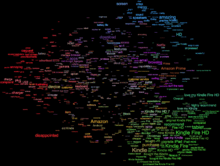
The company uses natural language processing and machine learning technology to derive insights from any unstructured text, such as product reviews, surveys and social media.[3] The technology leverages artificial intelligence to identify patterns, including unconventional or creative language.[2][4][5][16] Rather than human-powered keyword searches of data, the software automates taxonomy creation around concepts, allowing related words and phrases to be dynamically generated and tracked as part of its analysis.[2][5] Commercial applications include tracking sentiment during product launches and identifying consumer complaints before they emerge in the media.[2][3][4] The technology analyzes text in nine languages, as well as emoji.[17]
Competitors
Major competitors include Medallia, Clarabridge, Lexalytics and Crimson Hexagon.[10][18]
Investors
Acadia Woods led a $6.5 million round of funding, with Japan’s Digital Garage, in July 2014.[7][19][20] The company previously raised a $1.5 million seed round.[7][20]
References
- 1 2 3 4 Lohr, Steve (27 June 2014). "The U.S.-Germany Match Through a Social Media Lens". New York Times. Retrieved 3 March 2015.
- 1 2 3 4 5 Rusli, Evelyn (14 April 2014). "Firms Use Artificial Intelligence to Tap Shoppers' Views". The Wall Street Journal. Retrieved 3 March 2015.
- 1 2 3 Alba, Davey (12 February 2015). "The Startup That Helps You Analyze Twitter Chatter in Real Time". Wired. Retrieved 3 March 2015.
- 1 2 3 4 Noyes, Katherine (11 February 2015). "Luminoso to enterprises: Here's what all that chatter really means". PC World. Retrieved 3 March 2015.
- 1 2 3 4 Miller, Ron (2 July 2014). "Luminoso Lands $6.5M In Series A To Keep Building Cloud Text Analytics Service". TechCrunch. Retrieved 3 March 2015.
- 1 2 Darrow, Barb (11 February 2015). "Luminoso brings its text analysis smarts to streaming data". GigaOm. Retrieved 3 March 2015.
- 1 2 3 Kokalitcheva, Kia (2 July 2014). "Luminoso gets $6.5M to turn unstructured text into actionable data". Venture Beat. Retrieved 3 March 2015.
- ↑ Harris, David (16 October 2014). "40 Under 40: Catherine Havasi of Luminoso". Boston Business Journal. Retrieved 3 March 2015.
- 1 2 Havasi, Catherine (9 August 2014). "Who's Doing Common-Sense Reasoning And Why It Matters". TechCrunch. Retrieved 3 March 2015.
- 1 2 Wasserman, Todd (12 April 2014). "MIT's Luminoso Claims It's Cracked the Code on Text Mining". Mashable. Retrieved 3 March 2015.
- ↑ Robert Speer, Catherine Havasi, and Henry Lieberman. AnalogySpace: Reducing the Dimensionality of Common Sense Knowledge. AAAI 2008.
- ↑ Catherine Havasi. Discovering Semantic Relations Using Singular Value Decomposition Based Techniques. Ph.D Thesis, Brandeis University June 2009.
- ↑ Catherine Havasi, Rob Speer and Jason Alonso. ConceptNet 3: a Flexible, Multilingual Semantic Network for Common Sense Knowledge. Proceedings of Recent Advances in Natural Language Processing, 2007.
- ↑ Harris, David (15 May 2014). "How Cambridge startup Luminoso is helping to power Sony's World Cup social network". Boston Business Journal. Retrieved 3 March 2015.
- ↑ Schroter, Will (17 June 2014). "6 U.S. Startups Winning at the World Cup". Forbes. Retrieved 3 March 2015.
- ↑ Noyes, Katherine (11 February 2015). "Luminoso to enterprises: Here's what all that chatter really means". Networked World. Retrieved 3 March 2015.
- ↑ Nanos, Janelle (12 February 2015). "Luminoso's new 'Compass' tool navigates through online chatter". Beta Boston, Boston Globe. Retrieved 3 March 2015.
- ↑ Grimes, Seth. "Text Analytics in 2013". http://breakthroughanalysis.com/. Breakthrough Analysis. External link in
|website=(help) - ↑ Primack, Dan (2 July 2014). "Deals of the day: BlaBlaCar raises $100 million". Fortune. Retrieved 3 March 2015.
- 1 2 Temple, Jason (2 July 2014). "Say What? MIT Spin-Out Helps Businesses Translate Online Chatter.". Re/Code. Retrieved 3 March 2015.