Lusser's law
Lusser's law in systems engineering is a prediction of reliability. Named after engineer Robert Lusser,[1] and also known as Lusser's product law or the probability product law of series components, it states that the reliability of a series system is equal to the product of the reliability of its component subsystems, if their failure modes are known to be statistically independent. For a series of n components, this is expressed as:[2][3]
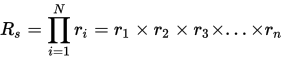
where Rs is the overall reliability of the system, and rn is the reliability of the nth component.
Lusser's law has been described as the idea that a series system is "weaker than its weakest link", as the product reliability of a series of components can be less than the lowest-value component.[4]
For example, given a series system of two components with different reliabilities — one of 0.95 and the other of 0.8 — Lusser's law will predict a reliability of

which is lower than either of the individual components.
References
- ↑ Collins, R. (July 14, 2003). "Lusser's Law". The American Spectator. Retrieved 10 August 2015.
- ↑ DeVale, J. (1998). "Basics of Traditional Reliability" (PDF). p. 8. Retrieved 11 August 2015.
- ↑ Kopp, C. (1996). "System Reliability and Metrics of Reliability" (PDF). Peter Harding & Associates, Pty Ltd. p. 7. Retrieved 11 August 2015.
- ↑ Critchley, Terry (2014). High Availability IT Services. CRC Press. p. 117. ISBN 9781482255911.