MID2
| View/Edit Human | View/Edit Mouse |
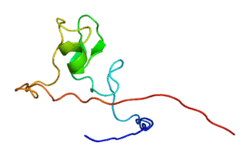
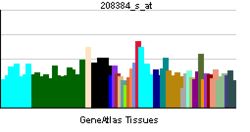
Midline-2 is a protein that in humans is encoded by the MID2 gene.[3][4]
Function
The protein encoded by this gene is a member of the tripartite motif (TRIM) family. The TRIM motif includes three zinc-binding domains, a RING, a B-box type 1 and a B-box type 2, and a coiled-coil region. The protein localizes to microtubular structures in the cytoplasm. Its function has not been identified. Alternate splicing of this gene results in two transcript variants encoding different isoforms.[4]
Interactions
MID2 has been shown to interact with MID1.[5][6]
References
- ↑ "Human PubMed Reference:".
- ↑ "Mouse PubMed Reference:".
- ↑ Buchner G, Montini E, Andolfi G, Quaderi N, Cainarca S, Messali S, Bassi MT, Ballabio A, Meroni G, Franco B (Sep 1999). "MID2, a homologue of the Opitz syndrome gene MID1: similarities in subcellular localization and differences in expression during development". Hum Mol Genet. 8 (8): 1397–407. doi:10.1093/hmg/8.8.1397. PMID 10400986.
- 1 2 "Entrez Gene: MID2 midline 2".
- ↑ Reymond A, Meroni G, Fantozzi A, Merla G, Cairo S, Luzi L, Riganelli D, Zanaria E, Messali S, Cainarca S, Guffanti A, Minucci S, Pelicci PG, Ballabio A (May 2001). "The tripartite motif family identifies cell compartments". EMBO J. 20 (9): 2140–51. doi:10.1093/emboj/20.9.2140. PMC 125245
 . PMID 11331580.
 - ↑ Short KM, Hopwood B, Yi Z, Cox TC (2002). "MID1 and MID2 homo- and heterodimerise to tether the rapamycin-sensitive PP2A regulatory subunit, alpha 4, to microtubules: implications for the clinical variability of X-linked Opitz GBBB syndrome and other developmental disorders". BMC Cell Biol. 3: 1. doi:10.1186/1471-2121-3-1. PMC 64779. PMID 11806752.
Further reading
- Lim J, Hao T, Shaw C, Patel AJ, Szabó G, Rual JF, Fisk CJ, Li N, Smolyar A, Hill DE, Barabási AL, Vidal M, Zoghbi HY (2006). "A protein-protein interaction network for human inherited ataxias and disorders of Purkinje cell degeneration.". Cell. 125 (4): 801–14. doi:10.1016/j.cell.2006.03.032. PMID 16713569.
- Jehee FS, Rosenberg C, Krepischi-Santos AC, Kok F, Knijnenburg J, Froyen G, Vianna-Morgante AM, Opitz JM, Passos-Bueno MR (2006). "An Xq22.3 duplication detected by comparative genomic hybridization microarray (Array-CGH) defines a new locus (FGS5) for FG syndrome.". Am. J. Med. Genet. A. 139 (3): 221–6. doi:10.1002/ajmg.a.30991. PMID 16283679.
- Rual JF, Venkatesan K, Hao T, Hirozane-Kishikawa T, Dricot A, Li N, Berriz GF, Gibbons FD, Dreze M, Ayivi-Guedehoussou N, Klitgord N, Simon C, Boxem M, Milstein S, Rosenberg J, Goldberg DS, Zhang LV, Wong SL, Franklin G, Li S, Albala JS, Lim J, Fraughton C, Llamosas E, Cevik S, Bex C, Lamesch P, Sikorski RS, Vandenhaute J, Zoghbi HY, Smolyar A, Bosak S, Sequerra R, Doucette-Stamm L, Cusick ME, Hill DE, Roth FP, Vidal M (2005). "Towards a proteome-scale map of the human protein-protein interaction network.". Nature. 437 (7062): 1173–8. doi:10.1038/nature04209. PMID 16189514.
- Yap MW, Nisole S, Lynch C, Stoye JP (2004). "Trim5alpha protein restricts both HIV-1 and murine leukemia virus.". Proc. Natl. Acad. Sci. U.S.A. 101 (29): 10786–91. doi:10.1073/pnas.0402876101. PMC 490012. PMID 15249690.
- Short KM, Hopwood B, Yi Z, Cox TC (2002). "MID1 and MID2 homo- and heterodimerise to tether the rapamycin-sensitive PP2A regulatory subunit, alpha 4, to microtubules: implications for the clinical variability of X-linked Opitz GBBB syndrome and other developmental disorders.". BMC Cell Biol. 3: 1. doi:10.1186/1471-2121-3-1. PMC 64779. PMID 11806752.
- Reymond A, Meroni G, Fantozzi A, Merla G, Cairo S, Luzi L, Riganelli D, Zanaria E, Messali S, Cainarca S, Guffanti A, Minucci S, Pelicci PG, Ballabio A (2001). "The tripartite motif family identifies cell compartments.". EMBO J. 20 (9): 2140–51. doi:10.1093/emboj/20.9.2140. PMC 125245. PMID 11331580.
- Perry J, Short KM, Romer JT, Swift S, Cox TC, Ashworth A (2000). "FXY2/MID2, a gene related to the X-linked Opitz syndrome gene FXY/MID1, maps to Xq22 and encodes an FNIII domain-containing protein that associates with microtubules.". Genomics. 62 (3): 385–94. doi:10.1006/geno.1999.6043. PMID 10644436.
- Cainarca S, Messali S, Ballabio A, Meroni G (1999). "Functional characterization of the Opitz syndrome gene product (midin): evidence for homodimerization and association with microtubules throughout the cell cycle.". Hum. Mol. Genet. 8 (8): 1387–96. doi:10.1093/hmg/8.8.1387. PMID 10400985.
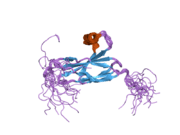
PDB gallery | ||||
|---|---|---|---|---|
| ||||
This article is issued from Wikipedia - version of the 5/20/2016. The text is available under the Creative Commons Attribution/Share Alike but additional terms may apply for the media files.