Mayor's mouse
| Mayor's mouse | |
|---|---|
| Scientific classification | |
| Kingdom: | Animalia |
| Phylum: | Chordata |
| Class: | Mammalia |
| Order: | Rodentia |
| Family: | Muridae |
| Genus: | Mus |
| Species: | M. mayori |
| Binomial name | |
| Mus mayori (Thomas, 1915) | |
| Subspecies | |
|
Mus mayori mayori | |
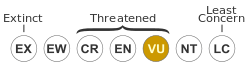
Mus mayori is a species of rodent in the genus Mus, the mice. Its common names include Mayor's mouse, highland rat,[1] and spiny mouse.[2] It is endemic to Sri Lanka.[1]
This mouse lives in tropical and subtropical forest types and wet grassland habitat. It is fossorial, seeking shelter by digging burrows. It is nocturnal.[1]
This species is widespread in parts of Sri Lanka but it faces a number of threats, including deforestation and domestic cats.[1]
There are two subspecies, M. m. mayori and M. m. pococki. A recent study catalogued the parasites associated with subspecies pococki: a mite of genus Echinolaelaps, a tick of genus Ixodes, and the sucking louse Polyplax spinulosa.[3] A new species of pseudoscorpion was found on the mouse, described, and named Megachernes kanneliyensis.[4] The mouse also carries the native Sri Lankan flea Stivalius phoberus.[5]
References
- 1 2 3 4 5 de A. Goonatilake, W., et al. Mus mayori. The IUCN Red List of Threatened Species 2008. Downloaded on 07 January 2016.
- ↑ Wijesinghe, M. R. Predicting effects of rainforest fragmentation from live trapping studies of small mammals in Sri Lanka. Journal of Threatened Taxa 4(6): 2629-2636.
- ↑ Ratnaweera, P. B., et al. (2010). Parasitic associations of a threatened Sri Lankan rainforest rodent, Mus mayor pococki (Rodentia: Muridae). Journal of Threatened Taxa, 2(6), 901-907.
- ↑ Harvey, M. S., et al. (2012). A new species of the pseudoscorpion genus Megachernes (Pseudoscorpiones: Chernetidae) associated with a threatened Sri Lankan rainforest rodent, with a review of host associations of Megachernes. Journal of Natural History, 46(41-42), 2519-2535.
- ↑ Yathramullage, S., Meegaskumbura, M., and Meegaskumbura, S. (2014). Record of five new endemic small mammal hosts for four ectoparasite species from Sri Lanka. Journal of Asia-Pacific Entomology 17 473-476.
External links
- Wilson, D. E. & Reeder, D. M. Mus (Coelomys) mayori. Mammal Species of the World. Third Edition. Johns Hopkins University Press.