Melaleuca polycephala
| Melaleuca polycephala | |
|---|---|
| Scientific classification | |
| Kingdom: | Plantae |
| (unranked): | Angiosperms |
| (unranked): | Eudicots |
| (unranked): | Rosids |
| Order: | Myrtales |
| Family: | Myrtaceae |
| Genus: | Melaleuca |
| Species: | M. polycephala |
| Binomial name | |
| Melaleuca polycephala Benth. | |
Melaleuca polycephala is a shrub in the myrtle family, Myrtaceae, and is endemic to the south-west of Western Australia. It is a sparsely foliaged, twiggy shrub with deep purple flowers in spring.
Description
Melaleuca polycephala is a bushy shrub with tangled branches growing to about 1 m (3 ft) tall and wide. Its leaves are arranged alternately, 5–15 mm (0.2–0.6 in) long, 2–4.5 mm (0.08–0.2 in) wide, narrow elliptic or narrow egg-shaped, tapering to a sharp point and with the veins prominent on the upper surface.[1]
The flowers are arranged in heads on the ends of branches which continue to grow after flowering. The heads contain between 3 and 7 groups of flowers in threes and are up to 12 mm (0.5 in) in diameter. The stamens are in five bundles around the flowers, each bundle containing 3 stamens. Flowering is mainly in September and October and is followed by fruit which are woody capsules 2.0–2.8 mm (0.08–0.1 in) long and in roughly spherical clusters.[1][2]
Taxonomy and naming
Melaleuca polycephala was first formally described in 1867 by George Bentham in Flora Australiensis.[3][4] The specific epithet (polycephala) is derived from the Greek words πολύς (polús) meaning “many"[5] and κεφαλή (kephalḗ) meaning "head"[6] in reference to the large number of flower heads in examples of this species.[1]
Distribution and habitat
This melaleuca occurs in and between the Gnowangerup, Pingrup and Jerramungup[1] districts in the Esperance Plains and Mallee biogeographic regions.[7] It grows in clay and sandy clay.[8]
Conservation
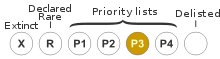
Melaleuca polycephala is classified as "Priority Three" by the Government of Western Australia Department of Parks and Wildlife[7] meaning that it is known from only a few locations and is not currently in imminent danger.[9]
References
- 1 2 3 4 Brophy, Joseph J.; Craven, Lyndley A.; Doran, John C. (2013). Melaleucas : their botany, essential oils and uses. Canberra: Australian Centre for International Agricultural Research. p. 288. ISBN 9781922137517.
- ↑ Holliday, Ivan (2004). Melaleucas : a field and garden guide (2nd ed.). Frenchs Forest, N.S.W.: Reed New Holland Publishers. pp. 168–169. ISBN 1876334983.
- ↑ "Melaleuca polycephala". APNI. Retrieved 16 April 2015.
- ↑ Mueller, Ferdinand (1866). Flora Australiensis, volume 3. London. pp. 152–153. Retrieved 16 April 2015.
- ↑ "poly-". Wiktionary. Retrieved 16 April 2015.
- ↑ "-cephaly". Wiktionary. Retrieved 16 April 2015.
- 1 2 "Melaleuca polycephala". FloraBase. Western Australian Government Department of Parks and Wildlife.
- ↑ Paczkowska, Grazyna; Chapman, Alex R. (2000). The Western Australian flora : a descriptive catalogue. Perth: Wildflower Society of Western Australia. p. 396. ISBN 0646402439.
- ↑ "Conservation codes for Western Australian flora and fauna" (PDF). Western Australian government department of parks and wildlife. Retrieved 16 April 2015.