Michael White (psychotherapist)
| Michael White | |
|---|---|
|
Michael White, October 2006; photograph by Jill Freedman | |
| Born |
29 December 1948 Adelaide, South Australia |
| Died |
4 April 2008 (aged 59) San Diego, California |
| Occupation | family therapist, author |
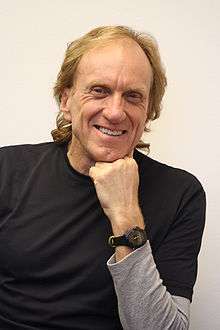
Michael White (29 December 1948 – 4 April 2008)[1] was an Australian social worker and family therapist. He is known as the founder of narrative therapy, and for his significant contribution to psychotherapy and family therapy, which have been a source of techniques adopted by other approaches.
Biography
Michael Kingsley White was born and raised in Adelaide, South Australia. His first professional job was as a probation and welfare worker. He earned an undergraduate social work degree from the University of South Australia in 1979 and worked as a psychiatric social worker at the Adelaide Children's Hospital. He founded the Dulwich Centre in 1983 and began a private practice as a family therapist. He continued to be associated with Dulwich Centre until his death.
White was a practicing social worker and co-director of the Dulwich Centre[2] in Adelaide, South Australia, and was author of several books of importance in the field of family therapy and narrative therapy.
In January 2008, White set up the Adelaide Narrative Therapy Centre[3] to provide counselling services and training workshops relevant to work with individuals, couples, families, groups and communities and to provide a context for exploring recent developments relevant to narrative practice."[4]
Michael White was also particularly known for his work with children and Indigenous Aboriginal communities, as well as with schizophrenia, anorexia/bulimia, men's violence, and trauma.
He received the following awards, honours, invitations:
- International Fellow, American Association for Marriage and Family Therapy
- Masters Interview, American Association of Marriage and Family Therapy Conference, San Francisco, 1989.
- Honorary Doctorate of Humane Letters, John F. Kennedy University, Orinda, California.
- Distinguished Contribution to Family Therapy Theory & Practice Award, American Family Therapy Academy, 1999.[5]
On 31 March 2008, Michael White suffered a sudden heart failure at a restaurant in San Diego, California. He died five days later, on 5 April 2008.[6]
Work
Influences
While early influences included those of systems theory and cybernetics (Gregory Bateson),[7] White's main work drew on a wide range of sources, including literary theory (Jerome Bruner), cultural anthropology (Clifford Geertz, Barbara Myerhoff, Victor Turner), non-structuralist psychology (William James, Lev Vygotsky) and French critical / post-structuralist philosophy (Jacques Derrida, Gilles Deleuze and Michel Foucault).[8]
Theoretical and practice innovations
Key therapeutic ideas developed by White include 'externalizing the problem',[9] commonly summarised as 'the person is not the problem, the problem is the problem'; 're-authoring' the dominant stories of people's lives; and the idea of 'double-listening' to accounts of trauma: not only the accounts of trauma itself, but how people have responded to trauma.
Key practices of narrative therapy and 'maps' of narrative practice include:
- The statement of position map / externalising conversations map
- Re-authoring conversations
- Re-membering conversations
- Definitional ceremonies
- Scaffolding conversations
- The absent but implicit
- Responding to personal failure conversations[10]
Publications
- 1989. Literate Means to Therapeutic Ends. With David Epston. Adelaide: Dulwich Centre Publications.
- 1990. Narrative Means to Therapeutic Ends. With David Epston. (WW Norton & Company, New York).
- 1995. Re-Authoring Lives: Interviews and Essays. Adelaide, South Australia: Dulwich Centre Publications. ISBN 0-646-22735-1
- 1995. Narratives of Therapists' Lives. Adelaide, South Australia: Dulwich Centre Publications.
- 2000. Reflections on Narrative Practice. Adelaide, South Australia: Dulwich Centre Publications.
- 2004. Narrative Practice and Exotic Lives: Resurrecting diversity in everyday life. Adelaide, South Australia: Dulwich Centre Publications.
- 1992. Experience, Contradiction, Narrative and Imagination: Selected papers of David Epston & Michael White, 1989-1991. With David Epston. Adelaide, South Australia: Dulwich Centre Publications.
- 2006. Narrative Therapy with Children and their Families. With Alice Morgan. Adelaide, South Australia: Dulwich Centre Publications.
- 2007. Maps of Narrative Practice. (WW Norton & Company, New York)
- 2011. Narrative Practice: Continuing the conversations. (WW Norton & Company, New York)
Michael White's books have also been published in Danish, Spanish, Japanese, Swedish, Italian, German, Chinese, Finnish, French and Portuguese.
Magazine articles and radio features
- Cowley, G. & K. Springen. (1995). Rewriting life stories. Newsweek, 17 April.
- Wylie, M.S. (1994). Panning for gold. Family Therapy Networker, 18(6), 40-48.
- Special report on narrative therapy, Life Matters, ABC Radio National, broadcast 23 December 1999 (repeated 8 October 2002).
- Writing on the Mind – the power of story telling, All in the Mind, ABC Radio National, broadcast 1 October 2005.
References
- ↑ Pearce, Jeremy (28 April 2008). "Michael White, 59, Dies; Used Stories as Therapy". The New York Times. Retrieved 13 February 2010.
- ↑ Dulwich Centre
- ↑ Dulwich Centre Email News, January 2008 Issue # 25
- ↑ Adelaide Narrative Therapy Centre
- ↑ AFTA Awards page Accessed 6 May 2008. Archived 20 September 2007 at the Wayback Machine.
- ↑ http://www.narrativetherapycentre.com/Documents/YUEN-Remembering-Michael-White.pdf
- ↑ White, M. & Epston, D. (1990). Narrative Means to Therapeutic Ends, pp. 1-2.
- ↑ White, M. (2007). Maps of Narrative Practice. (New York: W.W. Norton)
- ↑ Narrative Means to Therapeutic Ends, pp. 54-56.
- ↑ Narrative Means to Therapeutic Ends; Maps of Narrative Practice; White, M. (2000). Reflections on Narrative Practice Adelaide, South Australia: Dulwich Centre Publications
External links
- Dulwich Centre: Gateway to Narrative Therapy and Community Work
- Narrative Practice Adelaide
- Michael White Archive
- Narrative Therapy Bibliography
- New York Times obituary, 28 April 2008
- Narrative therapy founder dies, ABC News, 7 Apr 2008
- Social Construction Therapies Network