Novena (computing platform)
 | |
| Date invented | 2014 |
|---|---|
| Design firm | Bunnie Studios |
| Manufacturer | Kosagi |
| Introduced | 2014 |
| Processor | ARM Cortex-A9 (Freescale i.MX6 Quad) |
| Frequency | 1.2GHz (quad-core) |
| Memory | 4 GiB DDR3 |
| Ports |
1×1Gbit/s Ethernet |
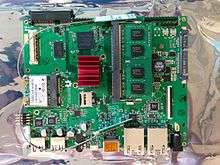
Novena is an open-source computing hardware project designed by Andrew "bunnie" Huang and Sean "Xobs" Cross.
Description
The initial design of Novena started in 2012.[1] It was developed by Sutajio Ko-usagi Pte. Ltd. and funded by a crowdfunding campaign which began on April 15, 2014. The first offering was a 1.2 GHz Freescale Semiconductor quad-core ARM architecture (i.MX6) computer closely coupled with a Xilinx FPGA. It was offered in "desktop", "laptop", or "heirloom laptop" form, or as a standalone motherboard.[2][3][4]
On May 19, 2014, the crowdfunding campaign concluded having raised just over 280% of its target. The extra funding allowed the project to achieve 4 "stretch goals": the development of free software graphics drivers for the on-board video accelerator (etnaviv); the inclusion of a general-purpose breakout board; the inclusion of a "ROMulator" breakout board; and the inclusion of the MyriadRF software defined radio with the "system-level" offerings. The goals were achieved during May, 2014.[5]
The Novena shipped with a screwdriver, as users are required to install the battery themselves, screw on the LCD bezel of their choice, and obtain speakers as a kit instead of using speaker boxes. Owners of a 3D printer can make and fine tune their own speaker box. The main boards were manufactured by AQS, an electronics manufacturing services provider.[6]
See also
References
- ↑ Andrew Huang and Sean Cross (October 27, 2015). "Novena: A Laptop With No Secrets: How we built a laptop with nothing but open-sourced hardware and software". IEEE Spectrum. Retrieved November 4, 2016.
- ↑ "Novena". Crowd Supply. Retrieved 2014-08-15.
- ↑ Klint Finley (2014-04-02). "The Almost Completely Open Source Laptop Goes on Sale". Enterprise. WIRED. Retrieved 2014-08-15.
- ↑ "Novena Helps Hackers Build Their Own Laptop". Blog.laptopmag.com. 2014-04-02. Retrieved 2014-08-15.
- ↑ "Stretch Goals". Novena. Crowd Supply. April 21, 2014. Retrieved November 4, 2016.
- ↑ Stett Holbrook (April 2, 2014). "The World's First Open Source Laptop Makes its Debut". Make. Retrieved November 4, 2016.