Moti Laxmi Upasika
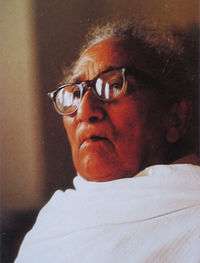
Moti Laxmi Upasika (Devanagari: मोतिलक्ष्मी उपासिका) (born Moti Laxmi Tuladhar) (30 June 1909 – 1997) was Nepal's first woman poet and short story writer of modern times. Her first work, a short story, was published in 1935.[1]
Early life
Moti Laxmi Upasika (also spelled Motilakshmī Upāsikā) was born in Kathmandu to father Drabya Dhar and mother Gyan Laxmi Tuladhar. Her father was a merchant who owned a business house in Lhasa, Tibet. Her brother was poet Chittadhar Hridaya.[2][3] She received informal education in Sanskrit, Pali and English.[4]
Writing career
Upasika, who also wrote under the pen name M. Laxmi, published her first work in 1935, a story in the Nepali language entitled "Rodan". It appeared in Sharada magazine published from Kathmandu.
She started writing in Nepal Bhasa with a poem entitled "Chitta Panchhi" (meaning "Heart bird") and a story "Lan" ("Road") which were published in Dharmadoot in 1944.[5] Dharmadoot was a Buddhist magazine published in Hindi by the Maha Bodhi Society from Sarnath, India. It also published contributions in Nepal Bhasa at the request of its subscribers in Nepal.[6][7]
Though most of her essays deal with religious subjects, her writings have been described as a bridge between religious and free prose.[8] Her essays are characterized by simple language and a powerful way of expressing her opinions.[9]
Published works
- Motima (मोतिमा: "Garland of Pearls"), a collection of essays, 1958
- Chakhunchiya Sarbay (चखुंचिया सर्बय् "Sparrow's Property"), a collection of poems, 1993[10]
- Moti Bakhan Puchah (मोति बाखं पुच: "Moti Collection of Stories"), a collection of short stories, 1994[11]
- Utpalvarna (उत्पलवर्णा), a collection of Buddhist stories, 1995[12]
- Dhaubaji (धौबजि "Yogurt and Rice Flakes"), a collection of essays, 1998
References
- ↑ Tuladhar, Prem Shanti (2000). Nepal Bhasa Sahityaya Itihas: The History of Nepalbhasa Literature. Kathmandu: Nepal Bhasa Academy. ISBN 99933-560-0-X. Page 183.
- ↑ LeVine, Sarah and Gellner, David N. (2005). Rebuilding Buddhism: The Theravada Movement in Twentieth-Century Nepal. Harvard University Press. ISBN 0674019083, 9780674019089. Page 39.
- ↑ Hridaya, Chittadhar; Lewis, Todd Thornton; Tuladhar, Subarna Man (2009). Sugata Saurabha: An Epic Poem from Nepal on the Life of the Buddha. Oxford University Press. ISBN 0195341821, 9780195341829. Page 377.
- ↑ Bajracharya, Phanindra Ratna (2003). Who's Who in Nepal Bhasha. Kathmandu: Nepal Bhasa Academy. ISBN 99933-560-0-X. Page 44.
- ↑ "Biodata of Moti Laxmi Upasika". Nepal Ritupau Vol. 57 No. 1. Nepal Bhasa Parisad. 2009. Page 1.
- ↑ Tuladhar, Prem Shanti (2000). Nepal Bhasa Sahityaya Itihas: The History of Nepalbhasa Literature. Kathmandu: Nepal Bhasa Academy. ISBN 99933-560-0-X. Page 121.
- ↑ Maharjan, Phra Sujan (2006). "The Revival of Theravada Buddhism and Its Contribution to Nepalese Society" (PDF). Bangkok: Mahachulalongkornrajavidyalaya University. Retrieved 16 March 2012. ISBN 974-364-509-8. Page 138.
- ↑ Malla, Kamal Prakash (1964). Musah Nibandha ("Essay par excellence"). Kathmandu: Chwasa Pasa. Page 6.
- ↑ Tuladhar, Prem Shanti (2000). Nepal Bhasa Sahityaya Itihas: The History of Nepalbhasa Literature. Kathmandu: Nepal Bhasa Academy. ISBN 99933-560-0-X. Page 209.
- ↑ "Library of Congress Catalog Record". Library of Congress. Retrieved 19 March 2012.
- ↑ "Library of Congress Catalog Record". Library of Congress. Retrieved 19 March 2012.
- ↑ "Library of Congress Catalog Record". Library of Congress. Retrieved 19 March 2012.