Niqmi-Epuh
| Niqmi-Epuh | |
|---|---|
| Great King of Yamhad | |
 | |
| Reign | c. 1700 BC – c. 1675 BC. Middle chronology |
| Predecessor | Yarim-Lim II |
| Successor | Irkabtum |
Niqmi-Epuh, also given as Niqmepa (reigned c. 1700 BC – c. 1675 BC - Middle chronology ) was the king of Yamhad (Halab) succeeding his father Yarim-Lim II
Reign
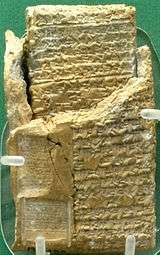
Little of Aleppo has been excavated by archaeologists, knowledge about Niqmi-Epuh comes from tablets discovered at Alalakh,[1] his existence is confirmed by a number of tablets with his seal on its envelope [2]
Yarim-Lim king of Alalakh, uncle of Yarim-Lim II and vassal of Yamhad died during Niqmi-Epuh reign and was succeeded by his son Ammitakum,[3] who started to assert Alalakh semi-independence.[4]
The tablets mentions Niqmi-Epuh votive status which he dedicated to Hadad and placed it in that Deity Temple,[5] tablet AlT*11 informs of his return from Nishin, a place not known before but certainly inside the territory of Yamhad because the tablet seems to refer to travel and not a military campaign.[6]
Niqmi-Epuh most celebrated deed was his conquest of the town Arazik near Charchemish,[7] the fall of this city was important to the extent of being suitable for dating several legal cases.[8]
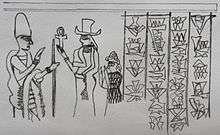
Niqmi-Epuh Seal
the seal of Niqmi-Epuh includes his name written in cuneiform inscription, the king is wearing a crown, facing two goddesses, one in Syrian dress and the other is wearing Babylonian dress.[9]
Death and succession
Niqmi-Epuh died ca. 1675 BC, he seems to have a number of sons including Irkabtum who succeeded him immediately, prince Abba-El,[10] and possibly Yarim-Lim III.[11] Hammurabi III the last king before the Hittites conquest might have been his son too.[12]
| King Niqmi-Epuh of Yamhad (Halab) Died: 1675 BC | ||
| Regnal titles | ||
|---|---|---|
| Preceded by Yarim-Lim II |
Great King of Yamhad 1700 – 1675 BC |
Succeeded by Irkabtum |
References
Citations
- ↑ prof : Ahmad Arhim Hebbo. History of Ancient Levant (part 1) Syria.
- ↑ Douglas Frayne. Old Babylonian Period (2003-1595 BC). p. 792.
- ↑ Horst Klengel. Syria, 3000 to 300 B.C. p. 62.
- ↑ THOMAS, D. WINTON. Archaeology and Old Testament study: jubilee volume of the Society for Old Testament Study, 1917-1967. p. 121.
- ↑ Direction Générale des Antiquités et des Musées., 1999. Annales archéologiques Arabes Syriennes, Volume 43. p. 174.
- ↑ Horst Klengel. Syria, 3000 to 300 B.C. p. 62.
- ↑ Akadémiai Kiadó, 1984. Acta Antiqua Academiae Scientiarum Hungaricae, Volume 30. p. 12.
- ↑ James Bennett Pritchard,Daniel E. Fleming. The Ancient Near East: An Anthology of Texts and Pictures. p. 197.
- ↑ Dominique Collon. Ancient Near Eastern Art. p. 96.
- ↑ Michael C. Astour. Hittite history and absolute chronology of the Bronze Age. p. 18.
- ↑ wilfred van soldt. Akkadica, Volumes 111-120. p. 105.
- ↑ Douglas Frayne. Old Babylonian Period (2003-1595 BC). p. 794.