Nirvana Kanda
| Nirvana Kanda | |
|---|---|
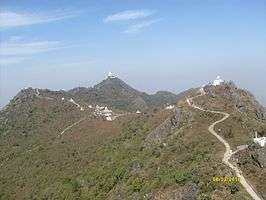 Tonks of 20 Tirthankaras at Samet Shikhar | |
| Information | |
| Author | Acharya Kundakunda |
| Part of a series on |
| Jainism |
|---|
 |
|
Jain prayers |
|
Ethics |
|
Major figures |
|
Major sects |
|
Festivals |
|
Pilgrimages |
 Jainism portal Jainism portal |
Nirvana Kanda is an ancient Prakrit Jain composition that describes the sacred sites where Jain sages have attained Nirvana[1] It is also termed Nirvana Bhakti.
In inscription of 13th century that describes the construction of the Kirti Stambha at Chittor gives 10 shlokas that give a rendering in Sanskrit.[2] A Hindi rendering Nirvana Kanda Bhasha was composed by Bhaiya Bhagvatidaas in Samvat 1741.
It is popularly recited on many occasions.[3]
Author
It is traditionally attributed to Acharya Kundakunda who is regarded to be the author of several Prakrit texts like Samayasar.
Contents
The text include:
- Nirvana sites of 24 tirthankaras (Ashtapad Mount, Champapuri, Girnar, Pawapuri and Samet Shikhar)
अट्ठावयम्मि उसहो, चम्पाए वासुपुज्ज जिणणाहो,
उज्जन्ते णेमिजिणो, पावाए णिब्बुदो महावीरो ||१||
वीसम तु जिणवरिंदा, अमरासुर वन्दिंदा धुदकिलेसा,
सम्मेदे गिरि सिहरे णिव्वाण गया, णमो तेसिं ||२||
"On Ashtapad Lord Rishabha, at Champa Lord Vasupujya, On Urjayant (Girnar) Lord Nemi, and at Pava Lord Mahavir attained nirvana.||
And the rest 20 Lord Jinas, worshipped by the gods, entered Nirvana at the top of mount Sammed, "namo" to them."||
The words "अट्ठावयम्मि उसहो" also occur in Tiloyapannatti.
- Nirvana sites of other Kevalias including Shatrunjaya
See also
References
- ↑ Framing the Jina: Narratives of Icons and Idols in Jain History, John Cort, Oxford University Press, 2010, p. 134
- ↑ jain Shilalekh Samgrah, Part V, Bharatiya Jnanapitha, 1971, p. 69
- ↑ भगवान महावीर को चढ़ाया निर्वाण लाडू, Bhaskar News Network, Nov 14, 2015, निर्वाण काण्ड के बाद निर्वाण लाडू चढ़ाया गया
| Gods | |||||||
|---|---|---|---|---|---|---|---|
| Philosophy | |||||||
| Branches |
| ||||||
| Practices | |||||||
| Literature | |||||||
| Symbols |
| ||||||
| Ascetics | |||||||
| Scholars | |||||||
| Community | |||||||
| Jainism in |
| ||||||
| Jainism and | |||||||
| Dynasties and empires | |||||||
| Related | |||||||
| Lists | |||||||
| Navboxes |
| ||||||
| |||||||