Novikov ring
- For a concept in quantum cohomology, see the linked article.
In mathematics, given an additive subgroup , the Novikov ring of is the subring of [1] consisting of formal sums such that and . The notion was introduced by S. P. Novikov in the papers that initiated the generalization of Morse theory using a closed one-form instead of a function.


![\mathbb{Z}[\![\Gamma]\!]](../I/m/942ac9fae044e12c1632cb965536d6258282e51e.svg)



The Novikov ring is a principal ideal domain. Let S be the subset of consisting of those with leading term 1. Since the elements of S are unit elements of , the localization of with respect to S is a subring of called the "rational part" of ; it is also a principal ideal domain.
![\mathbb{Z}[\Gamma]](../I/m/4693746711708b266e9cdb6b9e499c9e1f379a26.svg)
![\operatorname{Nov}(\Gamma)[S^{-1}]](../I/m/2e3f9982a44ed456e2cbced8055f3b117eea88bc.svg)
Novikov numbers
Given a smooth function f on a smooth manifold M with nondegenerate critical points, the usual Morse theory constructs a free chain complex such that the (integral) rank of is the number of critical points of f of index p (called the Morse number). It computes the homology of M: (cf. Morse homology.)



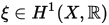
In an analogy with this, one can define "Novikov numbers". Let X be a connected polyhedron with a base point. Each cohomology class may be viewed as a linear functional on the first homology group and, composed with the Hurewicz homomorphism, it can be viewed as a group homomorphism . By the universal property, this map in turns gives a ring homomorphism , making a module over . Since X is a connected polyhedron, a local coefficient system over it corresponds one-to-one to a -module. Let be a local coefficient system corresponding to with module structure given by . The homology group is a finitely generated module over which is, by the structure theorem, a direct sum of the free part and the torsion part. The rank of the free part is called the Novikov Betti number and is denoted by . The number of cyclic modules in the torsion part is denoted by . If , is trivial and is the usual Betti number of X.


![\phi_\xi: \mathbb{Z}[\pi] \to \operatorname{Nov} = \operatorname{Nov}(\mathbb{R})](../I/m/8bce72a3415c5f46d023296664b687734d585339.svg)

![\mathbb{Z}[\pi]](../I/m/343e4f37a7355bdb8ba93cbbffbecf263af9d9ef.svg)


The analog of Morse inequalities holds for Novikov numbers as well (cf. the reference for now.)
Notes
- ↑ Here, is the ring consisting of the formal sums , integers and t a formal variable, such that the multiplication is an extension of a multiplication in the integral group ring .


References
- Farber, Michael (2004). Topology of closed one-forms. Mathematical surveys and monographs. 108. American Mathematical Society. ISBN 0-8218-3531-9. Zbl 1052.58016.
- S. P. Novikov, Multi-valued functions and functionals: An analogue of Morse theory. Soviet Math. Doklady 24 (1981), 222–226.
- S. P. Novikov: The Hamiltonian formalism and a multi-valued analogue of Morse theory. Russian Mathematical Surveys 35:5 (1982), 1–56.