Obersaxen Mundaun
| Obersaxen Mundaun | ||
|---|---|---|
|
Obersaxen village | ||
| ||
  Obersaxen Mundaun | ||
|
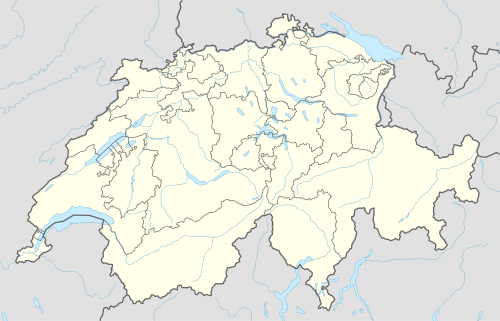
Location of Obersaxen Mundaun  | ||
| Coordinates: 46°44′N 9°6′E / 46.733°N 9.100°ECoordinates: 46°44′N 9°6′E / 46.733°N 9.100°E | ||
| Country | Switzerland | |
| Canton | Graubünden | |
| District | Surselva | |
| Area[1] | ||
| • Total | 70.11 km2 (27.07 sq mi) | |
| Population (Dec 2015[2]) | ||
| • Total | 1,146 | |
| • Density | 16/km2 (42/sq mi) | |
| Postal code | 7134, 7137 | |
| SFOS number | 3988 | |
| Localities | Obersaxen, Mundaun | |
| Surrounded by | Breil/Brigels, Degen, Lumbrein, Rueun, Sumvitg, Trun, Vella, Vignogn, Waltensburg/Vuorz | |
| Website |
website missing SFSO statistics | |
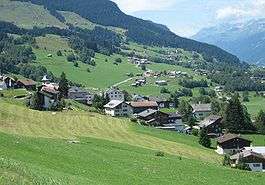

Obersaxen Mundaun is a municipality in the district of Surselva in the Swiss canton of Graubünden. On 1 January 2016 the former municipalities of Obersaxen and Mundaun merged to form the new municipality of Obersaxen Mundaun.[3]
History
Obersaxen
Obersaxen is first mentioned in 765 as Supersaxa though this is from a copy which dates from later. In 956 it was mentioned as Supersaxa, and in 1227 as Ubersahse.[4]
The current settlement was founded in the thirteenth century, when a group of German-speaking Walser settled the plateau. Right in the heart of the mainly Romansh-speaking Surselva (which encompasses the valley of the Vorderrhein, along with all of its side valleys, among others the Val Lumnezia), Obersaxen is an island of German-speakers.
Mundaun
Mundaun was formed on 1 January 2009 through the merger of Flond and Surcuolm.
Geography
Obersaxen Mundaun has a combined area, as of 2006, of 70.11 km2 (27.07 sq mi).[1]
The new municipality is located in the Lugnez sub-district of the Surselva district. It is located on the northern face of the Mundaun mountain chain and the Obersaxen high plateau south of the Vorderrhein river. It consists of a number of widely scattered settlements throughout the municipal area.
Demographics
Obersaxen Mundaun has a population (as of December 2015) of 1,146[2]
Historic Population
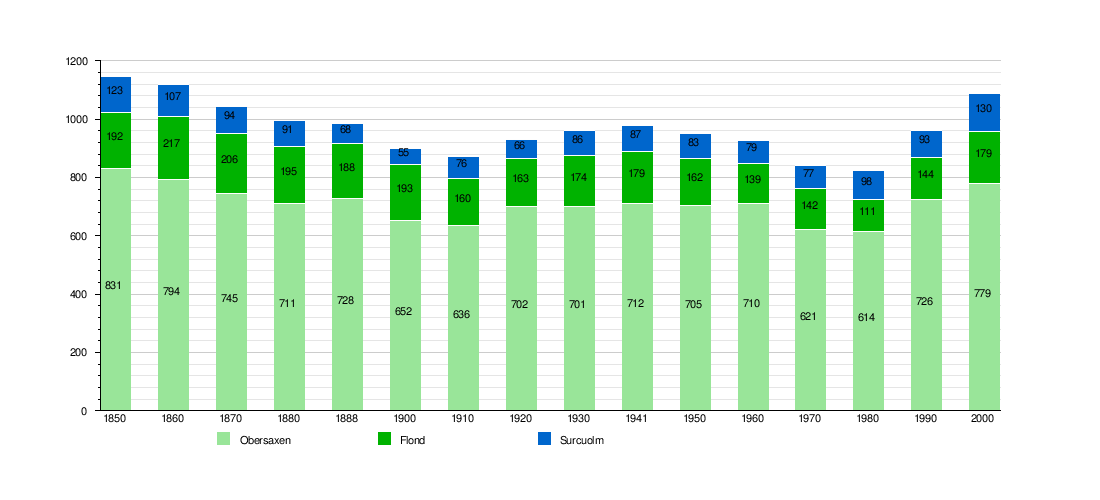
The historical population of Obersaxen and the two former municipalities that made up Mundaun, Flond and Surcuolm, is given in the following chart:[5]
References
- 1 2 Arealstatistik Standard - Gemeindedaten nach 4 Hauptbereichen
- 1 2 Swiss Federal Statistical Office - STAT-TAB, online database – Ständige und nichtständige Wohnbevölkerung nach institutionellen Gliederungen, Geburtsort und Staatsangehörigkeit (German) accessed 30 August 2016
- ↑ Amtliches Gemeindeverzeichnis der Schweiz published by the Swiss Federal Statistical Office (German) accessed 27 April 2016
- ↑ Obersaxen in German, French and Italian in the online Historical Dictionary of Switzerland.
- ↑ Swiss Federal Statistical Office STAT-TAB Bevölkerungsentwicklung nach institutionellen Gliederungen, 1850-2000 (German) accessed 27 April 2016
 |
Wikimedia Commons has media related to Obersaxen Mundaun. |
External links
- Mundaun in German, French and Italian in the online Historical Dictionary of Switzerland.
- Surcuolm in German, French and Italian in the online Historical Dictionary of Switzerland.
- Flond in German, French and Italian in the online Historical Dictionary of Switzerland.
- Obersaxen in German, French and Italian in the online Historical Dictionary of Switzerland.
 | ||