Operation Lifesaver
Operation Lifesaver is the largest rail safety organization in the United States.[1] It was founded by the Union Pacific Railroad in the early 1970s.[2]
In 1972, the Idaho State Highway Patrol, then-Governor Cecil Andrus and the Union Pacific Railroad mounted campaign to promote "Stop, Look and Listen" safety at highway-rail grade crossings. The initial teams spoke to civic groups, school groups, school bus and truck drivers. Idaho experienced a 43% reduction in fatalities that first year.[3]
Operation Lifesaver provides educational material free of charge to schools and civic organizations and they actively recruit and train volunteers to speak on the subject of rail safety.[4]
In 2006, Operation Lifesaver requested that Disney edit a scene of the Pixar film Cars in which the character of Lightning McQueen races a train to a grade crossing while the crossing lights are flashing. Disney/Pixar has removed the scene in question from theater showings but the DVD release of the movie still includes the scene.
On October 14th, 2016, Operation Lifesaver requested via a Facebook post that Hollister Co. remove advertisements from their website showing teenagers walking on railroad tracks. Hollister removed the advertisements five days later, on October 19th, 2016.
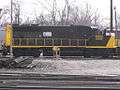 WAMX #4020 with an Operation Lifesaver Kansas sticker.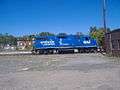
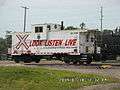 BNSF Manitoba Caboose (BN 12580) with Operation Lifesaver Canada paint scheme.
References
- ↑ "Safety Group Tied to Industry". New York Times. 14 November 2005. Retrieved 19 August 2014.
Operation Lifesaver is the nation's largest and most influential rail-safety group, but documents show that the organization is tightly bound to the railroad industry, and its critics, including many accident victims, say it inoculates railroads against liability in grade-crossing collisions
- ↑ Bogdanich, Walt; Jenny Nordberg (23 January 2005). "Highway Agency Disavows Claims by Rail Safety Group". New York Times. Retrieved 21 August 2014.
Operation Lifesaver, a nonprofit association co-founded three decades ago by Union Pacific, has denied having a pro-railroad agenda.
- ↑ "Statement of Gerri L. Hall, President, Operation Lifesaver, Inc.". Federal Document Clearing House. 29 April 1998. Retrieved 19 August 2014.
- ↑ "About Us | Operation Lifesaver, Inc.". oli.org. Retrieved 2015-06-20.