Optional referendum
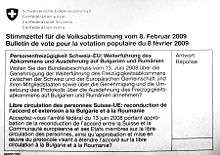
A ballot paper of the votation, organised on 8 February 2009, on the extension of the free movement of persons to Bulgaria and Romania.
.svg.png) |
| This article is part of a series on the politics and government of Switzerland |
|
The optional referendum (German: Fakultatives Referendum; French: Référendum facultatif) is an instrument of direct democracy in Switzerland. It allows citizens to oppose to laws voted by the parliament. A votation will be organised for every law that collected 50,000 valid signatures of opponents.
It is different from the mandatory referendum in that a collection of signatures is necessary to organise the referendum.
History
After pressure of a grass-roots movement, the optional referendum was introduced in 1874.[1]
See also
Bibliography
- Vincent Golay and Mix et Remix, Swiss political institutions, Éditions loisirs et pédagogie, 2008. ISBN 978-2-606-01295-3.
References
- ↑ (French) Horizons, magazine of the Swiss National Science Foundation and the Swiss Academies of Arts and Sciences, no. 99, 2013, p. 45.
External links

This article is issued from Wikipedia - version of the 2/9/2014. The text is available under the Creative Commons Attribution/Share Alike but additional terms may apply for the media files.