Orthant
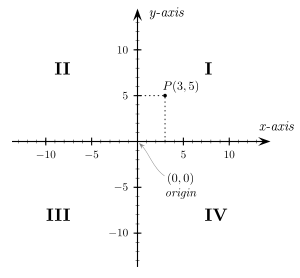
In geometry, an orthant[1] or hyperoctant[2] is the analogue in n-dimensional Euclidean space of a quadrant in the plane or an octant in three dimensions.
In general an orthant in n-dimensions can be considered the intersection of n mutually orthogonal half-spaces. By independent selections of half-space signs, there are 2n orthants in n-dimensional space.
More specifically, a closed orthant in Rn is a subset defined by constraining each Cartesian coordinate to be nonnegative or nonpositive. Such a subset is defined by a system of inequalities:
- ε1x1 ≥ 0 ε2x2 ≥ 0 · · · εnxn ≥ 0,
where each εi is +1 or −1.
Similarly, an open orthant in Rn is a subset defined by a system of strict inequalities
- ε1x1 > 0 ε2x2 > 0 · · · εnxn > 0,
where each εi is +1 or −1.
By dimension:
- In one dimension, an orthant is a ray.
- In two dimensions, an orthant is a quadrant.
- In three dimensions, an orthant is an octant.
John Conway defined the term n-orthoplex from orthant complex as a regular polytope in n-dimensions with 2n simplex facets, one per orthant.[3]
See also
- Cross polytope (or orthoplex) - a family of regular polytopes in n-dimensions which can be constructed with one simplex facets in each orthant space.
- Measure polytope (or hypercube) - a family of regular polytopes in n-dimensions which can be constructed with one vertex in each orthant space.
- Orthotope - Generalization of a rectangle in n-dimensions, with one vertex in each orthant.
Notes
- ↑ Advanced linear algebra By Steven Roman, Chapter 15
- ↑ Weisstein, Eric W. "Hyperoctant". MathWorld.
- ↑ J. H. Conway, N. J. A. Sloane, The Cell Structures of Certain Lattices (1991)
- The facts on file: Geometry handbook, Catherine A. Gorini, 2003, ISBN 0-8160-4875-4, p.113