PAWR
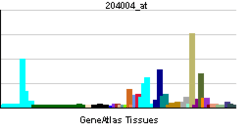
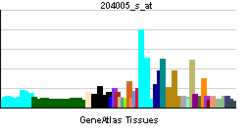
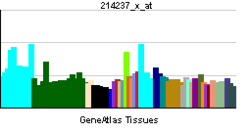
| View/Edit Human | View/Edit Mouse |
PRKC, apoptosis, WT1, regulator, also known as PAWR or Prostate apoptosis response-4 (Par-4), is a human gene coding for a tumor-suppressor protein that induces apoptosis in cancer cells, but not in normal cells.
Function
The tumor suppressor WT1 represses and activates transcription. The protein encoded by this gene is a WT1-interacting protein that itself functions as a transcriptional repressor. It contains a putative leucine zipper domain which interacts with the zinc finger DNA binding domain of WT1. This protein is specifically upregulated during apoptosis of prostate cells.[4] The active domain of the Par-4 protein has been found to confer cancer resistance in transgenic mice without compromising normal viability or aging, and may have therapeutic significance.[5]
Interactions
PAWR has been shown to interact with:
References
- ↑ "Diseases that are genetically associated with PAWR view/edit references on wikidata".
- ↑ "Human PubMed Reference:".
- ↑ "Mouse PubMed Reference:".
- ↑ "Entrez Gene: PAWR PRKC, apoptosis, WT1, regulator".
- ↑ Zhao Y, Burikhanov R, Qiu S, Lele SM, Jennings CD, Bondada S, Spear B, Rangnekar VM (Oct 2007). "Cancer resistance in transgenic mice expressing the SAC module of Par-4". Cancer Research. 67 (19): 9276–85. doi:10.1158/0008-5472.CAN-07-2124. PMID 17909035.
- ↑ Guo Q, Xie J (Feb 2004). "AATF inhibits aberrant production of amyloid beta peptide 1-42 by interacting directly with Par-4". The Journal of Biological Chemistry. 279 (6): 4596–603. doi:10.1074/jbc.M309811200. PMID 14627703.
- ↑ Kawai T, Akira S, Reed JC (Sep 2003). "ZIP kinase triggers apoptosis from nuclear PML oncogenic domains". Molecular and Cellular Biology. 23 (17): 6174–86. doi:10.1128/mcb.23.17.6174-6186.2003. PMC 180930
 . PMID 12917339.
 - ↑ Díaz-Meco MT, Municio MM, Frutos S, Sanchez P, Lozano J, Sanz L, Moscat J (Sep 1996). "The product of par-4, a gene induced during apoptosis, interacts selectively with the atypical isoforms of protein kinase C". Cell. 86 (5): 777–86. doi:10.1016/s0092-8674(00)80152-x. PMID 8797824.
- ↑ Xie J, Guo Q (Jul 2004). "Par-4 inhibits choline uptake by interacting with CHT1 and reducing its incorporation on the plasma membrane". The Journal of Biological Chemistry. 279 (27): 28266–75. doi:10.1074/jbc.M401495200. PMID 15090548.
- ↑ Roussigne M, Cayrol C, Clouaire T, Amalric F, Girard JP (Apr 2003). "THAP1 is a nuclear proapoptotic factor that links prostate-apoptosis-response-4 (Par-4) to PML nuclear bodies". Oncogene. 22 (16): 2432–42. doi:10.1038/sj.onc.1206271. PMID 12717420.
- ↑ Johnstone RW, See RH, Sells SF, Wang J, Muthukkumar S, Englert C, Haber DA, Licht JD, Sugrue SP, Roberts T, Rangnekar VM, Shi Y (Dec 1996). "A novel repressor, par-4, modulates transcription and growth suppression functions of the Wilms' tumor suppressor WT1". Molecular and Cellular Biology. 16 (12): 6945–56. doi:10.1128/mcb.16.12.6945. PMC 231698. PMID 8943350.
Further reading
- El-Guendy N, Rangnekar VM (Feb 2003). "Apoptosis by Par-4 in cancer and neurodegenerative diseases". Experimental Cell Research. 283 (1): 51–66. doi:10.1016/S0014-4827(02)00016-2. PMID 12565819.
- Bieberich E, MacKinnon S, Silva J, Noggle S, Condie BG (Aug 2003). "Regulation of cell death in mitotic neural progenitor cells by asymmetric distribution of prostate apoptosis response 4 (PAR-4) and simultaneous elevation of endogenous ceramide". The Journal of Cell Biology. 162 (3): 469–79. doi:10.1083/jcb.200212067. PMC 2172704. PMID 12885759.
- Gurumurthy S, Rangnekar VM (Feb 2004). "Par-4 inducible apoptosis in prostate cancer cells". Journal of Cellular Biochemistry. 91 (3): 504–12. doi:10.1002/jcb.20000. PMID 14755681.
- Ranganathan P, Rangnekar VM (Nov 2005). "Regulation of cancer cell survival by Par-4". Annals of the New York Academy of Sciences. 1059: 76–85. doi:10.1196/annals.1339.046. PMID 16382046.
- Díaz-Meco MT, Municio MM, Frutos S, Sanchez P, Lozano J, Sanz L, Moscat J (Sep 1996). "The product of par-4, a gene induced during apoptosis, interacts selectively with the atypical isoforms of protein kinase C". Cell. 86 (5): 777–86. doi:10.1016/S0092-8674(00)80152-X. PMID 8797824.
- Bonaldo MF, Lennon G, Soares MB (Sep 1996). "Normalization and subtraction: two approaches to facilitate gene discovery". Genome Research. 6 (9): 791–806. doi:10.1101/gr.6.9.791. PMID 8889548.
- Johnstone RW, See RH, Sells SF, Wang J, Muthukkumar S, Englert C, Haber DA, Licht JD, Sugrue SP, Roberts T, Rangnekar VM, Shi Y (Dec 1996). "A novel repressor, par-4, modulates transcription and growth suppression functions of the Wilms' tumor suppressor WT1". Molecular and Cellular Biology. 16 (12): 6945–56. doi:10.1128/mcb.16.12.6945. PMC 231698. PMID 8943350.
- Guo Q, Fu W, Xie J, Luo H, Sells SF, Geddes JW, Bondada V, Rangnekar VM, Mattson MP (Aug 1998). "Par-4 is a mediator of neuronal degeneration associated with the pathogenesis of Alzheimer disease". Nature Medicine. 4 (8): 957–62. doi:10.1038/nm0898-957. PMID 9701251.
- Johnstone RW, Tommerup N, Hansen C, Vissing H, Shi Y (Oct 1998). "Mapping of the human PAWR (par-4) gene to chromosome 12q21". Genomics. 53 (2): 241–3. doi:10.1006/geno.1998.5494. PMID 9790775.
- Kruman II, Nath A, Maragos WF, Chan SL, Jones M, Rangnekar VM, Jakel RJ, Mattson MP (Jul 1999). "Evidence that Par-4 participates in the pathogenesis of HIV encephalitis". The American Journal of Pathology. 155 (1): 39–46. doi:10.1016/s0002-9440(10)65096-1. PMC 1866661. PMID 10393834.
- Guo Q, Xie J, Chang X, Du H (May 2001). "Prostate apoptosis response-4 enhances secretion of amyloid beta peptide 1-42 in human neuroblastoma IMR-32 cells by a caspase-dependent pathway". The Journal of Biological Chemistry. 276 (19): 16040–4. doi:10.1074/jbc.M010996200. PMID 11278808.
- Chakraborty M, Qiu SG, Vasudevan KM, Rangnekar VM (Oct 2001). "Par-4 drives trafficking and activation of Fas and Fasl to induce prostate cancer cell apoptosis and tumor regression". Cancer Research. 61 (19): 7255–63. PMID 11585763.
- Chang S, Kim JH, Shin J (Jan 2002). "p62 forms a ternary complex with PKCzeta and PAR-4 and antagonizes PAR-4-induced PKCzeta inhibition". FEBS Letters. 510 (1-2): 57–61. doi:10.1016/S0014-5793(01)03224-0. PMID 11755531.
- Ohki R, Yamamoto K, Mano H, Lee RT, Ikeda U, Shimada K (Apr 2002). "Identification of mechanically induced genes in human monocytic cells by DNA microarrays". Journal of Hypertension. 20 (4): 685–91. doi:10.1097/00004872-200204000-00026. PMID 11910304.
- Hsu SC, Kirschenbaum F, Miller J, Cordell B, McCarthy JV (Jul 2002). "Structural and functional characterization of the upstream regulatory region of the human gene encoding prostate apoptosis response factor-4". Gene. 295 (1): 109–16. doi:10.1016/S0378-1119(02)00826-0. PMID 12242017.
- Cheema SK, Mishra SK, Rangnekar VM, Tari AM, Kumar R, Lopez-Berestein G (May 2003). "Par-4 transcriptionally regulates Bcl-2 through a WT1-binding site on the bcl-2 promoter". The Journal of Biological Chemistry. 278 (22): 19995–20005. doi:10.1074/jbc.M205865200. PMID 12644474.
- Boehrer S, Chow KU, Ruthardt M, Hoelzer D, Mitrou PS, Weidmann E (Sep 2002). "Expression and function of prostate-apoptosis-response-gene-4 in lymphatic cells". Leukemia & Lymphoma. 43 (9): 1737–41. doi:10.1080/1042819021000006510. PMID 12685825.
- Roussigne M, Cayrol C, Clouaire T, Amalric F, Girard JP (Apr 2003). "THAP1 is a nuclear proapoptotic factor that links prostate-apoptosis-response-4 (Par-4) to PML nuclear bodies". Oncogene. 22 (16): 2432–42. doi:10.1038/sj.onc.1206271. PMID 12717420.
- El-Guendy N, Zhao Y, Gurumurthy S, Burikhanov R, Rangnekar VM (Aug 2003). "Identification of a unique core domain of par-4 sufficient for selective apoptosis induction in cancer cells". Molecular and Cellular Biology. 23 (16): 5516–25. doi:10.1128/MCB.23.16.5516-5525.2003. PMC 166354. PMID 12897127.