PKN2
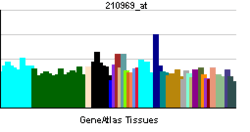
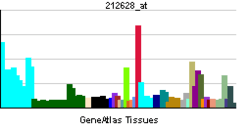
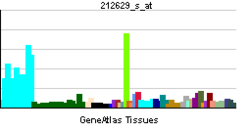
| View/Edit Human | View/Edit Mouse |
Serine/threonine-protein kinase N2 is an enzyme that in humans is encoded by the PKN2 gene.[4][5][6]
Interactions
PKN2 has been shown to interact with:
Further reading
- Quilliam LA, Lambert QT, Mickelson-Young LA, Westwick JK, Sparks AB, Kay BK, Jenkins NA, Gilbert DJ, Copeland NG, Der CJ (1997). "Isolation of a NCK-associated kinase, PRK2, an SH3-binding protein and potential effector of Rho protein signaling". J. Biol. Chem. 271 (46): 28772–28776. doi:10.1074/jbc.271.46.28772. PMID 8910519.
- Yu W, Liu J, Morrice NA, Wettenhall RE (1997). "Isolation and characterization of a structural homologue of human PRK2 from rat liver. Distinguishing substrate and lipid activator specificities". J. Biol. Chem. 272 (15): 10030–10034. doi:10.1074/jbc.272.15.10030. PMID 9092545.
- Vincent S, Settleman J (1997). "The PRK2 kinase is a potential effector target of both Rho and Rac GTPases and regulates actin cytoskeletal organization". Mol. Cell. Biol. 17 (4): 2247–56. PMC 232074
 . PMID 9121475.
 - Cryns VL, Byun Y, Rana A, Mellor H, Lustig KD, Ghanem L, Parker PJ, Kirschner MW, Yuan J (1997). "Specific proteolysis of the kinase protein kinase C-related kinase 2 by caspase-3 during apoptosis. Identification by a novel, small pool expression cloning strategy". J. Biol. Chem. 272 (47): 29449–29453. doi:10.1074/jbc.272.47.29449. PMID 9368003.
- Braverman LE, Quilliam LA (1999). "Identification of Grb4/Nckbeta, a src homology 2 and 3 domain-containing adapter protein having similar binding and biological properties to Nck". J. Biol. Chem. 274 (9): 5542–5549. doi:10.1074/jbc.274.9.5542. PMID 10026169.
- Flynn P, Mellor H, Casamassima A, Parker PJ (2000). "Rho GTPase control of protein kinase C-related protein kinase activation by 3-phosphoinositide-dependent protein kinase". J. Biol. Chem. 275 (15): 11064–11070. doi:10.1074/jbc.275.15.11064. PMID 10753910.
- Sun W, Vincent S, Settleman J, Johnson GL (2000). "MEK kinase 2 binds and activates protein kinase C-related kinase 2. Bifurcation of kinase regulatory pathways at the level of an MAPK kinase kinase". J. Biol. Chem. 275 (32): 24421–24428. doi:10.1074/jbc.M003148200. PMID 10818102.
- Koh H, Lee KH, Kim D, Kim S, Kim JW, Chung J (2000). "Inhibition of Akt and its anti-apoptotic activities by tumor necrosis factor-induced protein kinase C-related kinase 2 (PRK2) cleavage". J. Biol. Chem. 275 (44): 34451–34458. doi:10.1074/jbc.M001753200. PMID 10926925.
- Gross C, Heumann R, Erdmann KS (2001). "The protein kinase C-related kinase PRK2 interacts with the protein tyrosine phosphatase PTP-BL via a novel PDZ domain binding motif". FEBS Lett. 496 (2–3): 101–104. doi:10.1016/S0014-5793(01)02401-2. PMID 11356191.
- Hodgkinson CP, Sale GJ (2002). "Regulation of both PDK1 and the phosphorylation of PKC-zeta and -delta by a C-terminal PRK2 fragment". Biochemistry. 41 (2): 561–569. doi:10.1021/bi010719z. PMID 11781095.
- McDonald C, Vacratsis PO, Bliska JB, Dixon JE (2003). "The yersinia virulence factor YopM forms a novel protein complex with two cellular kinases". J. Biol. Chem. 278 (20): 18514–18523. doi:10.1074/jbc.M301226200. PMID 12626518.
- Anderson NL, Polanski M, Pieper R, Gatlin T, Tirumalai RS, Conrads TP, Veenstra TD, Adkins JN, Pounds JG, Fagan R, Lobley A (2004). "The human plasma proteome: a nonredundant list developed by combination of four separate sources". Mol. Cell Proteomics. 3 (4): 311–326. doi:10.1074/mcp.M300127-MCP200. PMID 14718574.
- Beausoleil SA, Jedrychowski M, Schwartz D, Elias JE, Villén J, Li J, Cohn MA, Cantley LC, Gygi SP (2004). "Large-scale characterization of HeLa cell nuclear phosphoproteins". Proc. Natl. Acad. Sci. U.S.A. 101 (33): 12130–12135. doi:10.1073/pnas.0404720101. PMC 514446. PMID 15302935.
- Yarrow JC, Totsukawa G, Charras GT, Mitchison TJ (2005). "Screening for cell migration inhibitors via automated microscopy reveals a Rho-kinase inhibitor". Chem. Biol. 12 (3): 385–395. doi:10.1016/j.chembiol.2005.01.015. PMID 15797222.
- DeGiorgis JA, Jaffe H, Moreira JE, Carlotti CG, Leite JP, Pant HC, Dosemeci A (2005). "Phosphoproteomic analysis of synaptosomes from human cerebral cortex". J. Proteome Res. 4 (2): 306–315. doi:10.1021/pr0498436. PMID 15822905.
- Kimura K, Wakamatsu A, Suzuki Y, Ota T, Nishikawa T, Yamashita R, Yamamoto J, Sekine M, Tsuritani K, Wakaguri H, Ishii S, Sugiyama T, Saito K, Isono Y, Irie R, Kushida N, Yoneyama T, Otsuka R, Kanda K, Yokoi T, Kondo H, Wagatsuma M, Murakawa K, Ishida S, Ishibashi T, Takahashi-Fujii A, Tanase T, Nagai K, Kikuchi H, Nakai K, Isogai T, Sugano S (2006). "Diversification of transcriptional modulation: large-scale identification and characterization of putative alternative promoters of human genes". Genome Res. 16 (1): 55–65. doi:10.1101/gr.4039406. PMC 1356129. PMID 16344560.
References
- ↑ "Drugs that physically interact with Serine/threonine-protein kinase N2 view/edit references on wikidata".
- ↑ "Human PubMed Reference:".
- ↑ "Mouse PubMed Reference:".
- ↑ Palmer RH, Ridden J, Parker PJ (January 1995). "Identification of multiple, novel, protein kinase C-related gene products". FEBS Lett. 356 (1): 5–8. doi:10.1016/0014-5793(94)01202-4. PMID 7988719.
- ↑ Palmer RH, Ridden J, Parker PJ (March 1995). "Cloning and expression patterns of two members of a novel protein-kinase-C-related kinase family". Eur J Biochem. 227 (1–2): 344–351. doi:10.1111/j.1432-1033.1995.tb20395.x. PMID 7851406.
- ↑ "Entrez Gene: PKN2 protein kinase N2".
- ↑ Koh H, Lee KH, Kim D, Kim S, Kim JW, Chung J (November 2000). "Inhibition of Akt and its anti-apoptotic activities by tumor necrosis factor-induced protein kinase C-related kinase 2 (PRK2) cleavage". J. Biol. Chem. 275 (44): 34451–8. doi:10.1074/jbc.M001753200. PMID 10926925.
- 1 2 Quilliam LA, Lambert QT, Mickelson-Young LA, Westwick JK, Sparks AB, Kay BK, Jenkins NA, Gilbert DJ, Copeland NG, Der CJ (November 1996). "Isolation of a NCK-associated kinase, PRK2, an SH3-binding protein and potential effector of Rho protein signaling". J. Biol. Chem. 271 (46): 28772–6. doi:10.1074/jbc.271.46.28772. PMID 8910519.
- ↑ Braverman LE, Quilliam LA (February 1999). "Identification of Grb4/Nckbeta, a src homology 2 and 3 domain-containing adapter protein having similar binding and biological properties to Nck". J. Biol. Chem. 274 (9): 5542–9. doi:10.1074/jbc.274.9.5542. PMID 10026169.
- ↑ Gross C, Heumann R, Erdmann KS (May 2001). "The protein kinase C-related kinase PRK2 interacts with the protein tyrosine phosphatase PTP-BL via a novel PDZ domain binding motif". FEBS Lett. 496 (2-3): 101–4. doi:10.1016/s0014-5793(01)02401-2. PMID 11356191.
- ↑ Hodgkinson CP, Sale GJ (January 2002). "Regulation of both PDK1 and the phosphorylation of PKC-zeta and -delta by a C-terminal PRK2 fragment". Biochemistry. 41 (2): 561–9. doi:10.1021/bi010719z. PMID 11781095.
- ↑ Balendran A, Biondi RM, Cheung PC, Casamayor A, Deak M, Alessi DR (July 2000). "A 3-phosphoinositide-dependent protein kinase-1 (PDK1) docking site is required for the phosphorylation of protein kinase Czeta (PKCzeta ) and PKC-related kinase 2 by PDK1". J. Biol. Chem. 275 (27): 20806–13. doi:10.1074/jbc.M000421200. PMID 10764742.
- ↑ Flynn P, Mellor H, Palmer R, Panayotou G, Parker PJ (January 1998). "Multiple interactions of PRK1 with RhoA. Functional assignment of the Hr1 repeat motif". J. Biol. Chem. 273 (5): 2698–705. doi:10.1074/jbc.273.5.2698. PMID 9446575.
This article is issued from Wikipedia - version of the 5/20/2016. The text is available under the Creative Commons Attribution/Share Alike but additional terms may apply for the media files.