PRESS statistic
In statistics, the predicted residual error sum of squares (PRESS) statistic is a form of cross-validation used in regression analysis to provide a summary measure of the fit of a model to a sample of observations that were not themselves used to estimate the model. It is calculated as the sums of squares of the prediction residuals for those observations.[1][2][3]
A fitted model having been produced, each observation in turn is removed and the model is refitted using the remaining observations. The out-of-sample predicted value is calculated for the omitted observation in each case, and the PRESS statistic is calculated as the sum of the squares of all the resulting prediction errors:[4]
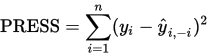
Given this procedure, the PRESS statistic can be calculated for a number of candidate model structures for the same dataset, with the lowest values of PRESS indicating the best structures. Models that are over-parameterised (over-fitted) would tend to give small residuals for observations included in the model-fitting but large residuals for observations that are excluded.
See also
References
- ↑ "Statsoft Electronic Statistics Textbook - Statistics Glossary". Retrieved May 2016. Check date values in:
|access-date=(help) - ↑ Allen, D. M. (1974), "The Relationship Between Variable Selection and Data Augmentation and a Method for Prediction," Technometrics, 16, 125–127
- ↑ Tarpey, Thaddeus (2000) "A Note on the Prediction Sum of Squares Statistic for Restricted Least Squares", The American Statistician, Vol. 54, No. 2, May, pp. 116–118
- ↑ "R Graphical Manual:Allen's PRESS (Prediction Sum-Of-Squares) statistic, aka P-square". Retrieved August 2012. Check date values in:
|access-date=(help)