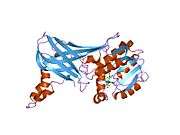
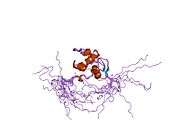
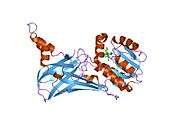
PRMT3
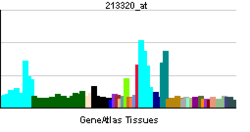
| View/Edit Human | View/Edit Mouse |
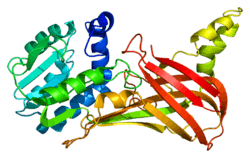
Protein arginine N-methyltransferase 3 is an enzyme that in humans is encoded by the PRMT3 gene.[3][4]
Model organisms
| Characteristic | Phenotype |
|---|---|
| Homozygote viability | Abnormal |
| Recessive lethal study | Normal |
| Fertility | Normal |
| General Observations | Abnormal |
| Body weight | Abnormal[5] |
| Anxiety | Normal |
| Neurological assessment | Normal |
| Grip strength | Normal |
| Hot plate | Normal |
| Dysmorphology | Normal |
| Indirect calorimetry | Abnormal[6] |
| Glucose tolerance test | Normal |
| Auditory brainstem response | Normal |
| DEXA | Abnormal[7] |
| Radiography | Normal |
| Body temperature | Normal |
| Eye morphology | Abnormal[8] |
| Clinical chemistry | Normal |
| Haematology | Normal |
| Peripheral blood lymphocytes | Abnormal |
| Micronucleus test | Normal |
| Heart weight | Normal |
| Skin Histopathology | Normal |
| Brain histopathology | Normal |
| Eye Histopathology | Normal |
| Salmonella infection | Normal[9] |
| Citrobacter infection | Normal[10] |
| All tests and analysis from[11][12] |
Model organisms have been used in the study of PRMT3 function. A conditional knockout mouse line, called Prmt3tm1a(EUCOMM)Wtsi[13][14] was generated as part of the International Knockout Mouse Consortium program — a high-throughput mutagenesis project to generate and distribute animal models of disease to interested scientists.[15][16][17]
Male and female animals underwent a standardized phenotypic screen to determine the effects of deletion.[11][18] Twenty seven tests were carried out on mutant mice and seven significant abnormalities were observed.[11] Fewer than predicted homozygous mutant mice survived until weaning due to hydrocephaly. The remaining tests were carried out on both heterozygous and homozygous mutant adult mice. Male heterzygous mice had a decreased respiratory quotient. Homozygous females had decreased body weight, length and bone mineral density. Homozygous males had abnormal peripheral blood lymphocyte counts and homozygotes of both sex had eye abnormalities.[11]
Interactions
PRMT3 has been shown to interact with RPS2.[19]
References
- ↑ "Human PubMed Reference:".
- ↑ "Mouse PubMed Reference:".
- ↑ Tang J, Gary JD, Clarke S, Herschman HR (Aug 1998). "PRMT 3, a type I protein arginine N-methyltransferase that differs from PRMT1 in its oligomerization, subcellular localization, substrate specificity, and regulation". J Biol Chem. 273 (27): 16935–45. doi:10.1074/jbc.273.27.16935. PMID 9642256.
- ↑ "Entrez Gene: PRMT3 protein arginine methyltransferase 3".
- ↑ "Body weight data for Prmt3". Wellcome Trust Sanger Institute.
- ↑ "Indirect calorimetry data for Prmt3". Wellcome Trust Sanger Institute.
- ↑ "DEXA data for Prmt3". Wellcome Trust Sanger Institute.
- ↑ "Eye morphology data for Prmt3". Wellcome Trust Sanger Institute.
- ↑ "Salmonella infection data for Prmt3". Wellcome Trust Sanger Institute.
- ↑ "Citrobacter infection data for Prmt3". Wellcome Trust Sanger Institute.
- 1 2 3 4 Gerdin AK (2010). "The Sanger Mouse Genetics Programme: High throughput characterisation of knockout mice". Acta Ophthalmologica. 88: 925–7. doi:10.1111/j.1755-3768.2010.4142.x.
- ↑ Mouse Resources Portal, Wellcome Trust Sanger Institute.
- ↑ "International Knockout Mouse Consortium".
- ↑ "Mouse Genome Informatics".
- ↑ Skarnes, W. C.; Rosen, B.; West, A. P.; Koutsourakis, M.; Bushell, W.; Iyer, V.; Mujica, A. O.; Thomas, M.; Harrow, J.; Cox, T.; Jackson, D.; Severin, J.; Biggs, P.; Fu, J.; Nefedov, M.; De Jong, P. J.; Stewart, A. F.; Bradley, A. (2011). "A conditional knockout resource for the genome-wide study of mouse gene function". Nature. 474 (7351): 337–342. doi:10.1038/nature10163. PMC 3572410
 . PMID 21677750.
 - ↑ Dolgin E (2011). "Mouse library set to be knockout". Nature. 474 (7351): 262–3. doi:10.1038/474262a. PMID 21677718.
- ↑ Collins FS, Rossant J, Wurst W (2007). "A Mouse for All Reasons". Cell. 128 (1): 9–13. doi:10.1016/j.cell.2006.12.018. PMID 17218247.
- ↑ van der Weyden L, White JK, Adams DJ, Logan DW (2011). "The mouse genetics toolkit: revealing function and mechanism.". Genome Biol. 12 (6): 224. doi:10.1186/gb-2011-12-6-224. PMC 3218837. PMID 21722353.
- ↑ Choi, Seeyoung; Jung Cho-Rok; Kim Jin-Young; Im Dong-Soo (Sep 2008). "PRMT3 inhibits ubiquitination of ribosomal protein S2 and together forms an active enzyme complex". Biochim. Biophys. Acta. Netherlands. 1780 (9): 1062–9. doi:10.1016/j.bbagen.2008.05.010. ISSN 0006-3002. PMID 18573314.
Further reading
- Gerhard DS, Wagner L, Feingold EA, et al. (2004). "The Status, Quality, and Expansion of the NIH Full-Length cDNA Project: The Mammalian Gene Collection (MGC)". Genome Res. 14 (10B): 2121–7. doi:10.1101/gr.2596504. PMC 528928. PMID 15489334.
- Singh V, Miranda TB, Jiang W, et al. (2004). "DAL-1/4.1B tumor suppressor interacts with protein arginine N-methyltransferase 3 (PRMT3) and inhibits its ability to methylate substrates in vitro and in vivo". Oncogene. 23 (47): 7761–71. doi:10.1038/sj.onc.1208057. PMID 15334060.
- Bachand F, Silver PA (2005). "PRMT3 is a ribosomal protein methyltransferase that affects the cellular levels of ribosomal subunits". EMBO J. 23 (13): 2641–50. doi:10.1038/sj.emboj.7600265. PMC 449775. PMID 15175657.
- Ota T, Suzuki Y, Nishikawa T, et al. (2004). "Complete sequencing and characterization of 21,243 full-length human cDNAs". Nat. Genet. 36 (1): 40–5. doi:10.1038/ng1285. PMID 14702039.
- Strausberg RL, Feingold EA, Grouse LH, et al. (2003). "Generation and initial analysis of more than 15,000 full-length human and mouse cDNA sequences". Proc. Natl. Acad. Sci. U.S.A. 99 (26): 16899–903. doi:10.1073/pnas.242603899. PMC 139241. PMID 12477932.
- Smith JJ, Rücknagel KP, Schierhorn A, et al. (1999). "Unusual sites of arginine methylation in Poly(A)-binding protein II and in vitro methylation by protein arginine methyltransferases PRMT1 and PRMT3". J. Biol. Chem. 274 (19): 13229–34. doi:10.1074/jbc.274.19.13229. PMID 10224081.
External links
- PRMT3 human gene location in the UCSC Genome Browser.
- PRMT3 human gene details in the UCSC Genome Browser.
PDB gallery | ||||||||
|---|---|---|---|---|---|---|---|---|
| ||||||||