Clinotarsus alticola
| Clinotarsus alticola | |
|---|---|
 | |
Scientific classification  | |
| Kingdom: | Animalia |
| Phylum: | Chordata |
| Class: | Amphibia |
| Order: | Anura |
| Family: | Ranidae |
| Genus: | Clinotarsus |
| Species: | C. alticola |
| Binomial name | |
| Clinotarsus alticola (Boulenger, 1882) | |
| Synonyms | |
| |
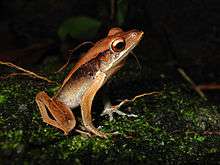
Clinotarsus alticola[2][3] is a species of frog in the Ranidae family. Common names for this species include: Assam Hills frog, Annandale's frog, pointed-headed frog, palebrown stream frog, hill frog, point-nosed frog, and high-altitude frog. It is found in northeastern India, Bangladesh, Myanmar, northern Peninsular Thailand, and possibly in Bhutan and possibly Nepal.[4]
Habitat
Clinotarsus alticola inhabit evergreen forests near large streams (the habitat for their tadpoles) in hill areas, usually near waterfalls.[1]
Description
Clinotarsus alticola are sexually dimorphic: males are 32–47 mm (1.3–1.9 in) in snout–vent length and females 43–61 mm (1.7–2.4 in). The advertisement call of males is a bird-like "chirp". In breeding sites, males greatly outnumber females and attempt to dislodge one another from the backs of females. Outside the breeding season adult Clinotarsus alticola are rarely encountered.[5]
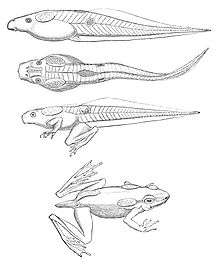
The tadpoles of Clinotarsus alticola are distinctive: they are large (up to 98 mm (3.9 in) in length), have many glands, and are black in colouration with red ocelli. The caudal ocellus is a unique feature among ranid tadpoles. Its colouration may be aposematic.[6]
References
 |
Wikispecies has information related to: Clinotarsus alticola |
 |
Wikimedia Commons has media related to Clinotarsus alticola. |
- 1 2 van Dijk, P.P., Ohler, A., Dutta, S., Bordoloi, S., Sarker, S.U. & Borah, M.M. 2004. Clinotarsus alticola. 2013.2 IUCN Red List of Threatened Species. Archived June 27, 2014, at the Wayback Machine. Downloaded on 16 January 2014.
- ↑ "Catalogue of Life". Retrieved March 27, 2012.
- ↑ "Encyclopedia of Life". Retrieved March 27, 2012.
- ↑ Frost, Darrel R. (2014). "Clinotarsus alticola (Boulenger, 1882)". Amphibian Species of the World: an Online Reference. Version 6.0. American Museum of Natural History. Retrieved 4 May 2014.
- ↑ Sailo, S. (2010). Studies on the ecology and biology of Rana alticola Boulenger (PhD thesis). Shillong: North-Eastern Hill University. p. 196.
- ↑ Grosjean, S, M Perez, A Ohler (2003). "Morphology and buccopharyngeal anatomy of the tadpole of Rana (Nasirana) alticola (Anura: Ranidae)" (PDF). Raffles Bulletin of Zoology. 51 (1): 101–107.