Parapuzosia seppenradensis
| Parapuzosia seppenradensis Temporal range: Late Cretaceous | |
|---|---|
 | |
Scientific classification  | |
| Kingdom: | Animalia |
| Phylum: | Mollusca |
| Class: | Cephalopoda |
| Subclass: | †Ammonoidea |
| Family: | †Desmoceratidae |
| Genus: | †Parapuzosia |
| Species: | †P. seppenradensis |
| Binomial name | |
| Parapuzosia seppenradensis (Landois, 1895) | |
| Synonyms | |
| |
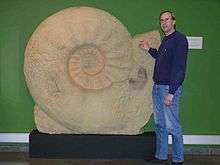
Parapuzosia seppenradensis is the largest known species of ammonite.[1] It lived during the Late Cretaceous period. A specimen found in Germany in 1895 measures 1.8 m (5.9 ft) in diameter, although the living chamber is incomplete. It is estimated that if complete, this specimen would have had a diameter of approximately 2.55 m (8.4 ft)[2] or even 3.5 m (11 ft).[3] The total live mass has been estimated at 1,455 kg (3,208 lb), of which the shell would constitute 705 kg (1,554 lb).[3]
See also
 |
Wikimedia Commons has media related to Parapuzosia. |
References
- ↑ Payne, J.L., A.G. Boyer, J.H. Brown, S. Finnegan, M. Kowalewski, R.A. Krause, Jr., S.K. Lyons, C.R. McClain, D.W. McShea, P.M. Novack-Gottshall, F.A. Smith, J.A. Stempien & S.C. Wang 2009. Two-phase increase in the maximum size of life over 3.5 billion years reflects biological innovation and environmental opportunity. PNAS 106(1): 24–27. doi:10.1073/pnas.0806314106
- ↑ (German) Landois, H. 1895. Die Riesenammoniten von Seppenrade, Pachydiscus Zittel Seppenradensis H. Landois. Jahresbericht des Westfälischen Provinzial-Vereins für Wissenschaft und Kunst 23: 99–108.
- 1 2 Teichert, C. & B. Kummel 1960. Size of endoceroid cephalopods. Breviora Museum of Comparative Zoology 128: 1–7.
- (German) Kennedy, W.J. & U. Kaplan 1995. Parapuzosia (Parapuzosia) seppenradensis (Landois) und die Ammonitenfauna der Dülmener Schichten, unteres Unter-Campan, Westfalen. Geologie und Paläontologie in Westfalen 33: 1–127.
This article is issued from Wikipedia - version of the 10/24/2016. The text is available under the Creative Commons Attribution/Share Alike but additional terms may apply for the media files.