Particular values of the Gamma function
The gamma function is an important special function in mathematics. Its particular values can be expressed in closed form for integer and half-integer arguments, but no simple expressions are known for the values at rational points in general. Other fractional arguments can be approximated through efficient infinite products, infinite series, and recurrence relations.
Integers and half-integers
For positive integer arguments, the gamma function coincides with the factorial, that is,

and hence

For non-positive integers, the gamma function is not defined.
For positive half-integers, the function values are given exactly by
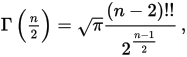
or equivalently, for non-negative integer values of n:
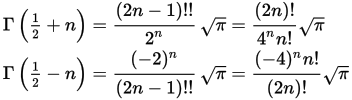
where n!! denotes the double factorial. In particular,












and by means of the reflection formula,









General rational arguments
In analogy with the half-integer formula,
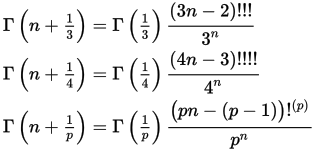
where n!(p) denotes the pth multifactorial of n. Numerically,






It is unknown whether these constants are transcendental in general, but Γ(1/3) and Γ(1/4) were shown to be transcendental by G. V. Chudnovsky. Γ(1/4) / 4√π has also long been known to be transcendental, and Yuri Nesterenko proved in 1996 that Γ(1/4), π, and eπ are algebraically independent.
The number Γ(1/4) is related to the lemniscate constant S by
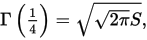
and it has been conjectured by Gramain that
![{\displaystyle \Gamma \left({\tfrac {1}{4}}\right)={\sqrt[{4}]{4\pi ^{3}e^{2\gamma -\mathrm {\delta } +1}}}}](../I/m/ef102369b292beda82513a94c04e130e7dc232d3.svg)
where δ is the Masser–Gramain constant  A086058, although numerical work by Melquiond et al. indicates that this conjecture is false.[1]
Borwein and Zucker have found that Γ(n/24) can be expressed algebraically in terms of π, K(k(1)), K(k(2)), K(k(3)), and K(k(6)) where K(k(N)) is a complete elliptic integral of the first kind. This permits efficiently approximating the gamma function of rational arguments to high precision using quadratically convergent arithmetic-geometric mean iterations. No similar relations are known for Γ(1/5) or other denominators.
In particular, Γ(1/4) is given by
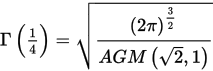
and Γ(1/6) is given by[2]
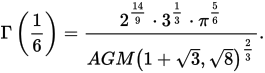
Other formulas include the infinite products
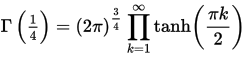
and

where A is the Glaisher-Kinkelin constant and G is Catalan's constant.
C. H. Brown derived rapidly converging infinite series for particular values of the gamma function:[3]

where,
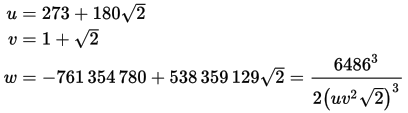
equivalently,
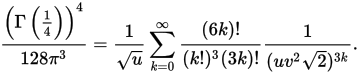
The following two representations for Γ(3/4) were given by I. Mező[4]

and
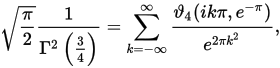
where ϑ1 and ϑ4 are two of the Jacobi theta functions.
Products
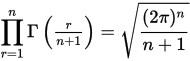
Some product identities include:






In general:
![{\displaystyle {\frac {\Gamma \left({\tfrac {1}{5}}\right)\Gamma \left({\tfrac {4}{15}}\right)}{\Gamma \left({\tfrac {1}{3}}\right)\Gamma \left({\tfrac {2}{15}}\right)}}={\frac {{\sqrt {2}}\,{\sqrt[{20}]{3}}}{{\sqrt[{6}]{5}}\,{\sqrt[{4}]{5-{\frac {7}{\sqrt {5}}}+{\sqrt {6-{\frac {6}{\sqrt {5}}}}}}}}}}](../I/m/52126d10bd265fbb9ae02f4e9cffc76aa64e1b1f.svg)
![{\displaystyle {\frac {\Gamma \left({\tfrac {1}{20}}\right)\Gamma \left({\tfrac {9}{20}}\right)}{\Gamma \left({\tfrac {3}{20}}\right)\Gamma \left({\tfrac {7}{20}}\right)}}={\frac {{\sqrt[{4}]{5}}\left(1+{\sqrt {5}}\right)}{2}}}](../I/m/a95dbe748f7508e191d98bce8099ddfaedecf243.svg)
Imaginary and complex arguments
The gamma function on the imaginary unit i = √−1 returns A212877, A212878:

It may also be given in terms of the Barnes G-function:

The gamma function with complex arguments returns






Other constants
The gamma function has a local minimum on the positive real axis

with the value

Integrating the reciprocal gamma function along the positive real axis also gives the Fransén–Robinson constant.
On the negative real axis, the first local maxima and minima (zeros of the digamma function) are:
| x | Γ(x) | OEIS |
|---|---|---|
| −0.5040830082644554092582693045 | −3.5446436111550050891219639933 | A175472 |
| −1.5734984731623904587782860437 | 2.3024072583396801358235820396 | A175473 |
| −2.6107208684441446500015377157 | −0.8881363584012419200955280294 | A175474 |
| −3.6352933664369010978391815669 | 0.2451275398343662504382300889 | A256681 |
| −4.6532377617431424417145981511 | −0.0527796395873194007604835708 | A256682 |
| −5.6671624415568855358494741745 | 0.0093245944826148505217119238 | A256683 |
| −6.6784182130734267428298558886 | −0.0013973966089497673013074887 | A256684 |
| −7.6877883250316260374400988918 | 0.0001818784449094041881014174 | A256685 |
| −8.6957641638164012664887761608 | −0.0000209252904465266687536973 | A256686 |
| −9.7026725400018637360844267649 | 0.0000021574161045228505405031 | A256687 |
See also
References
- ↑ Melquiond, Guillaume; Nowak, W. Georg; Zimmermann, Paul (2013). "Numerical approximation of the Masser–Gramain constant to four decimal places". Math. Comp. 82: 1235–1246. doi:10.1090/S0025-5718-2012-02635-4.
- ↑
- ↑ Cetin Hakimgolu-Brown : iamned.com math page
- ↑ Mező, István (2013), "Duplication formulae involving Jacobi theta functions and Gosper's q-trigonometric functions", Proceedings of the American Mathematical Society, 141 (7): 2401–2410, doi:10.1090/s0002-9939-2013-11576-5
- ↑ Raimundas Vidūnas, Expressions for Values of the Gamma Function
- ↑ Weisstein, Eric W. "Gamma Function". MathWorld.
- Gramain, F. (1981). "Sur le théorème de Fukagawa-Gel'fond". Invent. Math. 63 (3): 495–506. doi:10.1007/BF01389066.
- Borwein, J. M.; Zucker, I. J. (1992). "Fast Evaluation of the Gamma Function for Small Rational Fractions Using Complete Elliptic Integrals of the First Kind". IMA J. Numerical Analysis. 12 (4): 519–526. doi:10.1093/imanum/12.4.519. MR 1186733.
- X. Gourdon & P. Sebah. Introduction to the Gamma Function
- S. Finch. Euler Gamma Function Constants
- Weisstein, Eric W. "Gamma Function". MathWorld.
- Vidunas, Raimundas. "Expressions for values of the gamma function". arXiv:math.CA/0403510
 .
. - Vidunas, Raimundas (2005). "Expressions for values of the gamma function". Kyushu J. Math. 59 (2): 267–283. doi:10.2206/kyushujm.59.267. MR 2188592.
- Adamchik, V. S. (2005). "Multiple Gamma Function and Its Application to Computation of Series" (PDF). The Ramanujan Journal. 9 (3): 271–288. doi:10.1007/s11139-005-1868-3. MR 2173489.
- Duke, W.; Imamoglu, Ö. (2006). "Special values of multiple gamma functions" (PDF). J. Theor. Nombres Bordeaux. 18 (1): 113–123. doi:10.5802/jtnb.536. MR 2245878.