Pashayi people
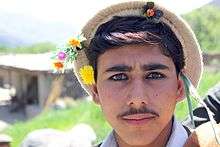 Pashai boy with flower hat | |
| Total population | |
|---|---|
| (Approx. 500,000[1]) | |
| Regions with significant populations | |
| Laghman, Kapisa and Nangarhar | |
| Languages | |
|
Pashai language Pashto also spoken as second language[1] | |
| Religion | |
| Islam | |
| Related ethnic groups | |
| Pashtuns, Kalash, Nuristani and Kashmiris |
Pashayi or Pashai (Persian: مردم پشهای) are a Dardic ethno-linguistic group living primarily in eastern Afghanistan. Their total population is estimated to be 500,000.[1] They are mainly concentrated in the northern parts of Laghman, Nangarhar, Kunar, Kapisa, Kabul, Baghlan, Nuristan, and also in Ghazni. Some believe the Pashai are descendants of ancient Gāndhārī.[2][3] Many Pashai consider themselves Pashtuns speaking a special language,[4] and many are bilingual in Pashto.[1] Pashai communities can also be found in the Chitral district of northwestern Pakistan. The majority of Pashai are Sunni Muslims and are often referred to as Kohistani,[4] while a minority are Nizari Ismaili Muslims.
| “ | Pashae, or Pashie or ("Padshahi") are attributive plural forms, meaning of the ("Kingdom" Padshahi"'). The Pashai are still found by that name in the Bamian and Lughman districts in the southern valleys[5] | ” |
Notable individuals
- Northern Alliance commander Hazrat Ali
See also
References
- 1 2 3 4 http://www.sil.org/asia/ldc/parallel_papers/ju-hong_yun.pdf
- ↑ Pashai. Everyculture.com. Retrieved on 2013-07-12.
- ↑ M. Longworth Dames; G. Morgenstierne & R. Ghirshman (1999). "AFGHĀNISTĀN". Encyclopaedia of Islam (CD-ROM Edition v. 1.0 ed.). Leiden, The Netherlands: Koninklijke Brill NV.
- 1 2 Pashai, Ethnic identity in Afghanistan, on nps.edu
- ↑ Henry Walter Bellew An Inquiry into the Ethnography of Afghanistan; p. 143
External links
 Media related to Pashai people at Wikimedia Commons
| Ethnic groups | |
|---|---|
| Foreign nationals | |