Pedal equation
For a plane curve C and a given fixed point O, the pedal equation of the curve is a relation between r and p where r is the distance from O to a point on C and p is the perpendicular distance from O to the tangent line to C at the point. The point O is called the pedal point and the values r and p are sometimes called the pedal coordinates of a point relative to the curve and the pedal point. Some curves have particularly simple pedal equations and knowing the pedal equation of a curve may simplify the calculation of certain of its properties such as curvature.
Equations
Cartesian coordinates
For C given in rectangular coordinates by f(x, y) = 0, and with O taken to be the origin, the pedal coordinates of the point (x, y) are given by:[1]
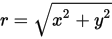
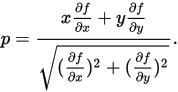
The pedal equation can be found by eliminating x and y from these equations and the equation of the curve.
The expression for p may be simplified if the equation of the curve is written in homogeneous coordinates by introducing a variable z, so that the equation of the curve is g(x, y, z) = 0. The value of p is then given by[2]
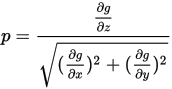
where the result is evaluated at z=1
Polar coordinates
For C given in polar coordinates by r = f(θ), then

where ψ is the polar tangential angle given by
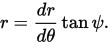
The pedal equation can be found by eliminating θ from these equations.[3]
Pedal equations for specific curves
Sinusoidal spirals
For a sinusoidal spiral written in the form

the polar tangential angle is

which produces the pedal equation

The pedal equation for a number of familiar curves can be obtained setting n to specific values:[4]
| n | Curve | Pedal point | Pedal eq. |
|---|---|---|---|
| 1 | Circle with radius a | Point on circumference | pa = r2 |
| −1 | Line | Point distance a from line | p = a |
| 1⁄2 | Cardioid | Cusp | p2a = r3 |
| − 1⁄2 | Parabola | Focus | p2 = ar |
| 2 | Lemniscate of Bernoulli | Center | pa2 = r3 |
| −2 | Rectangular hyperbola | Center | rp = a2 |
Epi- and hypocycloids
For a epi- or hypocycloid given by parametric equations


the pedal equation with respect to the origin is[5]
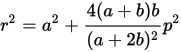
or[6]

with
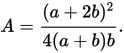
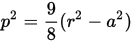
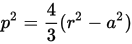
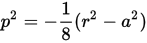
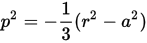
Special cases obtained by setting b= a⁄n for specific values of n include:
| n | Curve | Pedal eq. |
|---|---|---|
| 1, − 1⁄2 | Cardioid | |
| 2, − 2⁄3 | Nephroid | |
| −3, − 3⁄2 | Deltoid | |
| −4, − 4⁄3 | Astroid |
Other curves
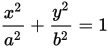
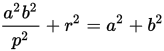
Other pedal equations are:[7]
| Curve | Equation | Pedal point | Pedal eq. |
|---|---|---|---|
| Ellipse | Center | ||
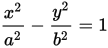
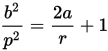
| Hyperbola | Center | ||
| Ellipse | Focus | ||
| Hyperbola | Focus | ||
| Logarithmic spiral | Pole |




See also
References
- R.C. Yates (1952). "Pedal Equations". A Handbook on Curves and Their Properties. Ann Arbor, MI: J. W. Edwards. pp. 166 ff.
- J. Edwards (1892). Differential Calculus. London: MacMillan and Co. pp. 161 ff.