Plaetoria (gens)
Plaetorius was the family name (nomen) of a plebeian gens in ancient Rome.
Roman Republic
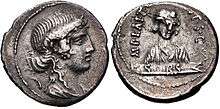
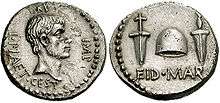
Plaetorii are noted as holding office during the Republic from the 2nd century BC through the civil wars of the 40s BC.[2] Several members of the gens issued denarii from the late 70s into the 40s,[3] one of them punning on the cognomen Cestianus by depicting an athlete holding a cestus.[4] The Cestiani branch seems to come from a Praenestine family of Cestii by adoption into the Plaetorii of Tusculum.[5] Their coinage representing Sors recognizes Praeneste as the Italic oracle most renowned for the casting of lots.[6] A Plaetorius is among the supporters of Pompeius in the civil wars of the 40s, and the best-known coinage from a member of the gens is a denarius issued for Brutus commemorating the assassination of Caesar on the Ides of March.
- Marcus Plaetorius, a tribune of the plebs at an uncertain date. He carried out passage of a plebiscite that established what attendants the praetor peregrinus might have. The office of praetor peregrinus was established in the late 240s BC.[7]
- Plaetorius, a tribune of the plebs before 192. No title is preserved,[8] but Cicero names a Lex Plaetoria[9] that protected young men and minors from fraud,[10] and references in Plautus to such legislation would date it prior to 191 BC.[11]
- Plaetorius, a tribune of the plebs before 175. A Plaetorius authored a law under which an altar was dedicated to Verminus by Aulus Postumius Albinus (consul 180 BC) as duovir, and another altar that was found in the Largo Argentina.[12]
- Gaius Plaetorius was a legate sent as one of three ambassadors to King Gentius of Illyria to protest attacks on allies of Rome.[13]
- Lucius Plaetorius, a senator in 129.[14]
- Marcus Plaetorius, a senator put to death on Sulla's orders in 82, along with Venuleius. Münzer distinguishes him from the M. Laetorius who accompanied Gaius Marius into exile in 88 BC, but the names Laetorius and Plaetorius often create textual difficulties.[15]
- Lucius Plaetorius, possibly a Cestianus, a quaestor ca. 74–72 BC, or as late as 66, when Cicero refers to him as a senator.[16] His father's name was Lucius. Crawford dates his coinage to 74.[17]
- Marcus Plaetorius Cestianus is the most extensively documented of the Republican Plaetorii, but the dating of his offices is problematic.[18] Crawford places his coinage as a monetalis in 69, but he was quaestor sometime before he prosecuted Fonteius in 69 BC,[19] and in the Late Republic a young man usually served as a moneyer before a quaestorship.[20] He was curule aedile most likely in 67,[21] when he also issued coinage. In 66, he was a iudex for a quaestio de sicariis.[22] He was praetor possibly in 64,[23] then governor in Macedonia, where he succeeded Lucius Manlius Torquatus in 63 and was followed by Gaius Antonius Hybrida in 62. He is called strategos (Greek στρατηγός) in an inscription from Delphi.[24] He seems to have served under Lentulus Spinther in Cilicia in 55,[25] but there is no evidence for an official position.[26]
- Gaius Plaetorius, quaestor under Gnaeus Domitius Calvinus in Pontus in 48.[27]
- Plaetorius Rustianus, a senator in 46. He was a leader among Pompey's forces in Africa and died at Hippo.[28]
- Lucius Plaetorius Cestianus, a quaestor or proquaestor under Brutus in 42.[29]
References
- ↑ P.G.P. MeyboomThe Nile Mosaic of Palestrina: Early Evidence of Egyptian Religion in Italy (Brill, 1995), p. 161.
- ↑ Unless otherwise noted, information on careers and citations of primary sources from T.R.S. Broughton, The Magistrates of the Roman Republic (American Philological Association, 1951, 1952, 1986), vols. 1–3.
- ↑ Michael H. Crawford, Roman Republican Coinage (Cambridge University Press, 1974), pp. 83, 86–87, 408, 415, 418.
- ↑ Eugene S. McCartney, "Casting Puns on Ancient Monuments," American Journal of Archaeology 23 (1919), p. 62.
- ↑ Crawford, Roman Republican Coinage, p. 418, citing T.P. Wiseman, New Men of the Roman Senate, 251.
- ↑ Crawford, Roman Republican Coinage, p. 418.
- ↑ Censorinus, De die natali 24.3; Plautus, Epidicus 25–27; Varro, De lingua latina 6.5; Aulus Gellius 3.2.4; Broughton, MRR2, p. 472.
- ↑ Discussed by Broughton, MRR2, p. 472.
- ↑ Plaetoria, Broughton contra RE, Supb. 7.398, which has Laetoria.
- ↑ Cicero, De officiis 3.61 and De natura deorum 3.74; also the Lex Iulia Municipalis, line 112.
- ↑ Plautus, Pseudolus 303f. and Rudens 1380–1382.
- ↑ Broughton, MRR2, p. 472.
- ↑ Livy 42.26.6–7; Broughton, MRR1, p. 414. The other two ambassadors were Aulus Terentius Varro and Gaius Cicereius.
- ↑ Senatus consultum de Agro Pergameno, with Plattorius amended to Plaetorius; Broughton, MRR2, p. 494.
- ↑ Valerius Maximus 9.2.1, see also Florus 2.9.26 (without praenomen) and Orosius 5.21.8 as P. Laetorius; Broughton, MRR2, p. 494, and MRR3, p. 157.
- ↑ Cicero, Pro Cluentio 165.
- ↑ Broughton, MRR2, p. 102, and MRR3, p. 157.
- ↑ See also Ronald Syme, reviewing Broughton's MRR in Classical Philology 50.2 (1955), pp. 129–130, 132.
- ↑ Cicero, Pro Fronteio 1.
- ↑ On this point see also Ronald Syme, “The Sons of Crassus.” Latomus 39 (1980) 403–408.
- ↑ Cicero, Pro Cluentio 126.
- ↑ Cicero, Pro Cluentio 147, see also 126.
- ↑ Broughton, MRR2, pp. 161–162, conjectures this date for a praetorship based on assigning his service as a iudex to 66 and on the gap that leaves room for his name on the Fasti of Macedonia.
- ↑ SEG I.165 Delphi.
- ↑ Cicero, Ad familiares 1.8.1, where the M. Plaetorius referred to is not identified as Cestianus.
- ↑ Broughton, MRR2, pp. 128, 143, 150 (note 3, where he explains his reasoning for assigning years for Plaetorius's offices), 161–162, 169, 219; MRR3, p. 157.
- ↑ Bellum Alexandrinum 34.5; Broughton, MRR2, p. 274.
- ↑ Bellum Africum 96; Broughton, MRR2, p. 494.
- ↑ Broughton, MRR2, p. 360. Epigraphic evidence as L. Plaet(orius) Cest(ianus).