Pleuromeia dubia
| Pleuromeia dubia Temporal range: Early Triassic | |
|---|---|
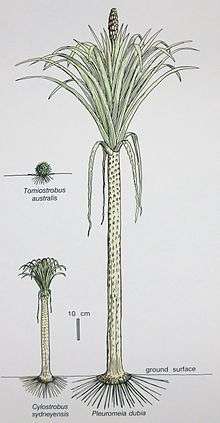 | |
| Reconstructions of extinct lycopsids Pleueromeia dubia and Cylostrobus sydneyensis (Pleuromeiaceae and Tomiostrobus australis (Isoetaceae) all from the Early Triassic Gosford and Newport Formations of the Sydney Basin, NSW, Australia.[1] | |
| Scientific classification | |
| Kingdom: | Plantae |
| Division: | Lycopodiophyta |
| Class: | Isoetopsida |
| Order: | Isoetales |
| Family: | †Pleuromeiaceae |
| Genus: | †Pleuromeia |
| Species: | †P. dubia |
| Binomial name | |
| †Pleuromeia dubia Retallack 1995 | |
Pleuromeia dubia is a tall species for the genus, with distinctive elongate leaf scars, and known from the Early Triassic of Australia and South Africa. Like other species of Pleuromeia it was a survivor of the marked greenhouse spike at the end of the Early Triassic.[2]
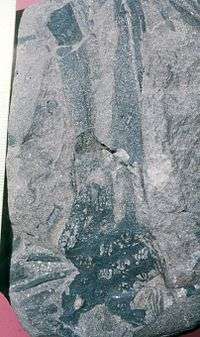
leafy apex of Pleuromeia dubia from the Early Triassic Newport Formation near Newport, NSW
See also
References
- ↑ Retallack, Gregory J. (1997). "Earliest Triassic origin of Isoetes and quillwort evolutionary radiation". Journal of Paleontology. 7 (3): 500–521.
- ↑ Retallack, Gregory J. (2013). "Permian and Triassic greenhouse crises". Gondwana Research. 24: 90–103. doi:10.1016/j.gr.2012.03.003.
This article is issued from Wikipedia - version of the 8/5/2016. The text is available under the Creative Commons Attribution/Share Alike but additional terms may apply for the media files.