Prosthechea
| Prosthechea | |
|---|---|
 | |
| Prosthechea cochleata | |
| Scientific classification | |
| Kingdom: | Plantae |
| (unranked): | Angiosperms |
| (unranked): | Monocots |
| Order: | Asparagales |
| Family: | Orchidaceae |
| Subfamily: | Epidendroideae |
| Tribe: | Epidendreae |
| Subtribe: | Laeliinae |
| Alliance: | Epidendrum |
| Genus: | Prosthechea Knowles & Westc., 1838 |
| Type species | |
| Prosthechea glauca Knowles & Westc. - Floral Cabinet 2: 111-112. 1838. | |
| Species | |
|
About 100 species - See text | |
| Synonyms[1] | |
| |
Prosthechea is a genus in the orchid family (Orchidaceae). The name is derived from the Greek word prostheke (appendix), referring to the appendage on the back of the column. Appendage orchid is a common name for this genus.[2]
The genus Prosthechea has only recently (1997; published in 1998) been reestablished by W. E. Higgins as a distinct genus (see references). Two species were later transferred to Euchile (E. citrina and E. mariae) by Withner in 1998.[3] The status of Euchile species as sister to Prosthechea excluding Euchile was confirmed by Higgins in his doctoral dissertation in 2000.[4] Previously, the species had been included in different genera : Anacheilium, Encyclia, Epidendrum, Euchile, Hormidium and Pollardia. The status as genus was confirmed by recent data, based on molecular evidence (nuclear (nrITS) and plastid (matK and trnL-F) DNA sequence data) (W. E. Higgins et al. 2003)
This a neotropical epiphytic genus, widespread across much of Latin America from Mexico to Paraguay, as well as in Florida and the West Indies.[1][5]
The roots of all Prosthechea species possess a velamen (a thick sponge-like covering) differentiated into epivelamen and endovelamen. Flavonoid crystals were observed in both the roots and leaves. The erect stems form flattened or thickened pseudobulbs. There are 1 to 3 terminal, sessile leaves. The leathery blade is ovate to lanceolate. (Euchile leaves are softer and thinner than other Prosthechea leaves.)
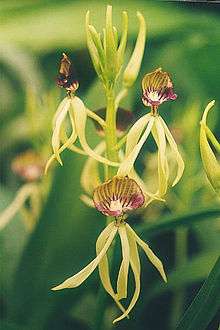
The flowers form an apical, paniculate raceme with a spathe at the base of the inflorescence . There is a great variety in the flowers of this genus. They may be attached to the stem by a peduncle or may be sessile. They can flower on the raceme at the same time or successively. They can be resupinate or non-resupinate (as in Prosthechea cochleata). Prosthechea flowers are unique among the Laeliinae in producing fluorescent flavenoid crystals when preserved in ethanol with 5% sodium hydroxide.[6]
The sepals are almost equal in length, while the petals can be much slender. The lip is pressed closely (adnate to proximal) to half of the column and shows a callus (a stiff protuberance). The column is 3- to 5-toothed at its top.
There are four, almost equal pollinia with an inverted egg shape. There are four stalks (or caudicles) in two pairs. The beak is entire, curved into a half circle and covered with viscous glycoside crystals.
The fruits consists of ellipse-shaped to egg-shaped, 1-locular, 3-winged capsules.
Species
- Prosthechea abbreviata (Schltr.) W.E.Higgins (1997 publ. 1998).
- Prosthechea aemula (Lindl.) W.E.Higgins (1997 publ. 1998).
- Prosthechea alagoensis (Pabst) W.E.Higgins (1997 publ. 1998).
- Prosthechea allemanii (Barb.Rodr.) W.E.Higgins (1997 publ. 1998).
- Prosthechea allemanoides (Hoehne) W.E.Higgins (1997 publ. 1998).
- Prosthechea aloisii (Schltr.) Dodson & Hágsater (1999).
- Prosthechea apuahuensis (Mansf.) Van den Berg (2001).
- Prosthechea arminii (Rchb.f.) Withner & P.A.Harding (2004).
- Prosthechea baculus (Rchb.f.) W.E.Higgins (1997 publ. 1998).
- Prosthechea barbozae Pupulin (2004).
- Prosthechea bennettii (Christenson) W.E.Higgins (1997 publ. 1998).
- Prosthechea bicamerata (Rchb.f.) W.E.Higgins (1997 publ. 1998).
- Prosthechea boothiana (Lindl.) W.E.Higgins (1997 publ. 1998).
- Prosthechea brachiata (A.Rich. & Galeotti) W.E.Higgins (1997 publ. 1998).
- Prosthechea brachychila (Lindl.) W.E.Higgins (1997 publ. 1998).
- Prosthechea brassavolae (Rchb.f.) W.E.Higgins (1997 publ. 1998).
- Prosthechea bulbosa (Vell.) W.E.Higgins (1997 publ. 1998).
- Prosthechea caetensis (Bicalho) W.E.Higgins (1997 publ. 1998).
- Prosthechea calamaria (Lindl.) W.E.Higgins (1997 publ. 1998).
- Prosthechea campos-portoi (Pabst) W.E.Higgins (1997 publ. 1998).
- Prosthechea campylostalix (Rchb.f.) W.E.Higgins (1997 publ. 1998).
- Prosthechea carrii V.P.Castro & Campacci (2001).
- Prosthechea chacaoensis (Rchb.f.) W.E.Higgins (1997 publ. 1998).
- Prosthechea chondylobulbon (A.Rich. & Galeotti) W.E.Higgins (1997 publ. 1998).
- Prosthechea christyana (Rchb.f.) Garay & Withner (2001).
- Prosthechea cochleata (L.) W.E.Higgins (1997 publ. 1998).
- Prosthechea cochleata var. cochleata.
- Prosthechea cochleata var. triandra (Ames) Hágsater (2002).
- Prosthechea concolor (Lex.) W.E.Higgins (1997 publ. 1998).
- Prosthechea cretacea (Dressler & G.E.Pollard) W.E.Higgins (1997 publ. 1998).
- Prosthechea elisae Chiron & V.P.Castro (2003).
- Prosthechea faresiana (Bicalho) W.E.Higgins (1997 publ. 1998).
- Prosthechea farfanii Christenson (2002).
- Prosthechea fausta (Rchb.f. ex Cogn.) W.E.Higgins (1997 publ. 1998).
- Prosthechea favoris (Rchb.f.) Salazar & Soto Arenas (2001).
- Prosthechea fortunae (Dressler) W.E.Higgins (1997 publ. 1998).
- Prosthechea fragrans (Sw.) W.E.Higgins (1997 publ. 1998).
- Prosthechea garciana (Garay & Dunst.) W.E.Higgins (1997 publ. 1998).
- Prosthechea ghiesbreghtiana (A.Rich. & Galeotti) W.E.Higgins (1997 publ. 1998).
- Prosthechea gilbertoi (Garay) W.E.Higgins (1997 publ. 1998).
- Prosthechea glauca Knowles & Westc. (1838).
- Prosthechea glumacea (Lindl.) W.E.Higgins (1997 publ. 1998).
- Prosthechea grammatoglossa (Rchb.f.) W.E.Higgins (1997 publ. 1998).
- Prosthechea greenwoodiana (Aguirre-Olav.) W.E.Higgins (1997 publ. 1998).
- Prosthechea hajekii D.E.Benn. & Christenson (2001).
- Prosthechea hartwegii (Lindl.) W.E.Higgins (1997 publ. 1998).
- Prosthechea hastata (Lindl.) W.E.Higgins (1997 publ. 1998).
- Prosthechea ionocentra (Rchb.f.) W.E.Higgins (1997 publ. 1998).
- Prosthechea ionophlebia (Rchb.f.) W.E.Higgins (1997 publ. 1998).
- Prosthechea jauana (Carnevali & I.Ramírez) W.E.Higgins (1997 publ. 1998).
- Prosthechea joaquingarciana Pupulin (2001).
- Prosthechea kautzkii (Pabst) W.E.Higgins (1997 publ. 1998).
- Prosthechea lambda (Linden ex Rchb.f.) W.E.Higgins (1997 publ. 1998).
- Prosthechea latro (Rchb.f. ex Cogn.) V.P.Castro & Chiron (2003).
- Prosthechea leopardina (Rchb.f.) Dodson & Hágsater (1999).
- Prosthechea lindenii (Lindl.) W.E.Higgins (1997 publ. 1998).
- Prosthechea linkiana (Klotzsch) W.E.Higgins (1997 publ. 1998).
- Prosthechea livida (Lindl.) W.E.Higgins (1997 publ. 1998)
- Prosthechea longipes (Rchb.f.) Chiron (2005)
- Prosthechea maculosa (Ames, F.T.Hubb. & C.Schweinf.) W.E.Higgins (1997 publ. 1998).
- Prosthechea magnispatha (Ames, F.T.Hubb. & C.Schweinf.) W.E.Higgins (1997 publ. 1998).
- Prosthechea megahybos (Schltr.) Dodson & Hágsater (1999).
- Prosthechea michuacana (Lex.) W.E.Higgins (1997 publ. 1998)
- Prosthechea micropus (Rchb.f.) W.E.Higgins (2005)
- Prosthechea moojenii (Pabst) W.E.Higgins (1997 publ. 1998).
- Prosthechea mulasii Soto Arenas & L.Cerv. (2002 publ. 2003).
- Prosthechea neglecta Pupulin (2001).
- Prosthechea neurosa (Ames) W.E.Higgins (1997 publ. 1998).
- Prosthechea obpiribulbon (Hágsater) W.E.Higgins (1997 publ. 1998).
- Prosthechea ochracea (Lindl.) W.E.Higgins (1997 publ. 1998).
- Prosthechea ochrantha (A.Rich.) (ined.)
- Prosthechea ortizii (Dressler) W.E.Higgins (1997 publ. 1998).
- Prosthechea pamplonensis (Rchb.f.) W.E.Higgins (1997 publ. 1998).
- Prosthechea panthera (Rchb.f.) W.E.Higgins (1997 publ. 1998).
- Prosthechea papilio (Vell.) W.E.Higgins (1997 publ. 1998).
- Prosthechea pastoris (Lex.) Espejo & López-Ferr. (2000).
- Prosthechea pringlei (Rolfe) W.E.Higgins (1997 publ. 1998).
- Prosthechea prismatocarpa (Rchb.f.) W.E.Higgins (1997 publ. 1998).
- Prosthechea pterocarpa (Lindl.) W.E.Higgins (1997 publ. 1998).
- Prosthechea pulcherrima (Klotzsch) W.E.Higgins (1997 publ. 1998).
- Prosthechea pulchra Dodson & W.E.Higgins (2001).
- Prosthechea punctifera (Rchb.f.) W.E.Higgins (1997 publ. 1998).
- Prosthechea pygmaea (Hook.) W.E.Higgins (1997 publ. 1998).
- Prosthechea racemifera (Dressler) W.E.Higgins (1997 publ. 1998).
- Prosthechea radiata (Lindl.) W.E.Higgins (1997 publ. 1998).
- Prosthechea regnelliana (Hoehne & Schltr.) W.E.Higgins (1997 publ. 1998).
- Prosthechea rhombilabia (S.Rosillo) W.E.Higgins (1997 publ. 1998).
- Prosthechea rhynchophora (A.Rich. & Galeotti) W.E.Higgins (1997 publ. 1998).
- Prosthechea sceptra (Lindl.) W.E.Higgins (1997 publ. 1998).
- Prosthechea semiaptera (Hágsater) W.E.Higgins (1997 publ. 1998).
- Prosthechea serrulata (Sw.) W.E.Higgins (1997 publ. 1998).
- Prosthechea sessiliflora (Edwall) W.E.Higgins (1997 publ. 1998).
- Prosthechea silvana Cath. & V.P.Castro (2003).
- Prosthechea sima (Dressler) W.E.Higgins (1997 publ. 1998).
- Prosthechea spondiada (Rchb.f.) W.E.Higgins (1997 publ. 1998).
- Prosthechea suzanensis (Hoehne) W.E.Higgins (1997 publ. 1998).
- Prosthechea tardiflora Mora-Ret. ex Pupulin (2001).
- Prosthechea tigrina (Linden ex Lindl.) W.E.Higgins (1997 publ. 1998).
- Prosthechea tripunctata (Lindl.) W.E.Higgins (1997 publ. 1998).
- Prosthechea trulla (Rchb.f.) W.E.Higgins (1997 publ. 1998).
- Prosthechea vagans (Ames) W.E.Higgins (1997 publ. 1998).
- Prosthechea varicosa (Bateman ex Lindl.) W.E.Higgins (1997 publ. 1998).
- Prosthechea vasquezii Christenson (2003).
- Prosthechea venezuelana (Schltr.) W.E.Higgins (1997 publ. 1998).
- Prosthechea vespa (Vell.) W.E.Higgins (1997 publ. 1998).
- Prosthechea vinacea Christenson (2003).
- Prosthechea vitellina (Lindl.) W.E.Higgins (1997 publ. 1998).
- Prosthechea widgrenii (Lindl.) W.E.Higgins (1997 publ. 1998).
References
- Higgins, W. E. (1997) [1998]. "A reconsideration of the genus Prosthechea (Orchidaceae)". Phytologia. 82: 370–383.
- Higgins, W. E., van den Berg, C., Whitten, W. M. (2003). "A Combined Molecular Phylogeny of Encyclia (Orchidaceae) and Relationships within Laeliinae". Selbyana. 23: 165–179.
- Van den Berg, C. (2001). "Nomenclatural notes on Laeliinae--III. Notes on Cattleya and Quisqueya, and a new combination in Prosthechea". Lindleyana. 16 (3:): 142, 143.
- PIRES M.D.F.D.O.; SEMIR J.; PINNA G.F.D.A.M.D.; FELIX L.P. (November 2003). "Taxonomic separation of the genera Prosthechea and Encyclia (Laeliinae: Orchidaceae) using leaf and root anatomical features". Botanical Journal of the Linnean Society. 143 (3): . 293–303. doi:10.1046/j.1095-8339.2003.00195.x.
- Chiron, G.R. (2003). "An Introduction to the Genus Prosthechea". The orchid Review. 111 (1250).
- Chiron, G. R. (2005). "Contribution a l'etude de Prosthechea section Parviloba (Orchidaceae)". Richardiana. 5 (3): 129–153. (in French)
- Pabst, G. F., J. L. Moutinho, and A. V. Pinto (1981). "An attempt to establish the correct statement for genus Anacheilium Hoffmanns. and revision of the genus Hormidium Lindl. ex Heynh.". Bradea. 3: 173–186.
Footnotes
- 1 2 Kew World Checklist of Selected Plant Families
- ↑ "Prosthechea". Natural Resources Conservation Service PLANTS Database. USDA. Retrieved 14 October 2015.
- ↑ C. L. Withner, Brassavola, Encyclia, and other genera of Mexico and Central America. The Cattleyas and their Relatives Timber Press, Portland, Oregon. 1998
- ↑ reported in W. E. Higgins: "PROSTHECHEA A CHEMICAL DISCONTINUITY IN LAELIINAE", Lankesteriana 7(2003)39-41
- ↑ Flora of North America v 26 p 613, Prosthechea Knowles & Westcott, Fl. Cab. 2: 111. 1838.
- ↑ W. E. Higgins, "PROSTHECHEA A CHEMICAL DISCONTINUITY IN LAELIINAE", Lankesteriana 7(2003)39-41, available online at http://www.jardinbotanicolankester.org/lankesteriana/Lankesteriana%20vol.%203.%202003/Lankesteriana%20N%207/Numeroporsecciones/17%20Higgins.pdf
External links
 Media related to Prosthechea at Wikimedia Commons
 Data related to Prosthechea at Wikispecies