Quotient automaton
In computer science, in particular in formal language theory, a quotient automaton can be obtained from a given nondeterministic finite automaton by joining some of its states. The quotient recognizes a superset of the given automaton; in some cases, handled by the Myhill–Nerode theorem, both languages are equal.
Formal definition
A (nondeterministic) finite automaton is a quintuple A = ⟨Σ, S, s0, δ, Sf⟩, where:
- Σ is the input alphabet (a finite, non-empty set of symbols),
- S is a finite, non-empty set of states,
- s0 is the initial state, an element of S,
- δ is the state-transition relation: δ ⊆ S × Σ × S, and
- Sf is the set of final states, a (possibly empty) subset of S.[1][note 1]
A string a1...an ∈ Σ* is recognized by A if there exist states s1, ..., sn ∈ S such that ⟨si-1,ai,si⟩ ∈ δ for i=1,...,n, and sn ∈ Sf. The set of all strings recognized by A is called the language recognized by A; it is denoted as L(A).
For an equivalence relation ≈ on the set S of A’s states, the quotient automaton A/≈ = ⟨Σ, S/≈, [s0], δ/≈, Sf/≈⟩ is defined by[2]:5
- the input alphabet Σ being the same as that of A,
- the state set S/≈ being the set of all equivalence classes of states from S,
- the start state [s0] being the equivalence class of A’s start state,
- the state-transition relation δ/≈ being defined by δ/≈([s],a,[t]) if δ(s,a,t) for some s ∈ [s] and t ∈ [t], and
- the set of final states Sf/≈ being the set of all equivalence classes of final states from Sf.
The process of computing A/≈ is also called factoring A by ≈.
Example
| Automaton diagram |
Recognized language |
Is the quotient of | |||
|---|---|---|---|---|---|
| A by | B by | C by | |||
| A: |  |
1+10+100 | |||
| B: | 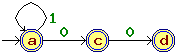 |
1*+1*0+1*00 | a≈b | ||
| C: | 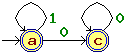 |
1*0* | a≈b, c≈d | c≈d | |
| D: |  |
(0+1)* | a≈b≈c≈d | a≈c≈d | a≈c |
For example, the automaton A shown in the first row of the table[note 2] is formally defined by
- ΣA = {0,1},
- SA = {a,b,c,d},
- sA
0 = a, - δA = { ⟨a,1,b⟩, ⟨b,0,c⟩, ⟨c,0,d⟩ }, and
- SA
f = { b,c,d }.
It recognizes the finite set of strings { 1, 10, 100 }; this set can also be denoted by the regular expression "1+10+100".
The relation (≈) = { ⟨a,a⟩, ⟨a,b⟩, ⟨b,a⟩, ⟨b,b⟩, ⟨c,c⟩, ⟨c,d⟩, ⟨d,c⟩, ⟨d,d⟩ }, more briefly denoted as a≈b,c≈d, is an equivalence relation on the set {a,b,c,d} of automaton A’s states. Building the quotient of A by that relation results in automaton C in the third table row; it is formally defined by
- ΣC = {0,1},
- SC = {a,c},[note 3]
- sC
0 = a, - δC = { ⟨a,1,a⟩, ⟨a,0,c⟩, ⟨c,0,c⟩ }, and
- SC
f = { a,c }.
It recognizes the finite set of all strings composed of arbitrarily many 1s, followed by arbitrarily many 0s, i.e. { ε, 1, 10, 100, 1000, ..., 11, 110, 1100, 11000, ..., 111, ... }; this set can also be denoted by the regular expression "1*0*". Informally, C can be thought of resulting from A by glueing state a onto state b, and glueing state c onto state d.
The table shows some more quotient relations, such as B = A/a≈b, and D = C/a≈c.
Properties
- For every automaton A and every equivalence relation ≈ on its states set, L(A/≈) is a superset of (or equal to) L(A).[2]:6
- Given a finite automaton A over some alphabet Σ, an equivalence relation ≈ can be defined on Σ* by x ≈ y if ∀ z ∈ Σ*: xz ∈ L(A) ↔ yz ∈ L(A). By the Myhill–Nerode theorem, A/≈ is a deterministic automaton that recognizes the same language as A.[1]:65–66 As a consequence, the quotient of A by every refinement of ≈ also recognizes the same language as A.
Notes
- ↑ Hopcroft and Ullman (sect.2.3, p.20) use a slightly deviating definition of δ, viz. as a function from S × Σ to the power set of S.
- ↑ In the automaton diagrams in the table, symbols from the input alphabet and state names are colored in green and red, respectively; final states are drawn as double circles.
- ↑ Strictly formal, the set is SC = { [a], [b], [c], [d] } = { [a], [c] }. The class brackets are omitted for readability.
References
- 1 2 John E. Hopcroft; Jeffrey D. Ullman (1979). Introduction to Automata Theory, Languages, and Computation. Reading/MA: Addison-Wesley. ISBN 0-201-02988-X.
- 1 2 Tristan le Gall and Bertrand Jeannet (Mar 2007). Analysis of Communicating Infinite State Machines Using Lattice Automata (PDF) (Publication Interne). Institut de Recherche en Informatique et Systèmes Aléatoires (IRISA) — Campus Universitaire de Beaulieu. ISSN 1166-8687.