RAE Larynx
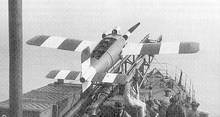
"RAE Larynx on cordite fired catapult of destroyer HMS Stronghold, July 1927. The man on the box is Dr. George Gardner, later Director of RAE." [1]
The Royal Aircraft Establishment Larynx (from "Long Range Gun with Lynx engine") was an early British pilotless aircraft, to be used as a guided anti-ship weapon. Started in September 1925, it was an early cruise missile guided by an autopilot.
A small monoplane powered by a 200 hp Armstrong Siddeley Lynx IV engine, it had a top speed of 200 mph (320 km/h); faster than contemporary fighters.[2]
It used autopilot principles developed by Professor Archibald Low and already used in the Ruston Proctor AT, a radio controlled biplane that was intended to be used against German Zeppelin bombers.
Project history
- First test 20 July 1927. Launched from cordite-powered catapult fitted to the S class destroyer HMS Stronghold. Crashed into Bristol Channel.
- Second test 1 September 1927. Thought to have flown 100 miles (160 km) and was then lost.
- Third test 15 October 1927. 112 mile (180 km) flight, hit five miles from target.
- Two more launches in September and October 1928 from HMS Thanet, another S class destroyer.
- Two additional launches May 1929. Launched from land, one overflew target and other was successful.[3]
References
- ↑ The Evolution of the Cruise Missile by Werrell, Kenneth P. see PDF page 29
- ↑ Gibson and Buttler. British Secret Projects: Hypersonics, ramjets and missiles Midland 2007
- ↑ Werrell PDF page 29
External links
- (1.0) The Aerial Torpedo
- Remote Piloted Aerial Vehicles : The 'Aerial Target' and 'Aerial Torpedo' in Britain
- Interwar British Experiments with Pilotless Aircraft pay to access
- "Automatic Flight" a 1958 Flight article
This article is issued from Wikipedia - version of the 1/22/2016. The text is available under the Creative Commons Attribution/Share Alike but additional terms may apply for the media files.