RML 9 pounder 8 and 6 cwt guns
| RML 9 pounder 8 cwt gun | |
|---|---|
|
RML 9 pounder 8 cwt Field Gun, at CFB Gagetown, New Brunswick. | |
| Type | Field gun |
| Place of origin |
 United Kingdom United Kingdom |
| Service history | |
| In service | 1871 - 1895 |
| Used by | British Empire |
| Production history | |
| Designer | Woolwich Arsenal |
| Manufacturer | Woolwich Arsenal |
| Variants |
9 pdr 8 cwt Mark I (Land Service) 8 cwt Mark II (Naval Service) 6 cwt Mark I (N.S.) 6 cwt Mark II (L.S.) 6 cwt. Mark III (N.S.) 6 cwt Mark IV (N.S.) |
| Specifications | |
| Weight | 8-long-hundredweight (400 kg) or 6-long-hundredweight (300 kg) |
|
| |
| Shell |
9.1 pounds (4.1 kg) (common shell) 9.8 pounds (4.4 kg) (shrapnel) |
| Action | RML |
| Breech | none – muzzle-loading |
| Muzzle velocity | 1,330 feet per second (405 m/s) |
| Effective firing range | 3,500 yards (3,200 m) |
.JPG)
The RML 9 pounder 8 cwt gun and the RML 9 pounder 6 cwt gun were British Rifled, Muzzle Loading (RML) field, horse and naval artillery guns manufactured in England in the 19th century, which fired a projectile weighing approximately 9 pounds (4.1 kg). "8 cwt" and "6 cwt" refers to the weight of the gun to differentiate it from other 9 pounder guns.
Service history
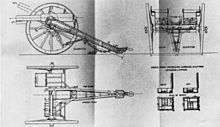
The 9 pounder 8 cwt Rifled Muzzle Loader was the field gun selected by the Royal Artillery in 1871 to replace the more sophisticated RBL 12 pounder 8 cwt Armstrong gun, which had acquired a reputation for unreliability.[1] The gun was rifled using the system developed by William Palliser, in which studs protruding from the side of the shell engaged with three spiral grooves in the barrel.[2] In 1874, a 6 cwt version was introduced for horse artillery and was later adopted for field artillery use, replacing the 8 cwt version. All variants used the same ammunition, which took the form of shrapnel shell, case shot and common shell.[1]
The 9 pounder remained in front-line service with the Royal Artillery until 1878 when the RML 13 pounder 8 cwt gun was introduced, however it remained in use with colonial forces until 1895 and saw action in the Anglo-Zulu War of 1879, the First Boer War of 1881 [1] and the Anglo-Egyptian War in 1882.[3]
Variants
- 9 pounder 8 cwt Mark I (Land Service): Introduced into the Royal Artillery in 1871. It was later withdrawn and modified for sea service.
- 9 pounder 8 cwt Mark II (Naval Service): Introduced in 1873 by the Royal Navy.
- 9 pounder 6 cwt Mark I (N.S.): A few were made for experimental trials but they proved to be too short; some were issued to the Royal Indian Navy. In 1873, forty five were completed for use as boat guns.
- 9 pounder 6 cwt Mark II (L.S.): A new design in 1874 for the Royal Horse Artillery, it was longer than the 8 cwt gun but had the same carriage.
- 9 pounder 6 cwt Mark III (N.S.): Introduced in 1879, a modified Mark II for naval service.
- 9 pounder 6 cwt Mark IV (N.S.): Similar to the Mark III with a steel jacket instead of wrought iron previously used, and with a strengthened cascabel.[4]
Surviving Examples
- Firepower - The Royal Artillery Museum, London
- Fort Nelson, Hampshire, Royal Armouries Collection
- Southsea Castle, Hampshire, England[5]
- North Battleford Museum, Saskatchewan
- CFB Petawawa, Ontario
- New Brunswick Military History Museum, CFB Gagetown, New Brunswick
- Fort Hughes, New Brunswick
- Royal Kennebecasis Yacht Club, New Brunswick
- Fort Anne, Nova Scotia[2]
- Fort St Catherine, Bermuda
- Australian Army Artillery Museum, Manly, New South Wales[6]
See also
References
- 1 2 3 Hall, DD (Major). "Military History Journal, Vol 3 No 5: June 1976 - AMMUNITION — PART II 9-PR 8 cwt RML". samilitaryhistory.org. The South African Military History Society. Retrieved 29 May 2014.
- 1 2 Skaarup, Harold A (2012), Shelldrake: Canadian Artillery Museums and Gun Monuments iUniverse.com, ISBN 978-14697-50002 (p. 131)
- ↑ Goodrich, Caspar F (Lt Cdr), Report of the British Naval and Military Operations In Egypt 1882, Navy Department, Washington, 1885, p.231
- ↑ Moore, David. "List of British Service Artillery in Use During the Victorian Period". www.victorianforts.co.uk. Victorian Forts and Artillery. Retrieved 29 May 2014.
- ↑ Boxell, A L (2010), The Ordnance of Southsea Castle Tricorn books, ISBN 978-0-9562498-4-5 (pp. 1–9)
- ↑ "ARTILLERY REGISTER - RML 9 Pounder 6 cwt Mark III". ww.artilleryhistory.org. The Royal Australian Artillery Historical Company. Retrieved 29 May 2014.
Further reading
- Captain John F Owen R.A., "Treatise on the Construction and Manufacture of Ordnance in the British Service", Prepared in the Royal Gun Factory, London, 1877, pages 254-257, 292.
External links
 |
Wikimedia Commons has media related to RML 9 pounder field guns. |
- Handbook for the 9-pr. R.M.L. guns of 6 cwt. and 8 cwt. land service, 1889, 1892, 1895 at State Library of Victoria
- Handbook for 9-pr. R.M.L. guns of 6 cwt. and 8 cwt. Land service 1895, 1901 at State Library of Victoria
- Handbook for 9-pr R.M.L. guns of 6cwt. and 8cwt., (Movable armament) 1898 at State Library of Victoria
- Armstrong RML 9 Pounder Mark II - views of the 9 pounder gun and its limber from the original handbook. Courtesy of the Royal Artillery Historical Trust
| Side arms | |||||||||||||||||||
|---|---|---|---|---|---|---|---|---|---|---|---|---|---|---|---|---|---|---|---|
| Muskets and Rifles | |||||||||||||||||||
| Artillery |
| ||||||||||||||||||
| Mortars |
| ||||||||||||||||||
| War rockets | |||||||||||||||||||
| Machine guns | |||||||||||||||||||
