Regelia megacephala
| Regelia megacephala | |
|---|---|
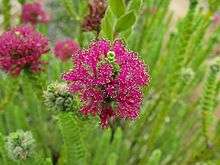 | |
| R. megacephala inflorescence in Royal Botanic Gardens, Cranbourne | |
| Scientific classification | |
| Kingdom: | Plantae |
| (unranked): | Angiosperms |
| (unranked): | Eudicots |
| (unranked): | Rosids |
| Order: | Myrtales |
| Family: | Myrtaceae |
| Genus: | Regelia |
| Species: | R. megacephala |
| Binomial name | |
| Regelia megacephala C.A.Gardner[1] | |
| Synonyms | |
|
Melaleuca gardneri Craven & R.D.Edwards | |
Regelia megacephala is a plant in the myrtle family, Myrtaceae and is endemic to the south-west of Western Australia. It is a taller shrub than others in its genus, with small, rounded leaves and clusters of purplish-red flowers from October to December.
Description
Regelia megacephala is an erect, straggly shrub which grows to a height of 2–5 m (7–20 ft). Its leaves are small and are arranged in alternating pairs (decussate) so that they make four rows along its long stems.[2]
The flowers are mauve and arranged in dense heads 15 mm (0.6 in) across on the ends of long stems which continue to grow after flowering. There are 5 sepals, 5 petals and 5 bundles of stamens. Flowering occurs from September to December and is followed by fruit which are woody capsules.[2]
Taxonomy and naming
Regelia megacephala was first formally described in 1964 by the Australian botanist, Charles Gardner in Journal of the Royal Society of Western Australia.[1] The specific epithet ("megacephala") is from the Ancient Greek μέγας (mégas) meaning "large"[3] and κεφαλή (kephalḗ) meaning “head”.[4]
Distribution and habitat
Regelia megacephala grows in red sand on rocky quartzite hills in the Avon Wheatbelt and Swan Coastal Plain biogeographic regions.[2][5] It is closely associated with Coomberdale chert which is mined for the production of silicon and is threatened by mining activity.[6][7]
Conservation
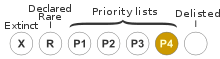
Regelia megacephala is classified as "Priority Four" by the Western Australian Government Department of Parks and Wildlife[5] meaning that is rare or near threatened.[8]
Use in horticulture
Regelia megacephala is not often seen in cultivation but is frost hardy, will grow in full or partial sun and is suitable for narrow gardens.[2][9] Its commercial potential for export as a Christmas flower has been assessed.[10]
References
- 1 2 "Regelia megacephala". APNI. Retrieved 27 August 2015.
- 1 2 3 4 "The genus Regelia". Australian native Plants Society Australia. Retrieved 27 August 2015.
- ↑ "mega-". Wiktionary. Retrieved 27 August 2015.
- ↑ "cephalon". Wiktionary. Retrieved 17 August 2015.
- 1 2 "Regelia megacephala". FloraBase. Retrieved 26 August 2015.
- ↑ "Extension of Quartz Mining and Strategy for Resource Access and Biodiversity Conservation" (PDF). Environmental Protection Authority Perth, Western Australia. Retrieved 27 August 2015.
- ↑ "Simcoa Operations:FAQ". Simcoa Operations Pty Ltd. Retrieved 27 August 2015.
- ↑ "Conservation codes for Western Australian Flora and Fauna" (PDF). Government of Western Australia Department of Parks and Wildlife. Retrieved 7 December 2015.
- ↑ Raleigh, Royce. "Newsletter: February-April 2015" (PDF). Wimmera Growers of Australian Plants Inc. Retrieved 27 August 2015.
- ↑ Seaton, Kevin (2013). Development of intergeneric rootstocks for christmas flowering verticordia a new christmas flower. Barton, A.C.T.: RIRDC. pp. 1–21. ISBN 978-1-74254-452-6.