Regrading
This article is about the environmental term. For the photography term, see Color grading.

Regrading for a subdivision in the Santa Monica Mountains, Los Angeles, California (1970s).
Regrading is the process of grading for raising and/or lowering the levels of land. Such a project can also be referred to as a regrade.
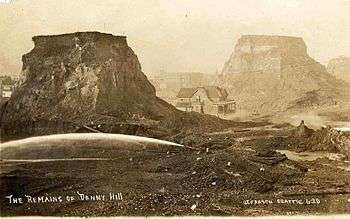
Regrading may be done on a small scale (as in preparation of a house site)[2] or on quite a large scale (as in major reconfiguration of the terrain of a city, such as the Denny Regrade in Seattle).[1]
Regrading is typically performed to make land more level (flatter), in which case it is sometimes called levelling.[3]) Levelling can have the consequence of making other nearby slopes steeper, and potentially unstable or prone to erosion.
Purposes
Reasons for regrading include:
- Enabling construction on lands that were previously too varied and/or steeply sloped.[2]
- Enabling transportation along routes that were previously too varied and/or steep.[1]
- Changing drainage patterns and rerouting surface flow.[2]
- Improving the stability of terrain adjacent to developments.[4]
Consequences
Potential problems and consequences from regrading include:
- Soil and/or slope instability
- Terrain prone to erosion
- Ecological impacts, habitat destruction, terrestrial and/or aquatic biological losses.[2]
- Drainage problems (surface and/or subsurface flow) for areas not considered in the regrading plan.[5]
- Loss of aesthetic natural landscape topography and/or historical cultural landscapes.
See also
|
 |
Wikimedia Commons has media related to Regrading. |
Notes
- 1 2 3 Walt Crowley, Seattle Neighborhoods: Belltown-Denny Regrade -- Thumbnail History, HistoryLink.org essay #1123, May 10, 1999. Accessed online 16 October 2007.
- 1 2 3 4 Trees and Home Construction: Minimizing the impact of construction activity on trees, University of Ohio Extension Bulletin 870-99. Accessed online 16 October 2007.
- ↑ "Montana, McLaren Tailings", p.35 in CERCLA Imminent Hazard Mining and Mineral Processing Facilities, Office of Solid Waste, U.S. Environmental Protection Agency, February 1997. Accessed online 16 October 2007.
- ↑ Malcolm Puller, Deep Excavations: A Practical Manual, Thomas Telford (1996). ISBN 0-7277-1987-4. p. 63.
- ↑ Barry Stone, Adjacent Property Regrading Creates Drainage Problem for Homeowner, doityourself.com. Accessed online 16 October 2007.
This article is issued from Wikipedia - version of the 6/29/2016. The text is available under the Creative Commons Attribution/Share Alike but additional terms may apply for the media files.