Retene
 | |
 | |
| Names | |
|---|---|
| IUPAC name
7-Isopropyl-1-methylphenanthrene | |
| Other names
Retene | |
| Identifiers | |
483-65-8  | |
| 3D model (Jmol) | Interactive image |
| ChemSpider | 9805  |
| ECHA InfoCard | 100.006.908 |
| EC Number | 207-597-9 |
| PubChem | 10222 |
| |
| |
| Properties | |
| C18H18 | |
| Molar mass | 234.33552 |
| Melting point | 98.5 °C (209.3 °F; 371.6 K) |
| Boiling point | 390 °C (734 °F; 663 K) |
| Except where otherwise noted, data are given for materials in their standard state (at 25 °C [77 °F], 100 kPa). | |
| verify (what is ?) | |
| Infobox references | |
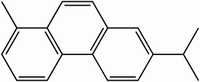
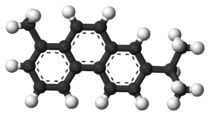
Retene, methyl isopropyl phenanthrene or 1-methyl-7-isopropyl phenanthrene, C18H18, is a polycyclic aromatic hydrocarbon present in the coal tar fraction, boiling above 360 °C. It occurs naturally in the tars obtained by the distillation of resinous woods. It crystallizes in large plates, which melt at 98.5 °C and boil at 390 °C. It is readily soluble in warm ether and in hot glacial acetic acid. Sodium and boiling amyl alcohol reduce it to a tetrahydroretene, whilst if it be heated with phosphorus and hydriodic acid to 260 °C, a dodecahydride is formed. Chromic acid oxidizes it to retene quinone, phthalic acid and acetic acid. It forms a picrate which melts at 123-124 °C.
Retene is derived by degradation of specific diterpenoids biologically produced by conifer trees.
The presence of traces of retene in the air is an indicator of forest fires; it is a major product of pyrolysis of conifer trees.[1] It is also present in effluents from wood pulp and paper mills.[2]
Retene, together with cadalene, simonellite and ip-iHMN, is a biomarker of higher plants, which makes it useful for paleobotanic analysis of rock sediments. Ratio of retene/cadalene in sediments can reveal the ratio of the genus Pinaceae in the biosphere.[3]
References
- ↑ Simonich, Staci. "Community Outreach and Education Program Presents Unsolved Mysteries of Human Health: How Scientists Study Toxic Chemicals". Oregon State University. Archived from the original on 16 Mar 2008.
The presence of the chemical retene (REE-teen) in the air is a good indication of burning vegetation.
- ↑ J. Koistinen, M. Lehtonena, K. Tukia, M. Soimasuo, M. Lahtiperab and A. Oikari (1998). "IDENTIFICATION OF LIPOPHILIC POLLUTANTS DISCHARGED FROM A FINNISH PULP AND PAPER MILL". Chemosphere. 37 (2): 219–235. doi:10.1016/S0045-6535(98)00041-1. PMID 9650265.
- ↑ Y. Hautevelle, R. Michels, F. Malartre and A. Trouiller (2005). "Vascular plant biomarkers as ancient vegetation proxies and their stratigraphic use for tracing paleoclimatic changes during Jurassic in Western Europe" (abstract). Geophysical Research Abstracts. 7: 10201.
 This article incorporates text from a publication now in the public domain: Chisholm, Hugh, ed. (1911). "article name needed". Encyclopædia Britannica (11th ed.). Cambridge University Press.