Zig zag (railway)
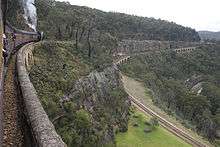
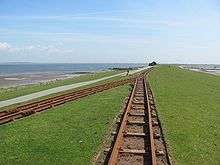
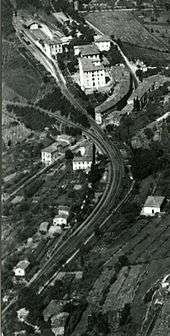
A railway zig zag, also called a switchback, is a method of climbing steep gradients with minimal need for tunnels and heavy earthworks.[1] For a short distance (corresponding to the middle leg of the letter "Z"), the direction of travel is reversed, before the original direction is resumed.[2]
A location on railways constructed by using a zig-zag alignment at which trains have to reverse direction in order to continue is a reversing station.[3]
Advantages
Zig zags tend to be cheaper to construct because the grades required are discontinuous. Civil engineers can generally find a series of shorter segments going back and forth up the side of a hill more easily and with less grading than they can a continuous grade which has to contend with the larger scale geography of the hills to be surmounted.
Disadvantages
Zig zags suffer from a number of limitations:
- The length of a train is limited to what will fit on the shortest stub track in the zig zag. The Lithgow Zig Zag stub was extended at great cost in 1908, only to be completely deviated in 1910.[4]
- Reversing a locomotive-hauled train without running an engine around to the rear of the train is hazardous. Top and tail or push pull operation with engines at the rear of the train helps.
- The process is slow due to the need to stop the train after each segment and reverse the switch.
- It is by nature a single track configuration.
Hazards
If wagons in a freight train are marshalled poorly, with a light vehicle located between heavy ones (particularly with buffer couplings), the move on the middle road of a zig zag can cause derailment of the light wagon.[5]
Examples
- Argentina
- Tren a las Nubes (1921)
- Australia
- Lithgow Zig Zag (rail line) (1869-1910) (see Zig Zag Railway) (preservation society) (1975-))
- Out of use:
- Thornleigh Zig Zag[6]
- Yarraglen (dismantled)
- Kalamunda Zig Zag – Two reversals
- Lapstone Zig Zag – Two reversals (1865)
- Mundaring Weir Branch Railway
- Yarloop, Western Australia (dismantled)
- Lake Margaret Tram 610 mm (2 ft)
- Burma (also known as Myanmar)
- Passenger line between Thazi and Kalaw, with four switchbacks; still in use
- China
- Qinglongqiao on the Jingbao Railway
- Chile
- Pisagua – Three reversals; long out of use but earthworks easy to trace
- Denmark
- Lemvig – Small side track from the harbor to the railway station, used only on special occasions. In reality only half a 'Z' as only one reversal is needed.
- Ecuador
- Sibambe on the Quito-Guayaquil line (cf. Empresa de Ferrocarriles Ecuatorianos)
- France
- Germany
- In use:
- Rauenstein (Hinterland Railway)
- Lauscha (Sonneberg – Probstzella railway)
- Ernstthal am Rennsteig: created by close of the Ernstthal–Probstzella railway
- Lüttmoorsiel-Nordstrandischmoor island railway
- Rennsteig (Rennsteig Railway, Ilmenau – Themar)
- Michaelstein (Rübeland Railway)
- Wurzbach (Saalfeld – Blankenstein railway)
- Altenkirchen station, Limburg–Altenkirchen railway
- out of use
- Schillingsfürst (dismantled)
- Lenzkirch in the Black Forest (dismantled)
- Elm (replaced in 1914 by Distelrasen Tunnel, but the structure is conserved within the Frankfurt-Fulda and Fulda-Gemünden railways and the connecting curve between the stations at Elm and Schlüchtern
- Steinhelle-Medebach railway (double zig zag)
- Mainspitze station in Frankfurt am Main, used from 1846 - 1848 to reach the provisional Frankfurt terminal of the Main-Neckar Railway (dismantled)
- In use:
- Hungary
- Nagybörzsönyi Erdei Vasút has a simple zig zag at the middle of the railway line between Kisirtás and Tolmács-hegy stations, with a loop in the middle of the Z shape, narrow gauge
- India
- Darjeeling Himalayan Railway has six full zig zags, most are from the construction of the current railway but one was added in the 1940s and at least one other was used temporarily following storm damage, narrow gauge
- Italy
- Saline-Volterra (dismantled in 1958)
- Japan
- Hakone Tozan Line has three zig zags, namely at Deyama S.B., Ōhiradai Station, Kami-Ōhidradai S.B.
- Hōhi Main Line at Tateno Station
- Kisuki Line at Izumo-Sakane Station
- Hisatsu Line at Okoba and Masaki stations
- Tateyama Sabō Erosion Control Works Service Train, the work train for an erosion control construction, is not open to general public, but deserves a mention for its 38 zig zags, 18 of them in a row.
- Niyama Station on Hakodate Main Line (see #Wartime type switchback)
- South Korea
- Yeongdong Line, between Heungjeon station and Nahanjeong station. This section closed in 2012 and replaced by Solan tunnel .
- Pakistan
- Peru
- Seven full Zigzags and one single reverse on the Central Railway of Peru
- PeruRail between Cuzco to Machu Picchu – Five switchbacks
- Slovakia
- Sweden
- Lövsjöväxeln (Lövsjö points) on Hällefors-Fredriksbergs Järnvägar (1875-1940)[7]
- Taiwan
- United States
- Hagans Switchback in Virginia
- Eight switchbacks at Cascade on GN – Replaced by tunnel which was in turn replaced by a longer tunnel
- Cass Scenic Railroad, West Virginia – Two switchbacks with 11% grade between, still in use
- Confusion Hill Mountain Train Ride, Piercy, California – Several switchbacks in use
- Industrial switchback, Montage Mountain Road, Scranton, Pennsylvania – Still in use
- Mount Hood Railroad, Hood River, Oregon – One switchback, still in use
- Roaring Camp and Big Trees Narrow Gauge Railroad, Felton, California – One switchback, still in use
- Shasta Sunset Dinner Train, McCloud, California – One switchback, "Signal Butte Switchback", in use
References
- ↑ Raymond, William G. (1912). "Railway Engineering" (Google books). In Beach, Frederick Converse. The Americana: A Universal Reference Library, Comprising the Arts and Sciences, Literature, History, Biography, Geography, Commerce, Etc., of the World. 17. New York: Scientific American Compiling Department. Retrieved 3 January 2010.
High mountain levels … may be tunneled … but … may be reached by one of several methods adopted to secure practical grades: (1) Zig-zag development … (2) Switchback development … (3) Spirals or loops …
- ↑ Raymond 1912. "Switch-back development … necessitating the use of switches at these ends and the backing of the train up alternate stretches."
- ↑ Jackson, Alan A. (2006). The Railway Dictionary (4th ed.). Stroud: Sutton Publishing. p. 285. ISBN 0-7509-4218-5.
- ↑ "The Zig-Zag Deviation.". The Dubbo Liberal and Macquarie Advocate (NSW : 1892 - 1927). NSW: National Library of Australia. 5 December 1908. p. 4. Retrieved 17 February 2013.
- ↑ "The Railway Accident on the Zig-zag.". Bathurst Free Press and Mining Journal (NSW : 1851 - 1904). NSW: National Library of Australia. 10 April 1895. p. 3. Retrieved 19 February 2013.
- ↑ "Historical and Archaeological Assessment of Proposed Cycleway, Near Thornleigh Quarry, Via De Saxe Close, Thornleigh (Berowra Valley Regional Park), N.S.W." (PDF). The construction of the railway siding and zig-zag to the quarry and also Hall’s Camp were associated with Amos & Co, who won the contract to build the section of railway from Strathfield to Hawkesbury River. Edward Higginbotham & Associates PTY LTD. Retrieved 15 March 2013.
- ↑ http://www.ekeving.se/b/HFJ/bgdskisser/