Rheintochter

Rheintochter was a German surface-to-air missile developed by Rheinmetall-Borsig[1] during World War II. Its name comes from the mythical Rheintöchter (Rhinemaidens) of Richard Wagner's opera series Der Ring des Nibelungen.
The missile was a multi-stage solid fuelled rocket.[2] It had four small control surfaces, resembling paddles, in the nose, six fins at the after end of the top stage, and four at the end of the main stage.[3] It stood 6.3 m (20 ft 8 in) tall, with a diameter of 54 cm (1 ft 9 in).[4] The sustainer motor, located ahead of the 136 kg (300 lb) warhead (rather than the now more usual behind), exhausted through six venturis between the first stage fins.[5]
History
Rheintochter was ordered in November 1942 by the German army (Heer). Starting in August 1943, 82 test firings were made. An air-launched version was also designed. The operational version was intended to be fired from a ramp or converted gun mount.[6]
The project was cancelled on February 6, 1945.
Example are on display at the Steven F. Udvar-Hazy Center in Chantilly, Virginia, and the Deutsches Museum in Munich.
Variants
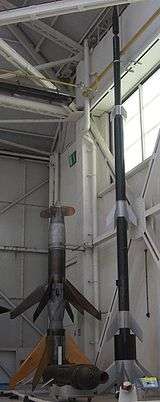
The initial R1 variant was powered by a two-stage solid-fuel rocket.
The proposed R2 did not offer any improvement over the R1, and was dropped in December 1944.[7]
The R3 model was developed, which had a liquid fuel engine with solid-fuel boosters ("strap-ons"). Only six trial missiles were fired.[8]
Characteristics
- Primary function: surface-to-air missile
- Contractor: Rheinmetall-Borsig
- Power plant: RI variant was 2-stage solid fuel; RIII was liquid fuel with solid-fuel boosters
- Length: 6.3 m (20 ft 8 in)[9]
- Diameter: 54 cm (1 ft 9 in)[10]
- Wing span: 2.65 m (8 ft 8 in)
- Launch weight: 1,748 kg (3,854 lb)
- Speed: 1,080 km/h (671 mph)[11]
- Warhead: 136 kg (300 lb)
- Range: km
- Altitude: R1 8 km
- Fuzes:
- Guidance system:
- Unit cost:
- Date deployed: Never
- Users: Germany
External links
 |
Wikimedia Commons has media related to Rheintochter. |
Notes
- ↑ Christopher, John. The Race for Hitler's X-Planes (The Mill, Gloucestershire: History Press, 2013), p.131.
- ↑ Christopher, p.131.
- ↑ Christopher, p.131.
- ↑ Christopher, p.131.
- ↑ Christopher, p.131.
- ↑ Christopher, p.131.
- ↑ Christopher, p.131.
- ↑ Christopher, p.132.
- ↑ Ford, Brian J., Secret Weapons, Osprey Publishing, 2011, p.80, ISBN 978 1 84908 390 4
- ↑ Ford, p.80
- ↑ Ford, p.80
Sources
- Christopher, John. The Race for Hitler's X-Planes. The Mill, Gloucestershire: History Press, 2013.
- Ford, Brian J., Secret Weapons, Osprey Publishing, 2011, ISBN 978 1 84908 390 4