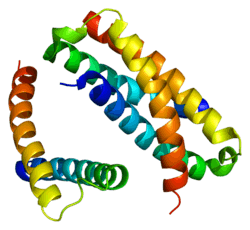
SH2B2
SH2B adapter protein 2 is a protein that in humans is encoded by the SH2B2 gene.[3][4]
Function
The protein encoded by this gene is expressed in B lymphocytes and contains pleckstrin homology and src homology 2 (SH2) domains. In Burkitt lymphoma cell lines, it is tyrosine phosphorylated in response to B cell receptor stimulation. Because it binds Shc independent of stimulation and Grb2 after stimulation, it appears to play a role in signal transduction from the receptor to Shc/Grb2.[4]
Interactions
SH2B2 has been shown to interact with TrkA[5] and Cbl gene.[6][7]
References
- ↑ "Human PubMed Reference:".
- ↑ "Mouse PubMed Reference:".
- ↑ Yokouchi M, Suzuki R, Masuhara M, Komiya S, Inoue A, Yoshimura A (Aug 1997). "Cloning and characterization of APS, an adaptor molecule containing PH and SH2 domains that is tyrosine phosphorylated upon B-cell receptor stimulation". Oncogene. 15 (1): 7–15. doi:10.1038/sj.onc.1201163. PMID 9233773.
- 1 2 "Entrez Gene: SH2B2 SH2B adaptor protein 2".
- ↑ Qian X, Riccio A, Zhang Y, Ginty DD (Nov 1998). "Identification and characterization of novel substrates of Trk receptors in developing neurons". Neuron. 21 (5): 1017–29. doi:10.1016/S0896-6273(00)80620-0. PMID 9856458.
- ↑ Wakioka T, Sasaki A, Mitsui K, Yokouchi M, Inoue A, Komiya S, Yoshimura A (May 1999). "APS, an adaptor protein containing Pleckstrin homology (PH) and Src homology-2 (SH2) domains inhibits the JAK-STAT pathway in collaboration with c-Cbl". Leukemia. 13 (5): 760–7. doi:10.1038/sj/leu/2401397. PMID 10374881.
- ↑ Ng C, Jackson RA, Buschdorf JP, Sun Q, Guy GR, Sivaraman J (Mar 2008). "Structural basis for a novel intrapeptidyl H-bond and reverse binding of c-Cbl-TKB domain substrates". EMBO J. 27 (5): 804–16. doi:10.1038/emboj.2008.18. PMC 2265755
 . PMID 18273061.
Further reading
- Glöckner G, Scherer S, Schattevoy R, Boright A, Weber J, Tsui LC, Rosenthal A (1998). "Large-Scale Sequencing of Two Regions in Human Chromosome 7q22: Analysis of 650 kb of Genomic Sequence around the EPO and CUTL1 Loci Reveals 17 Genes". Genome Res. 8 (10): 1060–73. doi:10.1101/gr.8.10.1060. PMC 310788. PMID 9799793.
- Qian X, Riccio A, Zhang Y, Ginty DD (1999). "Identification and characterization of novel substrates of Trk receptors in developing neurons". Neuron. 21 (5): 1017–29. doi:10.1016/S0896-6273(00)80620-0. PMID 9856458.
- Yokouchi M, Wakioka T, Sakamoto H, Yasukawa H, Ohtsuka S, Sasaki A, Ohtsubo M, Valius M, Inoue A, Komiya S, Yoshimura A (1999). "APS, an adaptor protein containing PH and SH2 domains, is associated with the PDGF receptor and c-Cbl and inhibits PDGF-induced mitogenesis". Oncogene. 18 (3): 759–67. doi:10.1038/sj.onc.1202326. PMID 9989826.
- Moodie SA, Alleman-Sposeto J, Gustafson TA (1999). "Identification of the APS protein as a novel insulin receptor substrate". J. Biol. Chem. 274 (16): 11186–93. doi:10.1074/jbc.274.16.11186. PMID 10196204.
- Wakioka T, Sasaki A, Mitsui K, Yokouchi M, Inoue A, Komiya S, Yoshimura A (1999). "APS, an adaptor protein containing Pleckstrin homology (PH) and Src homology-2 (SH2) domains inhibits the JAK-STAT pathway in collaboration with c-Cbl". Leukemia. 13 (5): 760–7. doi:10.1038/sj/leu/2401397. PMID 10374881.
- Iseki M, Takaki S, Takatsu K (2000). "Molecular cloning of the mouse APS as a member of the Lnk family adaptor proteins". Biochem. Biophys. Res. Commun. 272 (1): 45–54. doi:10.1006/bbrc.2000.2736. PMID 10872802.
- O'Brien KB, O'Shea JJ, Carter-Su C (2002). "SH2-B family members differentially regulate JAK family tyrosine kinases". J. Biol. Chem. 277 (10): 8673–81. doi:10.1074/jbc.M109165200. PMID 11751854.
- Liu J, Kimura A, Baumann CA, Saltiel AR (2002). "APS Facilitates c-Cbl Tyrosine Phosphorylation and GLUT4 Translocation in Response to Insulin in 3T3-L1 Adipocytes". Mol. Cell. Biol. 22 (11): 3599–609. doi:10.1128/MCB.22.11.3599-3609.2002. PMC 133825. PMID 11997497.
- Yabana N, Shibuya M (2002). "Adaptor protein APS binds the NH2-terminal autoinhibitory domain of guanine nucleotide exchange factor Vav3 and augments its activity". Oncogene. 21 (50): 7720–9. doi:10.1038/sj.onc.1205927. PMID 12400014.
- Ahn MY, Katsanakis KD, Bheda F, Pillay TS (2004). "Primary and essential role of the adaptor protein APS for recruitment of both c-Cbl and its associated protein CAP in insulin signaling". J. Biol. Chem. 279 (20): 21526–32. doi:10.1074/jbc.M307740200. PMID 15031295.
- Wilcox A, Katsanakis KD, Bheda F, Pillay TS (2004). "Asb6, an adipocyte-specific ankyrin and SOCS box protein, interacts with APS to enable recruitment of elongins B and C to the insulin receptor signaling complex". J. Biol. Chem. 279 (37): 38881–8. doi:10.1074/jbc.M406101200. PMID 15231829.
- Hu J, Hubbard SR (2005). "Structural characterization of a novel Cbl phosphotyrosine recognition motif in the APS family of adapter proteins". J. Biol. Chem. 280 (19): 18943–9. doi:10.1074/jbc.M414157200. PMID 15737992.
- Iseki M, Kubo-Akashi C, Kwon SM, Yamaguchi A, Takatsu K, Takaki S (2005). "APS, an adaptor molecule containing PH and SH2 domains, has a negative regulatory role in B cell proliferation". Biochem. Biophys. Res. Commun. 330 (3): 1005–13. doi:10.1016/j.bbrc.2005.03.073. PMID 15809095.
- Katsanakis KD, Pillay TS (2006). "Cross-talk between the two divergent insulin signaling pathways is revealed by the protein kinase B (Akt)-mediated phosphorylation of adapter protein APS on serine 588". J. Biol. Chem. 280 (45): 37827–32. doi:10.1074/jbc.M505959200. PMID 16141217.
- Li M, Li Z, Morris DL, Rui L (2007). "Identification of SH2B2beta as an inhibitor for SH2B1- and SH2B2alpha-promoted Janus kinase-2 activation and insulin signaling". Endocrinology. 148 (4): 1615–21. doi:10.1210/en.2006-1010. PMID 17204555.
PDB gallery |
|---|
|
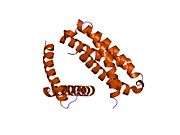
| 1q2h: Phenylalanine Zipper Mediates APS Dimerization |
| 1rpy: CRYSTAL STRUCTURE OF THE DIMERIC SH2 DOMAIN OF APS |
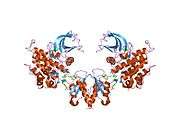
| 1rqq: Crystal Structure of the Insulin Receptor Kinase in Complex with the SH2 Domain of APS |
| 1v5m: Solution Structure of the Pleckstrin Homology Domain of Mouse APS |
|
|