Sanicula canadensis
| Sanicula canadensis | |
|---|---|
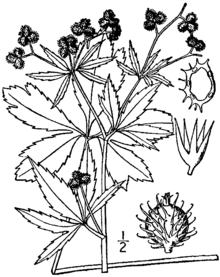 | |
| 1913 illustration[1] | |
| Scientific classification | |
| Kingdom: | Plantae |
| (unranked): | Angiosperms |
| (unranked): | Eudicots |
| (unranked): | Asterids |
| Order: | Apiales |
| Family: | Apiaceae |
| Genus: | Sanicula |
| Species: | S. canadensis |
| Binomial name | |
| Sanicula canadensis L. | |
Sanicula canadensis, the Canadian blacksnakeroot,[2] is a native plant of North America and a member of family Apiaceae. It is biennial or periennial, and spreads primarily by seed.[3] It grows from 1 to 4.5 feet tall, and is found in mesic deciduous woodlands.[3] The whitish-green flowers with sepals longer than petals, appearing late spring or early summer and lasting for approximately three weeks, are green and bur-like.[3][4] The bur-like fruit each split into 2 seeds.[3][4] The species ranges throughout the eastern United States (excluding Maine), extending north into Quebec and Ontario, and west into Texas and Wyoming.
References
- ↑ Britton, N.L., and A. Brown. 1913. An illustrated flora of the northern United States, Canada and the British Possessions. 3 vols. Charles Scribner's Sons, New York. Vol. 2: 624.
- ↑ "Sanicula canadensis". Natural Resources Conservation Service PLANTS Database. USDA. Retrieved 30 October 2015.
- 1 2 3 4 http://www.illinoiswildflowers.info/woodland/plants/cn_blsnakeroot.htm
- 1 2 http://wisflora.herbarium.wisc.edu/taxa/index.php?taxon=4973
External links
- USDA Plants Profile for Sanicula canadensis — with distribution map.
- Vanderbilt.edu: Detailed photos
- Missouriplants.com: Photos
This article is issued from Wikipedia - version of the 9/25/2016. The text is available under the Creative Commons Attribution/Share Alike but additional terms may apply for the media files.