Sanyo 6000 series
| Sanyo 6000 series | |
|---|---|
|
Set 6000 in service in April 2016 | |
| In service | April 2016 – |
| Manufacturer | Kawasaki Heavy Industries |
| Built at | Kobe |
| Replaced | 3000 series |
| Constructed | 2015– |
| Number built | 6 vehicles (2 sets) |
| Number in service | 6 vehicles (2 sets) |
| Formation | 3 cars per trainset |
| Fleet numbers | 6000- |
| Operator(s) | Sanyo Electric Railway |
| Depot(s) | Higashi-Futami |
| Line(s) served | |
| Specifications | |
| Car body construction | Aluminium alloy |
| Car length | 18,800 mm (61 ft 8 in) |
| Width | 2,790 mm (9 ft 2 in) |
| Height | 4 m (13 ft 1 in) |
| Doors | 3 pairs per side |
| Maximum speed |
|
| Acceleration | 3.0 km/h/s |
| Deceleration |
|
| Electric system(s) | 1,500 V DC |
| Current collection method | Overhead wire |
| Bogies | KW204 (motored), KW205 (trailer) |
| Track gauge | 1,435 mm (4 ft 8 1⁄2 in) |
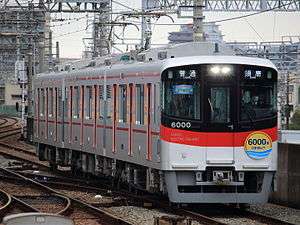
The Sanyo Electric Railway 6000 series (山陽電気鉄道6000系 San'yō Denki tetsudō 6000-kei) is an electric multiple unit (EMU) train type operated by the private railway operator Sanyo Electric Railway in Japan since April 2016.
Design
The trains have aluminium alloy bodies.[1]
Formations
The trains are formed as three-car sets as shown below, with two driving motor ("Mc") cars and one non-powered intermediate trailer ("T") car. Odd and even-numbered sets differ in that even-numbered sets have a gangway connection at the Sanyo Himeji (western) end, while odd-numbered sets have a gangway connection at the Nishidai (eastern) end.[2]
Even-numbered sets
| Designation | Mc1 | T | Mc2 |
|---|---|---|---|
| Numbering | 600x | 630x | 610x |
| Weight (t) | 34.0 | 27.9 | 34.2 |
| Capacity (total/seated) | 122/41 | 135/49 | 122/41 |
The intermediate trailer cars are fitted with two single-arm pantographs.[2]
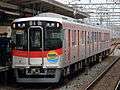 Car 6100 of set 6000, with a gangwayed cab end
Odd-numbered sets
| Designation | Mc3 | T | Mc4 |
|---|---|---|---|
| Numbering | 600x | 630x | 610x |
| Weight (t) | 34.2 | 27.9 | 34.0 |
| Capacity (total/seated) | 122/41 | 135/49 | 122/41 |
The intermediate trailer cars are fitted with two single-arm pantographs.[2]
Interior
Passenger accommodation consists of longitudinal bench seating throughout. Seat width is 480 mm (19 in) per person.[2] LED lighting is used.[2]
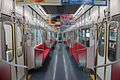 Interior view
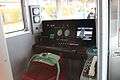 Driving cab interior
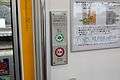 Interior passenger door controls
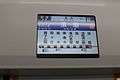 LCD passenger information display
History
Details of the new trains on order were first announced by Sanyo Electric Railway in May 2015.[1]
Set 6001, was delivered from the Kawasaki Heavy Industries factory in Kobe to the Sanyo Electric Railway depot at Higashi-Futami by road in November 2015.[3]
The trains entered revenue service on 27 April 2016, with a departure ceremony held at Sanyo Himeji Station.[4] Initially used only on the Sanyo Electric Railway Main Line, the trains also began operating on the Sanyo Electric Railway Aboshi Line from 17 May 2016.[5]
Future plans
Further new trains are scheduled to be delivered at the rate of approximately two or three sets per year.[6]
References
- 1 2 3 4 5 Sanada, Masahiro (July 2016). 山陽電気鉄道6000系 [Sanyo Electric Railway 6000 series]. Japan Railfan Magazine (in Japanese). Vol. 56 no. 663. Japan: Koyusha Co., Ltd. p. 86-91.
- ↑ 山陽6000系が陸送される [Sanyo 6000 series delivered by road]. Japan Railfan Magazine Online (in Japanese). Japan: Koyusha Co., Ltd. 28 November 2015. Retrieved 28 November 2015.
- ↑ 山陽電鉄6000系が営業運転を開始 [Sanyo Electric Railway 6000 series enters revenue service]. Japan Railfan Magazine Online (in Japanese). Japan: Koyusha Co., Ltd. 28 April 2016. Retrieved 28 April 2016.
- ↑ 【山陽】6000系 網干線でも営業運転を開始 [Sanyo Electric Railway 6000 series also enter service on Aboshi Line]. RM News (in Japanese). Japan: Neklo Publishing Co., Ltd. 18 May 2016. Retrieved 18 May 2016.
External links
 |
Wikimedia Commons has media related to Sanyo 6000 series. |
- Sanyo Electric Railway news release, May 2015 (Japanese)
- Kawasaki Heavy Industries news release, May 2015 (Japanese)