Four-toed jerboa
| Four-toed jerboa | |
|---|---|
 | |
| Scientific classification | |
| Kingdom: | Animalia |
| Phylum: | Chordata |
| Class: | Mammalia |
| Order: | Rodentia |
| Family: | Dipodidae |
| Genus: | Allactaga |
| Subgenus: | Scarturus Gloger, 1841 |
| Species: | A. tetradactyla |
| Binomial name | |
| Allactaga tetradactyla Lichtenstein, 1823 | |
 | |
| Geographic range | |
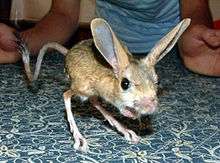
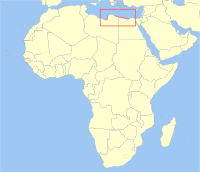
The four-toed jerboa (Allactaga tetradactyla) is a rodent of the family Dipodidae and genus Allactaga that has four digits. They are native to Egypt and Libya. Four-toed jerboas live in coastal salt marshes and dry deserts.
Physical appearance
Similar to the other jerboas in the genus Allactaga, the four-toed jerboa are small hopping rodents with large ears and a long tail with a black band near the white, feathery tip. The tail assists and serves as support when the jerboa is standing upright.[2] They have long hind feet and short forelegs.[3] The pelt of the four-toed jerboa is velvety in texture and the upper-parts are speckled black and orange, the rump orange, and the sides gray. The four-toed jerboa hind-limbs have an extra digit compared to other jerboas in the genus Allactaga. The extra digit is smaller in size and nonfunctional compared to the other three digits.[4]
Nutrition
Emerging at night, the four-toed jerboa eats grass, leaves, and soft seeds.[5] The low crown molars and soft palates help the Four-toed Jerboa chew plant material and seeds.[6]
Conservation status
The four-toed jerboa was listed as an animal on the Endangered Species List by the IUCN Red List. They are facing a very high risk of extinction due to habitat loss and restricted range.
References
- ↑ Hutterer, R.; Kryštufek, B. & Aulagnier, S. (2008). "Allactaga tetradactyla". IUCN Red List of Threatened Species. Version 2008. International Union for Conservation of Nature. Retrieved 11 February 2009.
- ↑ Kirmiz, John P. Adaptation to Desert Environment; A Study on the Jerboa, Rat and Man. London: Butterworths, 1962. 17. Print.
- ↑ Lagassé, Paul. "Jerboa." The Columbia Encyclopedia. 6th ed. New York: Columbia UP, 2000. Academic Search Premier. Web. 1 Oct. 2013.
- ↑ Shahin, A (2005). "Growth and Maturation of Metatarsals and Their Taxonomic Significance in the Jerboas Allactaga and Jaculus (Rodentia: Dipodidae)". Acta. 86 (2): 82.
- ↑ Holden, M. E. and G. G. Musser. 2005. Family Dipodidae. pp. 871–893 in Mammal Species of the World a Taxonomic and Geographic Reference. D. E. Wilson and D. M. Reeder eds. Johns Hopkins University Press, Baltimore
- ↑ Basyouny Shahin, Adel (1999). "A Comparative Study of the Molar and Soft Palate Characters of the Genera Allactaga and Jaculus (Mammalia: Rodentia) in Egypt". Zoology in the Middle East. 18 (1): 17–32. doi:10.1080/09397140.1999.10637779.