Semi-abelian category
In mathematics, specifically in category theory, a semi-abelian category is a pre-abelian category in which the induced morphism is a bimorphism, i.e., a monomorphism and an epimorphism, for every morphism .


Properties
The two properties used in the definition can be characterized by several equivalent conditions.[1]
Every semi-abelian category has a maximal exact structure.
If a semi-abelian category is not quasi-abelian, then the class of all kernel-cokernel pairs does not form an exact structure.
Examples
Every quasi-abelian category is semi-abelian. In particular, every abelian category is semi-abelian. Non quasi-abelian examples are the following.
- The category of (possibly non Hausdorff) bornological spaces is semi-abelian.[2][3][4]
- Let be the quiver

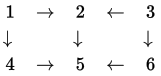
and be a field. The category of finitely generated projective modules over the algebra is semi-abelian.[5]


History
The concept of a semi-abelian category was developed in the 1960s. Raikov conjectured that the notion of a quasi-abelian category is equivalent to that of a semi-abelian category. Around 2005 it turned out that the conjecture is false.[6]
Left and right semi-abelian categories
By dividing the two conditions on the induced map in the definition, one can define left semi-abelian categories by requiring that is a monomorphism for each morphism . Accordingly, right quasi-abelian categories are pre-abelian categories such that is an epimorphism for each morphism .[7]

If a category is left semi-abelian and right quasi-abelian, then it is already quasi-abelian. The same holds, if the category is right semi-abelian and left quasi-abelian.[8]
Citations
- ↑ Kopylov et. al., 2012.
- ↑ Bonet et. al., 2004/2005.
- ↑ Sieg et. al., 2011, Example 4.1.
- ↑ Rump, 2011, p. 44.
- ↑ Rump, 2008, p. 993.
- ↑ Rump, 2011, p. 44f.
- ↑ Rump, 2001.
- ↑ Rump, 2001.
References
- José Bonet, J., Susanne Dierolf, The pullback for bornological and ultrabornological spaces. Note Mat. 25(1), 63–67 (2005/2006).
- Yaroslav Kopylov and Sven-Ake Wegner, On the notion of a semi-abelian category in the sense of Palamodov, Appl. Categ. Structures 20 (5) (2012) 531–541.
- Wolfgang Rump, A counterexample to Raikov’s conjecture, Bull. London Math. Soc. 40, 985–994 (2008).
- Wolfgang Rump, Almost abelian categories, Cahiers Topologie Géom. Différentielle Catég. 42(3), 163–225 (2001).
- Wolfgang Rump, Analysis of a problem of Raikov with applications to barreled and bornological spaces, J. Pure and Appl. Algebra 215, 44–52 (2011).
- Dennis Sieg and Sven-Ake Wegner, Maximal exact structures on additive categories, Math. Nachr. 284 (2011), 2093–2100.