Shamsur Rahman Faruqi
| Shamsur Rahman Faruqi شمس الرحمٰن فاروقی | |
|---|---|
 | |
| Born |
Shamsur Rahman Faruqi 15 January 1935 India |
| Nationality | Indian |
| Occupation | poet, critic |
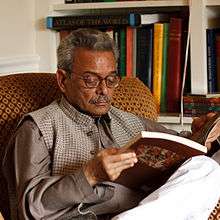
Shamsur Rahman Faruqi (Urdu: شمس الرحمٰن فاروقی) (born 15 January 1935) is an Indian poet and one of the leading Urdu critics and theorists. He has formulated fresh models of literary appreciation.[1] He absorbed western principles of literary criticism and subsequently applied them to Urdu literature, but only after adapting them to address literary aesthetics native to Arabic, Persian, and Urdu [2]
Early life
He was born on 15 January 1935 in India. He received his Master of Arts (MA) degree in English from Allahabad University in 1955.[1]
Career
He began writing in 1960. Initially he worked for the Indian postal service (1960-1968), and then as a chief postmaster-general and member of the Postal Services Board, New Delhi until 1994. He was also editor of his literary magazine Shabkhoon and part-time professor at the South Asia Regional Studies Center at the University of Pennsylvania.[1]
An expert in classical prosody and ‘ilm-e bayan (the science of poetic discourse), he has contributed to modern literary discourse with a profundity rarely seen in contemporary Urdu critics.[1] His most recent books, The Mirror of Beauty (translated into English from the Urdu Kai Chaand The Sar-e-Aasmaan in 2006), and The Sun That Rose From The Earth (Penguin India, 2014), have been highly critically acclaimed. [3] He is the recipient of numerous honors and awards. Most recently he was awarded the prestigious Saraswati Samman for his work She`r-e Shor-Angez, a four-volume study of the eighteenth-century poet Mir Taqi Mir.[1]
Anjum Hasan in The Caravan on 'The Mirror of Beauty': http://www.caravanmagazine.in/books/paradise-rectitude Rajni George in Open Magazine, profile of Shamsur Rahman Faruqi: http://www.openthemagazine.com/article/books/the-last-ustad Mayank Austen Soofi's interview with Shamsur Rahman Faruqi in Mint: http://www.livemint.com/Leisure/n6UCQZrqyozgLHV0W1IFAL/Shamsur-Rahman-Faruqi-Darcy-was-a-damn-sexist.html
Dastangoi
Dastangoi is a 16th-century Urdu oral storytelling art form.[4] The art form was revived in 2005[5] and has been performed in India, Pakistan, and the United States.[6] The art form reached its zenith in the Indian sub-continent in the 19th century and is said to have died with the demise of Mir Baqar Ali in 1928.[5] Shamsur Rahman Faruqi and his nephew, writer and director Mahmood Farooqui have played significant roles in its revival in the 21st century.[7]
Awards
He was awarded the Saraswati Samman, a prestigious literary award in India in 1996.[1] The Government of India awarded him the civilian honour of Padma Shri in 2009.[8]
Bibliography
- Sher, Ghair Sher, Aur Nasr, (1973)[1]
- The Secret Mirror, (in English, 1981)[1]
- Ghalib Afsaney Ki Himayat Mein, (1989)[1]
- Sher Shore Angez (in 3 volumes, 1991–93)[1]
- Mir Taqi Mir 1722-1810 (Collected works with commentary and explanation)[1]
- Urdu Ka Ibtedai Zamana (2001)[1]
- Ganj-i-Sokhta (poetry)[1]
- Sawar Aur Doosray Afsanay (2001)[1]
- The Sun That Rose from the Earth, Penguin Books India, 2014, 600 p. (short stories)
- Kai Chand Thay Sar-e-Asmaan (2006)[9]
- The Mirror of Beauty, Penguin Books India, 2013, 984 p. (novel)
- Jadeediyat Kal Aur Aaj (2007)
See also
References
- 1 2 3 4 5 6 7 8 9 10 11 12 13 14 "Shamsur Rehman Faruqi - The master critic". Columbia.Edu (source=Daily Dawn-11 July 2004). Retrieved 2012-08-25.
- ↑ "A Conversation with Shamsur Rahman Faruqi by Prem Kumar Nazar" (PDF). UrduStudies.com. Retrieved 2012-09-13.
- ↑ http://www.openthemagazine.com/article/books/the-last-ustad
- ↑ "Walk Back In Time: Experience life in Nizamuddin Basti, the traditional way". The Indian Express. 29 November 2012. Retrieved 18 December 2012.
- 1 2 Ahmed, Shoaib (6 December 2012). "Indian storytellers bring Dastangoi to Alhamra". Dawn. Retrieved 18 December 2012.
- ↑ Sayeed, Vikram Ahmed (14 January 2011). "Return of dastangoi". Frontline. Retrieved 18 December 2012.
- ↑ Husain, Intizar (2011-12-25). "COLUMN: Dastan and dastangoi for the modern audience". Dawn (newspaper). Retrieved 2013-11-07.
- ↑ "Padma Awards" (PDF). Ministry of Home Affairs, Government of India. 2015. Retrieved 21 July 2015.
- ↑ http://www.academia.edu/6435134/Shamsur_Rahman_Faruqis_The_Mirror_of_Beauty_Striking_a_Discordant_Note
External links
- Shamsur Rahman Faruqi Website
- Work in English
- "A Conversation with Literary Critic and Novelist Shamsur Rahman Faruqi", New York Times